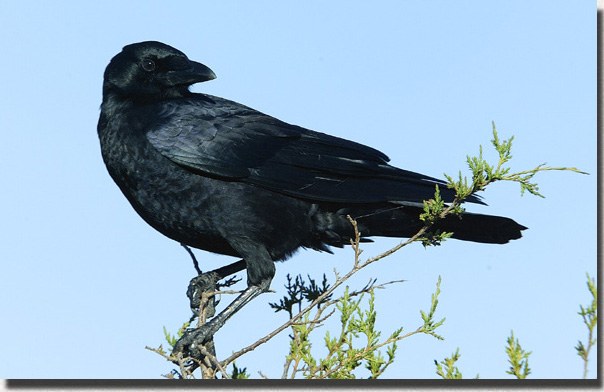
American Crow
- Habitat
- Farmland, woodlots, urban parks, suburban neighborhoods, and open country nearly statewide
- Size
- 16-21 in
- Lifespan
- Commonly reaches 7-8 years in the wild; banding records document individuals living well beyond a decade, with some recoveries in the mid-teens.
- Diet
- Omnivorous: insects, carrion, grain, fruit, eggs, nestlings, garbage
About the American Crow
The American Crow is a large, all-black bird instantly familiar across Oklahoma, measuring 16 to 21 inches long with a heavy bill, fan-shaped tail, and glossy black plumage that can show a faint purplish or greenish sheen in good light. Sexes look alike, and juveniles are similarly black but with a duller, less glossy sheen and, in the first few weeks after fledging, blue-gray eyes that darken to brown with age. It is often confused with the Common Raven, but ravens are larger, have shaggier throat feathers and wedge-shaped tails, and are rare to absent across most of the state; the familiar cawing crow of Oklahoma yards and farmland is almost always this species.
Crows thrive in nearly any open or semi-open landscape, including farm fields, woodland edges, river corridors, city parks, and suburban lawns, and they are found statewide year-round. Their diet is remarkably broad: insects and earthworms, waste grain, fruit and seeds, carrion, eggs and nestlings of other birds, and human food scraps. This dietary flexibility, combined with strong problem-solving skills, lets crows exploit food sources many other birds cannot, and flocks will follow tractors plowing fields or gather at roadkill and landfills.
American Crows are among the most social and intelligent birds in North America. Breeding pairs often keep offspring from previous years as helpers that assist in defending the territory and feeding new nestlings, a cooperative breeding strategy uncommon among songbirds. Pairs build a bulky stick nest high in a tree fork, typically well hidden in foliage, and lay four to six eggs that the female incubates alone for roughly two and a half weeks while the male and any helpers bring food; young remain dependent on the family group for weeks after fledging, begging noisily with a distinctive rattling call quite different from the adult caw.
Outside the breeding season, crows gather into large communal roosts, sometimes numbering in the thousands, that shift locations through the winter. Their vocal range extends well beyond the familiar "caw," including rattles, clicks, and mimicked sounds, and their capacity for problem-solving, tool use, and recognizing individual human faces has been repeatedly documented in scientific studies, making them among the most cognitively sophisticated birds studied to date.
Crows are famous for mobbing predators, gathering noisily in groups to harass hawks and owls—especially Great Horned Owls, a significant nest predator—often diving and calling until the raptor abandons its perch. This same social intelligence extends to apparent recognition of danger associated with dead crows, and some researchers have described crows gathering around a dead flock member in a way that may help them learn about local threats. American Crows are also known to be highly susceptible to West Nile virus, which caused substantial population impacts in parts of the country after the virus arrived in North America in the late 1990s, though crow numbers in most areas, including Oklahoma, have generally remained robust given the species' adaptability and broad diet. American Crows show some regional variation in size and voice across their broad range, and populations in the Great Plains, including Oklahoma, tend to average slightly smaller than birds from the humid Southeast. Urban roosts often form near well-lit areas, such as parking lots or city centers, possibly because artificial light offers some protection from nocturnal predators like Great Horned Owls, and a single roost can draw crows commuting in from foraging areas many miles away each evening. Although sometimes confused with the specialized tool-using New Caledonian Crow of the South Pacific, a different species entirely, American Crows have also been observed using simple tools and solving multi-step problems in captivity and the field, underscoring just how adaptable and cognitively flexible this familiar backyard bird really is.
Frequently asked questions
What do American Crows eat?
Almost anything—insects, grain, fruit, carrion, eggs, and human food scraps—making them one of the most adaptable birds in North America.
Where can I see American Crows in Oklahoma?
Nearly everywhere—farmland, parks, neighborhoods, and roadsides across the entire state year-round.
How long do American Crows live?
Typically several years, with many individuals reaching 7-8 years and some banded birds documented living into their teens.
Is the American Crow common in Oklahoma?
Yes, it is one of the most widespread and abundant birds in the state throughout the year.
Why do crows gather in such large flocks in winter?
Communal winter roosts, sometimes numbering in the thousands, likely offer safety in numbers and opportunities to share information about food sources, before birds disperse to breeding territories each spring.
Where to find it
This species favors city / backyard habitat. See real Oklahoma locations on the Habitats map.