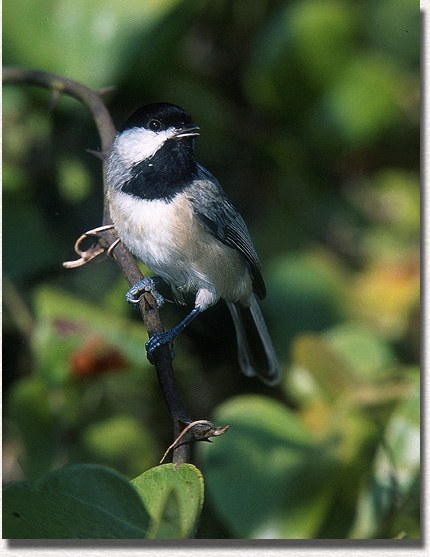
Black-capped Chickadee
- Habitat
- Deciduous and mixed woodlands, edges, parks, and backyards; primarily a northern species whose range only marginally reaches northern Oklahoma, where it overlaps and hybridizes with the similar Carolina Chickadee
- Size
- 5-5.5 in
- Lifespan
- Averages roughly 2-3 years in the wild; the oldest banded individual on record lived over 11 years.
- Diet
- Insects, seeds, and berries; also caches food for later retrieval
About the Black-capped Chickadee
The Black-capped Chickadee is a small, active songbird with a black cap and bib framing white cheeks, a gray back and wings edged in white, and buffy-white underparts. It looks nearly identical to the Carolina Chickadee found through most of Oklahoma, and the two species are best told apart by voice and range rather than plumage alone, since visual differences are subtle and inconsistent, especially where the two overlap and hybridize.
This species is a familiar and popular feeder bird across the northern two-thirds of the United States and most of Canada, favoring deciduous and mixed woodlands, edges, and residential areas with trees and shrubs. It forages actively and acrobatically, often hanging upside down from twig tips to extract insects, seeds, and berries, and it is famous for caching food items individually in bark crevices and other hiding spots, then relying on spatial memory—remembering thousands of cache locations—to retrieve them later, particularly important for surviving cold winters. Research on the species has shown that the hippocampus, the brain region most associated with spatial memory, actually grows larger in autumn as chickadees ramp up caching activity, then shrinks back somewhat afterward, a remarkable seasonal adjustment tied directly to the demands of remembering so many hidden food stores.
An important note for Oklahoma birders: the Black-capped Chickadee's range only marginally reaches the state, mainly along its northern tier, and the chickadee found across the great majority of Oklahoma is actually the very similar Carolina Chickadee. The two species meet and interbreed in a narrow hybrid zone, and genuine Black-capped Chickadees away from the far north of the state should be identified cautiously, since hybrid and backcrossed individuals in the contact zone can show a confusing mix of features and even intermediate or mismatched vocalizations that don't cleanly match either parent species.
Where it does occur, the species is known for its complex "chick-a-dee-dee-dee" call, in which the number of "dee" notes increases with the perceived level of threat, along with a simple, clear "fee-bee" whistled song used in spring. Researchers studying this call system in the species have found it to be remarkably information-rich, functioning almost like a basic communication code that can convey the type and urgency of a nearby threat to other chickadees and even to other species that have learned to recognize it.
Black-capped Chickadees nest in cavities, either excavating their own hole in soft, rotten wood or adopting an abandoned woodpecker cavity or nest box, and both members of a pair help line the chamber with moss, plant down, and animal hair before the female lays and incubates the clutch. Outside the breeding season, chickadees typically join small mixed-species foraging flocks together with nuthatches, kinglets, and woodpeckers, often serving as the vocal core of the group; other species appear to key in on chickadee alarm calls as a general warning system, benefiting from the chickadee's vigilance even while foraging independently nearby. Winter flocks of Black-capped Chickadees maintain a distinct dominance hierarchy, with higher-ranking individuals gaining priority access to the best foraging sites and roost cavities, and researchers have documented a specific "gargle" call used mainly in disputes between flock members to assert or contest rank. These same winter flocks typically occupy a defined home range that the group defends loosely against neighboring flocks, and pairs that will eventually breed together the following spring often first form their bond while still part of a larger winter flock. On especially cold nights, chickadees can also lower their body temperature into a controlled, mild hypothermic state, reducing their metabolic energy demands enough to survive conditions that would otherwise be difficult to endure on limited winter food reserves.
Frequently asked questions
What does the Black-capped Chickadee eat?
Insects, seeds, and berries, often cached individually and retrieved later using precise spatial memory.
Where can I see a Black-capped Chickadee in Oklahoma?
Only in the far northern part of the state; most of Oklahoma's "chickadees" are actually the very similar Carolina Chickadee.
How long do Black-capped Chickadees live?
They average 2-3 years in the wild, though the oldest banded individual on record lived over 11 years.
Is the Black-capped Chickadee common in Oklahoma?
No, it barely reaches the state's northern edge; the Carolina Chickadee is the expected species across most of Oklahoma.
Why is the chickadee's alarm call so complex?
The number of 'dee' notes in its 'chick-a-dee-dee-dee' call increases with the level of perceived threat, functioning almost like an information-rich code that other chickadees, and even other bird species, can interpret.
Where to find it
This species favors city / backyard habitat. See real Oklahoma locations on the Habitats map.