Cedar Waxwing
- Habitat
- Open woodlands, clearings, towns, parks; often near cedar/mountain-ash trees; very gregarious in winter and migration
- Size
- 6½–8 in
- Lifespan
- Banding records show a maximum of about 7-8 years, though most individuals live far shorter lives.
- Diet
- Insects, berries, flowers, tree sap; roughly 70% fruit annually; young are fed insects first, with berries added within days
About the Cedar Waxwing
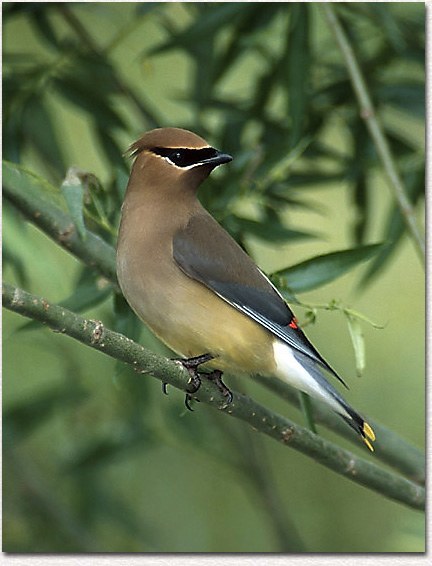
The Cedar Waxwing is an elegant, sleek-crested songbird, soft brown fading to gray on the wings and pale yellow on the belly, with a black mask outlined in white and a tail tipped in bright yellow. Its name comes from the waxy, red, droplet-like tips found on the secondary wing feathers of many adults, a feature unique among North American birds whose exact function remains debated, though it may play a role in signaling age or mate quality, since the number and size of these waxy tips tends to increase as a bird gets older. At 6.5 to 8 inches, and almost always encountered in tight, coordinated flocks, a lone Cedar Waxwing is something of a rarity.
Waxwings favor open woodlands, clearings, and even towns and parks, particularly where cedar or mountain-ash trees provide reliable fruit crops. Highly gregarious outside the breeding season, they travel in flocks that can number from a handful to several hundred birds, moving nomadically across the landscape in search of ripening fruit, which means their presence at any one location can be unpredictable and tied closely to local food availability rather than fixed seasonal timing. Because it depends so heavily on a fluctuating fruit supply, the Cedar Waxwing is also one of the latest-nesting songbirds in North America, often not beginning to breed until well into summer when berry crops are reliably ripening.
Fruit dominates the Cedar Waxwing's diet, making up roughly 70 percent of what it eats over the course of a year, supplemented by insects, flower petals, and tree sap. Interestingly, nestlings are started on a diet of insects for the extra protein, with berries introduced within just the first few days of life, a faster shift toward the adult fruit-heavy diet than in most other songbirds. Waxwings are also known for their habit of passing a single berry from bill to bill down a perched line of birds before one finally swallows it, a striking display of social feeding behavior that is also sometimes incorporated into courtship, with a male passing a berry to a prospective mate as part of a simple pair-bonding ritual.
Because much of its diet depends on fruit that continues fermenting after it's overripe, the Cedar Waxwing has an unusual and sometimes amusing tendency to become visibly intoxicated, occasionally to the point of impaired flight, after gorging on fermented berries late in the season, and there are documented cases of small numbers of waxwings dying after colliding with windows or vehicles while impaired in this way. The species is also remarkably tame and approachable, often allowing close observation, and its tight-flocking, highly social nature persists even at feeding sites, where dozens of birds may strip a single fruiting tree together before moving on as a unit.
The closely related Bohemian Waxwing, a slightly larger, grayer bird of the northern boreal forest, occasionally irrupts south into the northern United States in some winters when its usual berry crops fail, and the two species can sometimes be found together at a good fruiting tree, offering a useful side-by-side comparison for anyone lucky enough to encounter both in the same season. Cedar Waxwing populations appear to have benefited in some regions from ornamental plantings of fruiting trees and shrubs in suburban landscaping, giving the species another reliable food source alongside its traditional wild cedar and mountain-ash crops.
Frequently asked questions
What are the red tips on a Cedar Waxwing's wings?
They're waxy, droplet-like tips on the secondary feathers, unique among North American birds, and their exact purpose is still debated by researchers.
Can Cedar Waxwings really get drunk?
Yes, eating large amounts of overripe, fermenting fruit can leave them visibly intoxicated, sometimes affecting their flight.
Do Cedar Waxwings share food with each other?
They're known to pass a single berry from bill to bill along a perched line of birds before one finally eats it.
Why are Cedar Waxwings almost always seen in flocks?
They're highly social and nomadic, traveling together to track down ripening fruit crops across the landscape.
Why does the Cedar Waxwing nest later in the year than most songbirds?
Because its diet depends so heavily on ripening fruit, it typically delays nesting until berry crops are reliably available in mid to late summer.
Where to find it
This species favors city / backyard habitat. See real Oklahoma locations on the Habitats map.