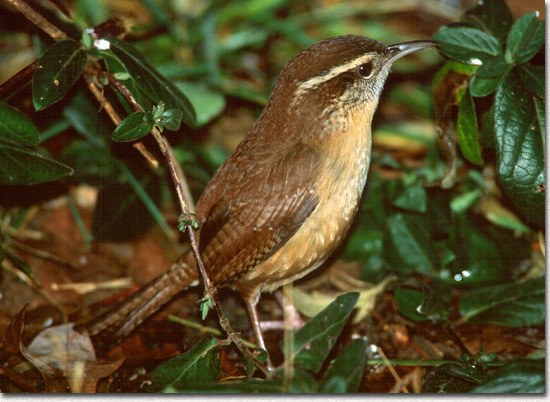
Carolina Wren
- Habitat
- Brushy areas, moist woodlands and swamps, suburbs, gardens, tangles, brush piles
- Size
- 5½ in
- Lifespan
- Usually lives around 6 years in the wild; the oldest banded bird reached nearly 8 years.
- Diet
- Insects, invertebrates, small vertebrates, a few seeds
About the Carolina Wren
The Carolina Wren is a compact, energetic bird, rich reddish-brown above and warm buff below, with a bold white eyebrow stripe that is among its most reliable field marks. At 5.5 inches it's similarly sized to the related Bewick's Wren but has a shorter tail and a noticeably warmer, more rufous overall tone, along with a voice -- a loud, ringing "tea-kettle tea-kettle tea-kettle" -- that is disproportionately powerful for such a small bird. Only the male typically sings this full song, though both sexes give a variety of scolding chatters and rattles, and mated pairs sometimes perform a duet of overlapping calls that helps maintain contact in dense cover.
Carolina Wrens favor brushy tangles, moist woodlands, swamp edges, suburban yards, gardens, and brush piles, staying low and moving through dense cover with quick, mouse-like hops. Unlike many songbirds, this species does not migrate, remaining on its territory year-round even through harsh winters, which can cause local population crashes during severe ice storms or extended cold snaps, though numbers typically rebound within a few breeding seasons as survivors from milder nearby areas repopulate the affected range. This vulnerability to hard winters has also meant the species' range edge shifts northward during runs of mild winters and retreats again after a particularly severe one, a boom-and-bust pattern well documented across its northern range limit.
The diet leans heavily on insects, spiders, and other invertebrates, occasionally including small vertebrates, with just a small proportion of seeds rounding out the menu. Carolina Wrens forage by poking and probing into crevices, brush piles, and leaf litter, and their curiosity often extends to investigating human structures directly, which regularly brings them into contact with garages, porches, and sheds in search of insects.
This curiosity carries over into nest-site selection, and Carolina Wrens are famous for choosing bizarre and highly varied spots to build: crevices in stone walls, old tin cans, birdhouses intended for other species, and even coat pockets left hanging on an outdoor clothesline have all been documented as nest sites. The species is also a devoted visitor to suet feeders, readily supplementing its natural insect diet with the fat and protein suet provides, especially valuable during the colder months when its year-round residency puts it at greatest risk from food scarcity. Carolina Wrens form long-term pair bonds and typically stay together on the same territory throughout the year, with the male singing his loud, repetitive song largely year-round to maintain that bond and defend the pair's shared ground rather than only during a defined spring breeding season.
A pair may attempt several broods across the warmer months, and both parents help build the dome-shaped nest and feed the young, a level of shared cooperative effort common among wrens but especially pronounced in this species' resident, nonmigratory lifestyle. The species is also an occasional, though less frequent, host of Brown-headed Cowbird parasitism compared with more open-nesting songbirds, likely because its typically well-concealed, domed nest structure offers a bit more protection from a searching female cowbird. The Carolina Wren is the state bird of South Carolina, and its year-round loud song is often one of the first bird sounds newcomers to the Southeast and southern Plains learn to recognize, since it can be heard from dense cover on almost any day of the year regardless of season or weather.
Frequently asked questions
Does the Carolina Wren migrate?
No, it stays on its territory year-round, though severe winters can temporarily reduce local populations.
Where does the Carolina Wren build its nest?
In surprisingly varied and odd locations, including stone wall crevices, tin cans, birdhouses, and even pockets on a hanging coat.
What is the easiest way to identify a Carolina Wren?
Look for its rich reddish-brown upperparts, buff underside, and bold white eyebrow stripe, along with its loud "tea-kettle" song.
What food attracts Carolina Wrens to backyard feeders?
Suet is a particular favorite, supplementing the insects and invertebrates that make up most of its natural diet.
Do both male and female Carolina Wrens sing?
Mainly the male sings the full, loud song, though both sexes give scolding chatters and rattles, and paired birds sometimes overlap calls in a duet-like exchange.
Where to find it
This species favors city / backyard habitat. See real Oklahoma locations on the Habitats map.