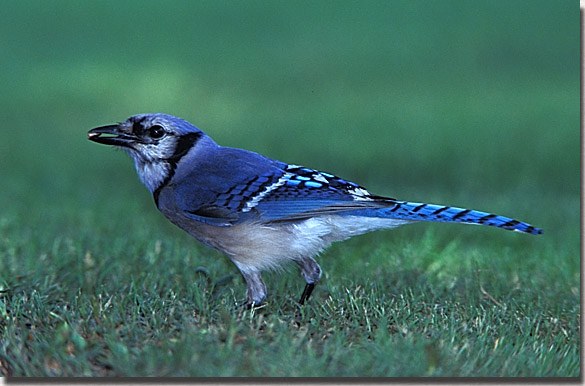
Blue Jay
- Habitat
- Deciduous and mixed woodlands, suburbs, parks, and backyards statewide
- Size
- 9-12 in
- Lifespan
- Averages around 7 years in the wild; the oldest banded individual on record lived over 17 years.
- Diet
- Acorns and other nuts, seeds, insects, and occasionally eggs or nestlings
About the Blue Jay
The Blue Jay is one of the most conspicuous and familiar birds across Oklahoma, with vivid blue upperparts, a white face and underparts, a black necklace-like band across the throat and around the head, and a prominent crest that can be raised or lowered depending on the bird's mood. Its blue color is not from pigment but from microscopic feather structures that scatter light, a feature shared with several other blue-plumaged birds; a fallen jay feather held up to strong backlight will actually appear dull brown, since the blue only appears when light scatters back toward the viewer in the usual way.
Blue Jays are highly vocal and have an extensive repertoire of calls, including a harsh "jay" scream, softer musical notes, and convincing imitations of hawk calls, which some researchers believe may help clear other birds away from feeders or may simply reflect the species' general vocal flexibility. They are omnivorous and opportunistic, eating acorns and other nuts, seeds, insects, and occasionally the eggs or nestlings of other birds, and they are common visitors to backyard feeders offering peanuts or sunflower seed. Like other corvids, jays are considered among the more intelligent songbirds, capable of solving simple problems, remembering the locations of hundreds of cached food items, and recognizing individual people over time.
One of the Blue Jay's most ecologically significant behaviors is its habit of caching acorns and other nuts, carrying and burying them in scattered locations for later use; because jays inevitably fail to recover every cached nut, this behavior has long been credited by ecologists with helping oak trees spread and recolonize after disturbances, including forest recovery following the retreat of glaciers thousands of years ago. A single jay may cache several thousand acorns in a good mast year, often carrying more than one at a time in an expandable throat pouch, and its spatial memory for retrieving them later is considered impressive even among food-caching birds generally.
Blue Jays are permanent residents across Oklahoma, present year-round, though some individuals do migrate seasonally in parts of their range, a pattern still not fully understood since not all jays move even within the same population, and migrating flocks are sometimes observed streaming along lakeshores and ridgelines in loose groups during spring and fall. Highly social, intelligent, and bold, Blue Jays often travel in small family groups and are quick to mob predators such as hawks or owls with loud, coordinated scolding calls that frequently draw in other songbird species to join the harassment. Young jays remain with their parents for a couple of months after fledging, gradually learning the caching and foraging behaviors that will serve them for the rest of their lives, and family groups often stay loosely associated well into the fall before dispersing. Like other corvids, Blue Jays are also known to be highly susceptible to West Nile virus, and local populations in parts of the country saw noticeable declines after the disease arrived in North America in the late 1990s, though numbers have since stabilized or recovered in most areas.
Blue Jays also play a role in policing feeder etiquette of a sort, since their loud alarm calls at the approach of a hawk or cat are often heeded by chickadees, titmice, and sparrows sharing the same yard, making the jay something of an unofficial lookout for the whole neighborhood's bird community. Nests are built by both members of a pair in the fork of a tree or dense shrub, typically well hidden in foliage, and clutches usually number four or five eggs incubated mainly by the female while the male brings her food. Regional populations show some variation in overall coloring and size, with birds in the humid Southeast tending to appear slightly duller than the crisp, vivid blue typical of jays farther north and west, a pattern seen in a number of widespread songbirds and generally attributed to subtle differences in feather wear and local climate.
Frequently asked questions
What does the Blue Jay eat?
A wide range of foods including acorns, other nuts, seeds, insects, and occasionally eggs or nestlings of other birds.
Where can I see a Blue Jay in Oklahoma?
Nearly everywhere -- woodlands, parks, and backyards statewide, year-round.
How long do Blue Jays live?
They average around 7 years in the wild, with the oldest banded individual on record reaching over 17 years.
Is the Blue Jay common in Oklahoma?
Yes, it's one of the most common and recognizable birds in the state throughout the year.
Why does the Blue Jay's blue coloring look different in changing light?
Its blue comes from microscopic feather structures that scatter light rather than from pigment, so a feather held up to strong backlight can appear dull brown instead of blue.
Where to find it
This species favors city / backyard habitat. See real Oklahoma locations on the Habitats map.