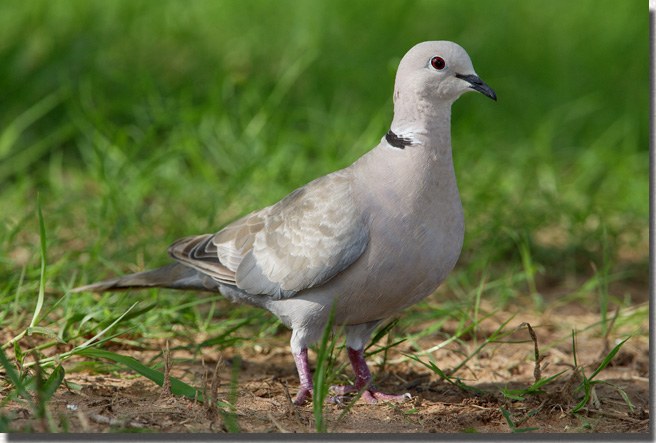
Eurasian Collared-Dove
- Habitat
- Towns, farmsteads, and suburban or urban areas with scattered trees and reliable food sources
- Size
- 12-13 in
- Lifespan
- Most don't live past 5-6 years, but the oldest wild individual on record lived roughly 17 years, 8 months.
- Diet
- Seeds and grain, often found at bird feeders or around livestock and grain facilities
About the Eurasian Collared-Dove
The Eurasian Collared-Dove is a pale, sandy-gray dove somewhat larger and stockier than the native Mourning Dove, with a squared, rather than pointed, tail showing a bold black-and-white pattern in flight, and a thin black half-collar across the back of the neck that gives the species its name. Its plumage is noticeably plainer and paler overall than the more richly colored Mourning Dove.
The species is not native to North America. It was introduced to the Bahamas in the 1970s, likely via the pet trade or an accidental release, spread to Florida by the 1980s, and expanded explosively across the continent in the decades since, reaching Oklahoma by roughly the 1990s or 2000s. It's now common and widespread in towns and farmland across the state, closely tied to human settlement and rarely found far from buildings or farmyards.
It forages mostly on the ground for seeds and waste grain, frequently around farms, grain elevators, and backyard feeders, and is highly tolerant of human activity, often seen perched on wires, rooftops, and other structures near towns, sometimes in small loose flocks that gather wherever grain is regularly available.
The species builds a simple, flimsy stick platform nest and can raise multiple broods across an extended breeding season, sometimes nesting in nearly every month of the year in mild climates. Its ongoing spread across nearly the entire continental United States within about three decades of its Florida arrival is one of the fastest documented range expansions of any introduced bird in North America, and its repetitive three-syllable 'coo-COO-cup' call is now a familiar sound in many towns where it was unknown a generation ago, often the first sign of its arrival in a new area well before it's actually seen. Some birders and wildlife agencies have expressed concern about competition with native doves and pigeons for food and nest sites, though clear evidence of significant harm to native species remains limited so far. Its calm, tolerant nature around people has also made it a familiar and generally well-liked sight in Oklahoma towns, even among residents unaware that the bird is a relatively recent arrival rather than a longtime native species.
Frequently asked questions
Is the Eurasian Collared-Dove native to Oklahoma?
No, it's an introduced species that arrived in the Americas via the Bahamas in the 1970s and reached Oklahoma within a few decades.
How do I tell it apart from a Mourning Dove?
It's larger and paler with a squared tail and a black half-collar on the neck, unlike the smaller, slimmer Mourning Dove's pointed tail and lack of a collar.
Why has it spread so quickly across the US?
It thrives around human development, tolerates a wide range of climates, and breeds prolifically over a long season, all of which fueled its rapid continental expansion.
What does its call sound like?
A repetitive, three-syllable 'coo-COO-cup,' quite different from the softer, mournful cooing of the native Mourning Dove.
Where to find it
This species favors city / backyard habitat. See real Oklahoma locations on the Habitats map.