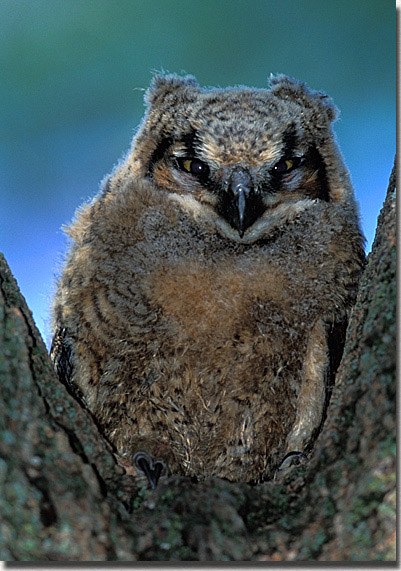
Great-horned Owl
- Habitat
- Extremely adaptable, found in forests, deserts, farmland, and even urban parks
- Size
- 18-25 in
- Lifespan
- Banded wild individuals have been recorded to at least 13 years, and other wild sightings suggest ages up to around 28 years; captive birds can live several decades longer.
- Diet
- A very broad diet including rabbits, rodents, skunks, other birds (including raptors), and reptiles
About the Great-horned Owl
The Great-horned Owl is a large, powerful owl with prominent feather tufts, often called 'horns,' piercing yellow eyes, a mottled brown-and-gray body, and a distinctive white throat patch. It's one of the largest and most widespread owls in North America, instantly recognizable by its deep, rhythmic 'hoo-H'HOO-hoo-hoo' call, which carries well across open country and dense woodland alike, especially on still winter nights.
It's found throughout Oklahoma year-round in nearly every habitat type, from dense woodland to open prairie, farmland, and even city parks and cemeteries. It's among the most adaptable owls on the continent, occupying a wider range of habitats than almost any other North American raptor, and is often the owl most likely to be encountered by someone who isn't specifically looking for one.
An opportunistic, powerful predator, the Great-horned Owl hunts mainly at night from a perch, taking prey ranging from small rodents up to rabbits, skunks, and even other raptors, including smaller owls and hawks, sometimes preying on birds considerably larger than itself. Its grip strength is exceptionally strong for its size, and it's one of relatively few predators that regularly kills skunks, apparently owing to a comparatively poor sense of smell that leaves it undeterred by the skunk's usual chemical defense.
The species doesn't build its own nest, instead taking over old nests built by hawks, crows, or herons, or using cavities and cliff ledges. It's also one of the earliest nesting birds in North America, often laying eggs in the depths of winter, sometimes as early as January or February, so that owlets have the maximum possible time to develop and learn to hunt before the following winter, an unusually early breeding schedule compared to most other birds that requires the incubating female to tolerate extended exposure to snow and freezing temperatures on the nest. Its extremely broad diet and habitat tolerance make it one of the most successful and widely distributed owls in the Western Hemisphere, found from dense Amazonian forest to suburban Oklahoma neighborhoods, and its deep hooting call is often what most people picture when they imagine a generic 'owl' sound.
Frequently asked questions
Why does the Great-horned Owl nest so early in the year?
Nesting in mid-winter gives owlets a longer period to grow, learn to hunt, and become independent before the following winter, an advantage that seems to outweigh the cold.
Can a Great-horned Owl really kill a skunk?
Yes, it's one of the few predators that regularly preys on skunks, likely because owls have a comparatively weak sense of smell.
Does it build its own nest?
No, it typically takes over an abandoned nest built by a hawk, crow, or heron, or uses a cavity, snag, or cliff ledge.
What are the 'horns' on its head?
They aren't ears at all, just tufts of feathers likely used for camouflage and visual signaling; the owl's actual ears are asymmetrically placed on the sides of its head.
Where to find it
This species favors city / backyard habitat. See real Oklahoma locations on the Habitats map.