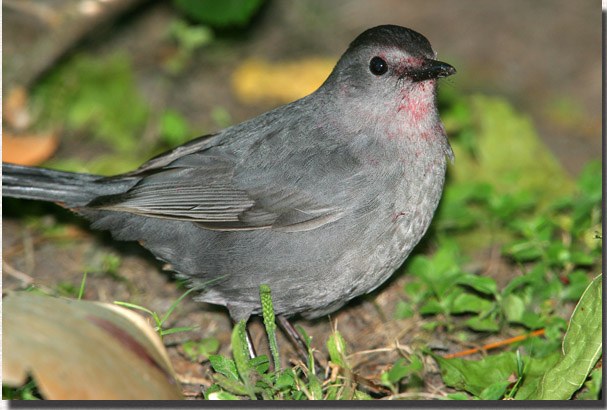
Gray Catbird
- Habitat
- Dense shrubby thickets, forest edges, tangled hedgerows, and overgrown suburban gardens
- Size
- About 8.5-9.4 inches long
- Lifespan
- The oldest banded individual on record reached at least 17 years, 11 months, though most wild catbirds likely live only a few years
- Diet
- Insects and other invertebrates plus a large share of berries and small fruits, especially outside the breeding season
About the Gray Catbird
The Gray Catbird is a slate-gray songbird with a black cap, a slim frame, and a long tail it often flicks and cocks upward. Its name comes from its distinctive call, a nasal, cat-like mewing note that it mixes in with a much longer, rambling, and often improvisational song. Look for a rusty patch of feathers tucked under the tail, a subtle but useful field mark on an otherwise plain gray bird. Unlike many songbirds, catbirds show almost no difference in appearance between males and females, so the sexes can only be reliably distinguished by behavior, such as which bird incubates or sings most persistently.
Catbirds favor dense, brushy cover: forest edges, streamside thickets, overgrown fence rows, and unmanicured shrubby yards, where they can move and forage under a protective tangle of branches. They breed across most of the eastern and central United States and southern Canada, including throughout Oklahoma, and winter from the southeastern states south into Central America and the Caribbean. Because they favor exactly the kind of tangled, unmowed edge habitat that many homeowners tend to clear away, catbirds are often cited as a good example of a common bird whose numbers benefit directly from leaving a brushy corner of the yard unmanicured.
Diet shifts seasonally: catbirds eat mostly insects, spiders, and other invertebrates gleaned from leaves and the ground during the breeding season, then shift toward a fruit-heavy diet of berries in late summer and fall, which fuels migration and helps disperse seeds of many native shrubs. They forage low, usually within a few feet of the ground or within thick cover, rarely venturing into open space. Favored fruiting shrubs include dogwood, elderberry, and various viburnums, and catbirds are considered important seed dispersers for several of these native plants, carrying seeds well away from the parent shrub in their droppings.
Gray Catbirds are accomplished vocal mimics in the same family as mockingbirds and thrashers, capable of weaving snippets of other birds' calls into their own song, and an individual's extended, rambling song can run on for several minutes without obvious repetition. They are also known for a distinctive nest-defense behavior: females can recognize and eject the eggs of brown-headed cowbirds, a brood parasite, from their nests at a notably high rate compared to many other host species, making catbirds one of the more effective natural defenses against cowbird parasitism. This strong rejection response is thought to stem from the species' evident ability to recognize its own egg pattern well enough to detect and discard an odd one out.
Most Gray Catbirds are medium-distance migrants, departing Oklahoma and other northern breeding areas in fall for wintering grounds along the Gulf Coast, Florida, the Caribbean, and Central America, though a portion of the population winters as far north as the southeastern United States. During migration and on the wintering grounds the species becomes even more strongly tied to fruit, since berries provide a dense, quickly digestible energy source for long flights. Its extensive vocal repertoire, sometimes including dozens of distinct phrase types strung together in a single extended song, has made it a frequent subject of research into how songbirds acquire and vary their vocalizations over a lifetime.
Predators of the Gray Catbird include snakes, small mammals, and various hawks, and nests placed in dense shrubs offer real but imperfect protection against these threats. The oldest banded Gray Catbird on record lived over 17 years, a remarkably long lifespan for a small songbird and a testament to the protective value of the dense, tangled cover the species relies on throughout its life. Catbirds are also occasionally recorded as cowbird hosts despite their strong egg-rejection abilities, since young cowbird nestlings that hatch before rejection occurs can still sometimes fledge successfully from a catbird nest.
Frequently asked questions
Why is the Gray Catbird named for a cat?
Its most recognizable call is a nasal, mewing note that closely resembles a cat's meow.
Is the Gray Catbird related to mockingbirds?
Yes, it belongs to the same family, Mimidae, and shares their talent for mimicking other birds' sounds.
What kind of yard or habitat attracts Gray Catbirds?
Dense, brushy, unmanicured cover such as thickets, hedgerows, and shrubby garden edges, especially with fruiting shrubs like dogwood or elderberry.
Do catbirds tolerate cowbird eggs in their nests?
Not well, catbirds are known for recognizing and ejecting brown-headed cowbird eggs at a high rate.
Can you tell male and female Gray Catbirds apart by sight?
Not really, the sexes look essentially identical and are usually distinguished only by behavior, such as which bird sings or incubates.
Where to find it
This species favors city / backyard habitat. See real Oklahoma locations on the Habitats map.