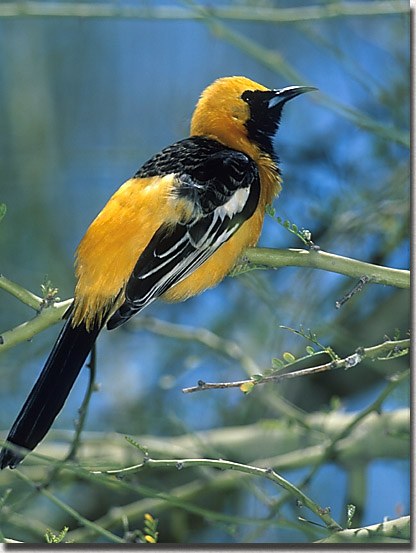
Hooded Oriole
- Habitat
- Palm groves, riparian woodland, and suburban yards with ornamental palms across the desert Southwest
- Size
- About 7.9-9.1 inches long
- Lifespan
- The oldest banded individual on record was at least 6 years old
- Diet
- Nectar, insects, and fruit
About the Hooded Oriole
The Hooded Oriole is a slim, long-tailed oriole with a slightly down-curved bill well suited to probing flowers. Males are bright orange-yellow with a black throat, face mask, back, and tail, while females and immatures are a more subdued yellow-olive without the black facial markings. Its long tail and habit of pumping it while perched help distinguish it from other similarly colored orioles, and young males often acquire patches of black on the throat a full year before completing the rest of their adult plumage, producing a distinctly patchy transitional look.
This species has a particularly strong association with palm trees, both native fan palms and the ornamental palms widely planted in Southwestern towns and cities, which it uses for both nesting and foraging. Its range covers the southwestern United States from California and Arizona through Texas, and the spread of ornamental palm plantings in urban and suburban landscaping has actually helped the species expand its range in some areas over the past century. It is not part of Oklahoma's regular avifauna and would be a notable rarity there.
Hooded Orioles feed on flower nectar, often visiting hummingbird feeders and tubular flowers, as well as insects and spiders gleaned from foliage, and soft fruit when available. Nectar feeding is aided by a bill that, while not as specialized as a hummingbird's, allows the bird to probe deep into blossoms, and the species will sometimes pierce the base of a long flower to reach nectar directly rather than entering from the front, a shortcut called nectar robbing also used by some other songbirds.
A defining behavioral trait is its nest construction: females typically sew a hanging pouch nest to the underside of a palm frond, piercing the leaf with the bill and thread through plant fibers to stitch the nest in place, an unusually intricate technique that produces a secure nest well hidden and protected from the elements under the drooping palm fronds. The species is also a frequent host to parasitism by Bronzed Cowbirds in parts of its range, a pressure it shares with several other Southwestern songbirds, and female orioles will sometimes attempt to bury a cowbird egg under a new nest lining rather than incubating it alongside their own.
Most Hooded Orioles are migratory, arriving in the southwestern United States in early spring and withdrawing to Mexico for the winter, though a small number remain year-round in the warmest parts of southern Texas and California where food and mild weather persist through the colder months. Its call is a soft, husky whistle, less musical than some other orioles, and pairs are often first noticed at hummingbird feeders or flowering trees rather than by song. Because the species' range lies well to the southwest, any report from Oklahoma would be considered an unusual, out-of-range record worth documenting carefully.
The male's song, though softer and less frequently heard than the calls, is a quiet, warbling mix of whistles and chattering notes, often delivered from cover rather than a prominent, exposed perch the way many other oriole species sing. Predators of eggs and nestlings include snakes and various climbing mammals capable of reaching a hanging nest, though the enclosed, woven pouch design and its position high under a palm frond likely deters at least some potential nest raiders compared to a more open cup nest. Banding data on the species remains fairly limited, but related oriole species typically live from 6 to 10 years in the wild when they survive their first migratory cycle, and there is no strong reason to expect the Hooded Oriole differs dramatically from this general pattern.
Frequently asked questions
Why is the Hooded Oriole so closely linked to palm trees?
It commonly nests and forages in palms, and the spread of ornamental palm plantings has helped it expand into more urban Southwestern areas.
How does a Hooded Oriole build its nest?
The female sews a hanging pouch nest to the underside of a palm frond by piercing the leaf and threading plant fibers through it.
Is the Hooded Oriole found in Oklahoma?
No, it is a Southwestern species and would be considered a rare vagrant if seen in Oklahoma.
What does a Hooded Oriole eat?
Mainly nectar from flowers, along with insects, spiders, and soft fruit.
Do Hooded Orioles deal with cowbird parasitism?
Yes, they are frequently parasitized by Bronzed Cowbirds, and females sometimes bury a cowbird egg under a fresh nest lining rather than incubate it.
Where to find it
This species favors city / backyard habitat. See real Oklahoma locations on the Habitats map.