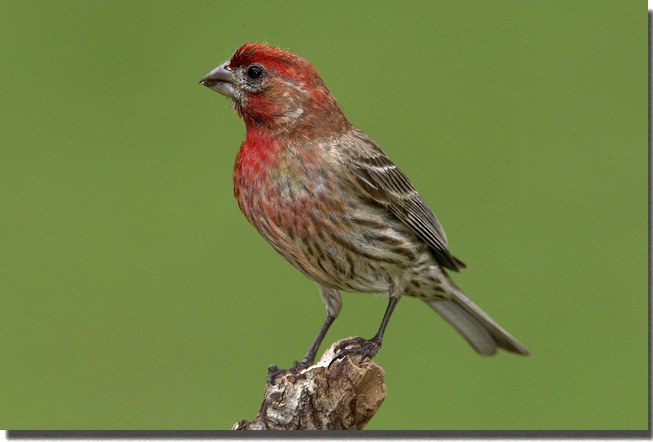
House Finch
- Habitat
- Urban areas, suburbs, parks, farms, ranches, roadsides, feeders, desert; gregarious, very abundant
- Size
- 5–6 in, sparrow-sized
- Lifespan
- Oldest banded bird reached nearly 12 years, but typical wild lifespan is only a few years.
- Diet
- Fruit buds and tree sap; virtually no insects consumed, and nestlings are fed almost entirely on seeds
About the House Finch
The House Finch is a small, sparrow-sized bird, 5 to 6 inches long, common and gregarious across an enormous range of human-altered landscapes. Males are easily recognized by bright red coloring across the breast, forehead, eyebrow, and rump, though the exact shade of red can vary from pale orange to deep crimson depending on diet during molt, since the pigments come directly from food rather than being produced by the bird itself. Females lack any red entirely, showing a plainer streaked brown pattern that offers better camouflage while nesting.
Today's House Finch population across the eastern and central United States actually descends from a specific and well-documented introduction: birds sold illegally as 'Hollywood Finches' in the cage-bird trade of the 1940s were released on Long Island, New York, in 1971 to avoid prosecution under the law protecting native birds, and the resulting population spread rapidly westward, eventually merging with the species' native range in the western US and Mexico. This is a fairly unusual case of an already-native North American bird also being reestablished from released captive stock in a completely different part of the continent.
House Finches are extremely abundant in urban areas, suburbs, parks, farms, ranches, roadsides, and at backyard feeders, and they thrive on a diet dominated by fruit buds and tree sap rather than insects, which they consume in virtually negligible amounts compared to many other songbirds. Even nestlings are raised almost entirely on seeds rather than the insect-heavy diet typical of most baby songbirds, an unusual pattern among North American finches.
As the introduced population expanded, House Finches came into direct competition with House Sparrows for nest sites, since both species favor similar cavities and ledges around buildings and other structures. The species is also known for a cheerful, warbling song that males deliver from rooftops, wires, and treetops, a familiar sound around feeders and yards throughout much of the year, and its willingness to nest in hanging planters, wreaths, and other everyday human structures has made it one of the most easily observed songbirds at close range. Despite this competition and a lifespan that typically only reaches a few years in the wild, House Finches have become one of the most familiar and numerous backyard birds across the continent, with the oldest banded individual on record living nearly 12 years.
Frequently asked questions
Why do some male House Finches look more orange than red?
The intensity of red comes from pigments in their diet during molt, so the shade can range from pale orange to deep red depending on what they eat.
How did House Finches spread across the eastern United States?
Cage-bird sellers released illegally captured birds on Long Island in 1971, and the population spread rapidly westward from there.
What do House Finches eat?
Mostly fruit buds and tree sap, with virtually no insects, and nestlings are fed almost entirely seeds.
Do House Finches compete with other birds?
Yes, they compete with House Sparrows for nest sites in urban and suburban areas.
Where to find it
This species favors city / backyard habitat. See real Oklahoma locations on the Habitats map.