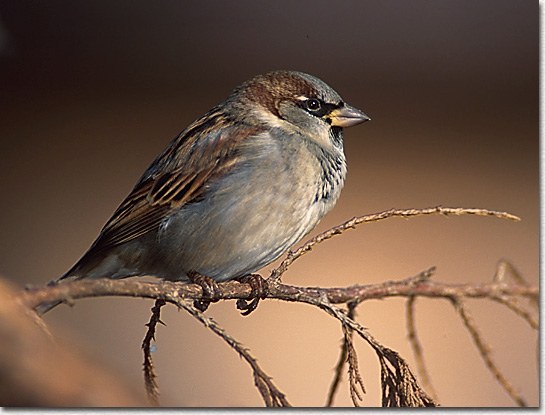
House Sparrow
- Habitat
- Towns, cities, suburbs, farms, ranches — one of the most abundant birds in North America
- Size
- 5–6½ in
- Lifespan
- Oldest banded individuals reached 13-16 years in different records, though average wild lifespan is much shorter.
- Diet
- Insects, fruit, spiders; grass and forb seeds, blossoms; young are fed mostly insects
About the House Sparrow
The House Sparrow is a small, chunky bird, 5 to 6½ inches long, and one of the most abundant and widely recognized birds across North America, largely due to its close, long-standing association with human settlements. Males show a black throat patch, white cheeks, a chestnut nape, and a gray crown and rump, a smart combination that makes breeding males fairly easy to identify. Females and juveniles are far plainer, streaked in dull brown above and dingy white below, offering better camouflage for birds that spend much of their time foraging on open ground. The extent of black on a male's throat and chest, sometimes called its "badge," tends to grow larger with age and social status, giving flock mates a quick visual cue about which males are dominant.
House Sparrows are found virtually everywhere people live, from towns and cities to suburbs, farms, and ranches, rarely straying far from buildings, agricultural structures, or other signs of human activity. This close relationship with people dates back to the species' origins in the Middle East and its long history of association with human agriculture across Europe and Asia, long before its introduction to North America in the 19th century, when a small number of birds released in New York quickly multiplied and spread across the continent within a few decades.
The diet is broad and adaptable, including insects, fruit, spiders, and a wide variety of grass and forb seeds and blossoms, reflecting the opportunistic feeding style that has helped the species thrive in so many different environments. Young are fed mostly insects, which provide the concentrated protein needed for rapid nestling growth even though adults rely more heavily on seeds and plant material. House Sparrows are also frequent visitors to dust baths, working loose dirt into their feathers in a behavior thought to help manage feather parasites, much as some other ground-associated songbirds do.
Outside the breeding season, House Sparrows commonly form large communal winter roosts, often close to human dwellings or tucked into dense evergreen shrubs and trees, where the birds benefit from shared warmth and safety in numbers during cold weather. As an introduced species in North America, House Sparrows compete aggressively with native cavity-nesting birds such as bluebirds and Purple Martins for nest sites, sometimes destroying eggs or evicting the rightful occupants outright, a conflict that has made them a target of active nest-box management by many bluebird conservation programs.
Banding records show a wide range in maximum lifespan, with the oldest individuals reaching somewhere between 13 and 16 years in different studies, even though the average wild House Sparrow lives for a much shorter span given the many hazards of urban and agricultural life. Interestingly, populations in parts of its native European range have declined sharply in recent decades even as the species remains abundant across much of North America, a pattern researchers have linked to changes in urban insect availability and modern building design that leaves fewer nesting crevices.
House Sparrow predators include domestic and feral cats, various hawks, and larger songbirds that will take eggs or nestlings when the opportunity arises, though the species' close association with buildings and dense shrubbery offers some protection simply by keeping potential nest sites close to human activity that deters many predators. Beyond the familiar chirping calls, House Sparrows have a surprisingly varied vocal repertoire used to coordinate flock movement, signal alarm, and negotiate social status within a roost, though none of these calls approach the complexity of a true song in the way many other songbirds communicate. Because the species breeds so readily and in such large numbers, it remains one of the most frequently studied birds in urban ecology research worldwide.
Frequently asked questions
How can you identify a male House Sparrow?
Males have a black throat, white cheeks, a chestnut nape, and a gray crown and rump, with the size of the black throat patch signaling social status.
Where do House Sparrows live?
They live almost exclusively around human settlements, including towns, cities, suburbs, farms, and ranches.
What do House Sparrows eat?
They eat insects, fruit, spiders, and a variety of seeds and blossoms, while young are fed mostly insects.
Do House Sparrows roost together?
Yes, they form large winter roosts, often near human dwellings or in dense evergreens.
Do House Sparrows cause problems for native birds?
Yes, as an introduced species they compete aggressively with native cavity nesters like bluebirds and Purple Martins for nest sites, sometimes destroying eggs.
Where to find it
This species favors city / backyard habitat. See real Oklahoma locations on the Habitats map.