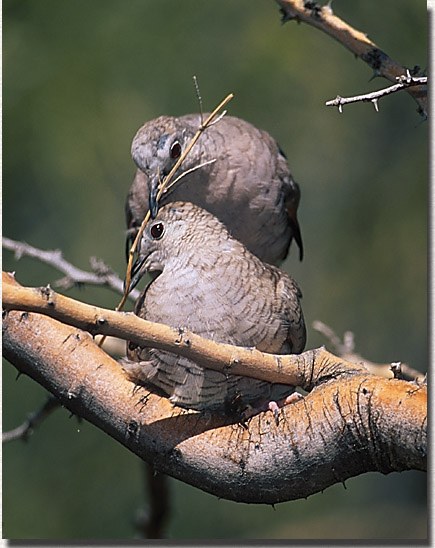
Inca Dove
- Habitat
- Dry open country with mesquite and cactus, cities, towns, lawns, parks, gardens, fields, farms, feedlots
- Size
- 8 in
- Lifespan
- Normally lives only 2-3 years in the wild; the oldest banded bird reached almost 11 years.
- Diet
- "Little known; primarily seeds" — young presumably fed crop milk; drinking water required
About the Inca Dove
The Inca Dove is a tiny, delicate dove with a notably long tail relative to its small overall size of about 8 inches. Its plumage has a distinctive scaly texture created by dark edging on each gray feather, giving the whole body a finely etched, almost reptilian pattern at close range, while rufous tones flash from the wings when the bird takes flight. This scaly appearance is one of the most reliable field marks for identifying the species, along with its diminutive size compared to most other North American doves, and it is noticeably smaller and slimmer than the closely related Common Ground Dove with which it sometimes overlaps in range.
The species favors dry, open country studded with mesquite and cactus across the arid Southwest, but it has also adapted comfortably to cities, towns, lawns, parks, gardens, fields, and farms, including feedlots where spilled grain offers a reliable food source. It is often described as remarkably tame, frequently seen perched on telephone wires or resting along roadsides with little apparent concern for passing people or vehicles, and its range has expanded northward into new areas over the past century as towns and agricultural land have spread across the Southwest, providing exactly the open, disturbed ground the species favors.
Detailed information on the Inca Dove's diet remains fairly limited, but it is understood to feed primarily on seeds gathered from the ground, a typical foraging style for small, ground-oriented doves. Like other doves, young are presumed to be fed on crop milk, a nutrient-rich secretion produced in the parent's crop, though direct observation of this in the species is not extensively documented. Access to drinking water is considered essential for the species, tying it to areas within reach of a reliable water source even in otherwise very dry habitat.
One of the Inca Dove's more distinctive traits is the buzzing sound produced by its outer wing feathers in flight, an auditory signature that can alert an observer to a bird's presence even before it comes into view. Its call is a soft, repeated two-note coo, often rendered as sounding faintly like the phrase "no hope," a mnemonic long used by birders to help remember the sound. On cold nights, small groups of Inca Doves will huddle together in a compact pyramid, one bird stacked partly atop another, a communal warming strategy that helps the tiny birds conserve body heat when temperatures drop.
Lifespan in the wild is typically short, averaging only 2 to 3 years, though the oldest documented banded individual defied those odds by reaching almost 11 years, a striking exception for such a small-bodied bird facing the usual pressures of predation and harsh weather. Pairs may raise several broods across a long breeding season, a productivity that helps offset the species' otherwise short average lifespan and high annual mortality.
Predators of the Inca Dove include domestic cats, various hawks, and snakes that raid the species' flimsy, loosely built stick nest, which offers eggs and young relatively little physical protection compared to the more substantial nests built by many other birds. Because the species lives in a warm climate for much of its range, the breeding season can stretch across many months of the year rather than being confined to a short spring window, allowing pairs to attempt several nesting cycles in succession if conditions remain favorable. Beyond its distinctive wing-whistle in flight, the Inca Dove also gives a range of soft cooing calls used between paired birds and to maintain contact within a small feeding flock, sounds easily lost amid the louder calls of other birds sharing the same urban and suburban habitat.
Frequently asked questions
What makes the Inca Dove's plumage distinctive?
Its feathers have dark scaly edging that gives the whole body a finely scaled appearance, with rufous flashing in the wings during flight.
Where does the Inca Dove live?
It lives in dry, open country with mesquite and cactus, as well as cities, towns, parks, gardens, and farms.
What sound does an Inca Dove make in flight?
Its outer wing feathers produce a buzzing sound as it flies, and its call is a soft two-note coo some birders remember as sounding like 'no hope.'
How long do Inca Doves typically live?
They normally live only 2 to 3 years in the wild, though the oldest banded bird reached almost 11 years.
How do Inca Doves stay warm on cold nights?
Small groups huddle together in a compact, stacked pyramid formation to conserve body heat.
Where to find it
This species favors city / backyard habitat. See real Oklahoma locations on the Habitats map.