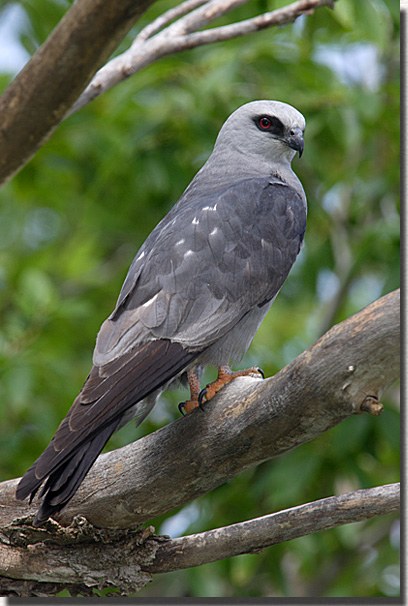
Mississippi Kite
- Habitat
- Open woodlands, shelterbelts, riparian corridors, and increasingly urban parks and neighborhoods
- Size
- About 13-14.6 inches long with a wingspan of roughly 3 feet
- Lifespan
- The oldest banded individual on record reached at least 11 to 12 years old
- Diet
- Mostly large flying insects such as cicadas, dragonflies, and grasshoppers, caught and eaten in flight; occasionally small vertebrates
About the Mississippi Kite
The Mississippi Kite is a slim, graceful raptor with pointed wings, a pale gray head, darker gray body, and a black tail, giving it a streamlined, almost falcon-like silhouette in flight. Its buoyant, effortless soaring and gliding style, often performed while foraging, makes it one of the more elegant fliers among North American birds of prey. Juvenile kites look quite different from adults, wearing a heavily streaked brown plumage above and below that takes a couple of years to molt into the clean gray-and-white adult pattern, so a young bird seen in late summer can easily be mistaken for an entirely different species by an inexperienced observer.
This kite breeds across the southern Great Plains and south-central United States, including much of Oklahoma, where it is a familiar summer sight over open woodlands, shelterbelts, riparian tree lines, and increasingly city parks and tree-lined neighborhoods, since the species has adapted well to nesting in mature urban and suburban trees in some towns. It is a long-distance migrant, wintering in central South America. Kites typically arrive on their Oklahoma breeding grounds in spring and depart again by early fall, and on breezy days they can often be seen "kiting," holding a nearly stationary position in the air by angling into the wind with barely a wingbeat, a technique that lets them scan for insect prey below without expending much energy.
Most of its diet consists of large flying insects, particularly cicadas, dragonflies, and grasshoppers, which it catches and often eats on the wing, using remarkable aerial agility to snatch prey directly out of the air, transferring a catch from foot to bill in flight without needing to land. It will occasionally take small vertebrates such as frogs, lizards, or small birds, but insects make up the bulk of its food. Kites also readily take advantage of disturbances that flush insects into the open, following farm machinery, prescribed burns, or even lawnmowers, since a stirred-up cloud of grasshoppers or other insects offers an easy opportunity to feed with little searching required.
Mississippi Kites often nest loosely colonially, with several pairs sometimes settling in the same stand of trees, building a fairly small, shallow stick nest high in a fork of the canopy and typically laying just one or two eggs, a modest clutch size compared with many other raptors. Adults are well known for aggressively defending their nest area, occasionally swooping at people or pets that wander too close, a behavior that has led to local news coverage in some Oklahoma towns where nesting kites have taken up residence in shade trees near homes and parks. Because it depends on a healthy insect food base, particularly large flying insects, the species can be a useful indicator of overall insect abundance in the areas where it breeds.
Over recent decades, the Mississippi Kite's breeding range has expanded noticeably northward and westward from its historical core in the south-central United States, a shift some researchers attribute to increased tree planting in shelterbelts and towns across the Great Plains providing more nesting opportunities in formerly treeless areas. Migrating flocks can gather in impressively large numbers, sometimes hundreds of birds together, as they move between their North American breeding grounds and South American wintering areas, offering a striking spectacle at certain concentration points along the migration route, with birds often riding thermals in loose, wheeling groups to conserve energy over the long overland journey.
Frequently asked questions
Is the Mississippi Kite common in Oklahoma?
Yes, it breeds widely across much of the state during summer, including in some urban and suburban tree-lined areas.
What does the Mississippi Kite mainly eat?
Large flying insects such as cicadas, dragonflies, and grasshoppers, usually caught and eaten in flight.
Why do Mississippi Kites sometimes swoop at people?
Nesting pairs can be aggressive in defending their nest tree, occasionally diving at people or pets that come too close.
Where does the Mississippi Kite spend the winter?
It migrates long distances to winter in central South America.
How can you tell a young Mississippi Kite from an adult?
Juveniles show heavily streaked brown plumage rather than the clean gray-and-white adult pattern, and take a couple of years to molt into full adult dress.
Where to find it
This species favors city / backyard habitat. See real Oklahoma locations on the Habitats map.