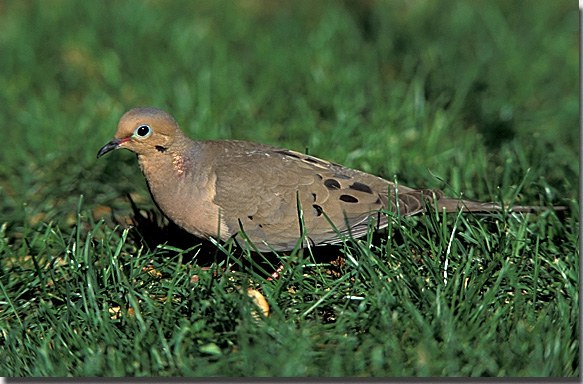
Mourning Dove
- Habitat
- Open country, farmland, woodland edges, and suburban yards; one of the most widespread birds in North America
- Size
- About 9-13.4 inches long, including a long, pointed tail
- Lifespan
- Most wild birds live only one to a few years, but the oldest banded individual on record reached an exceptional 30 years, 4 months old
- Diet
- Almost entirely seeds and grain
About the Mourning Dove
The Mourning Dove is a familiar, slender-bodied dove with soft grayish-brown plumage, a small head, a long pointed tail edged in white, and dark spots on the folded wing. Its soft, mournful cooing call, from which it gets its name, is one of the most recognizable bird sounds across rural and suburban Oklahoma, and its wings produce a sharp whistling sound on takeoff caused by air moving through modified feathers.
Few North American birds are as widespread and adaptable as the Mourning Dove, which is found across virtually all of the continental United States, including throughout Oklahoma, in habitats ranging from farmland and grassland to suburban yards, city parks, and desert scrub. Its tolerance for human-altered landscapes and readiness to nest in ornamental trees or shrubs has helped it remain abundant even as some other native birds have declined.
Its diet is almost entirely seeds and waste grain, gathered by walking and pecking at the ground in open areas, and it is capable of eating a remarkably large volume of seed in a single feeding session, storing it temporarily in an expandable crop before digesting it later at a safer resting spot. Doves also need to drink regularly and can suck up water continuously without tilting the head back, unlike most other birds.
Mourning Doves are prolific breeders, often raising multiple broods, sometimes more than five, in a single breeding season, a reproductive strategy that helps offset relatively high annual mortality and supports its status as the most commonly hunted game bird in the country. Its exceptional documented banding longevity record, over 30 years for one individual, stands in sharp contrast to the much shorter average lifespan of most wild doves, illustrating just how much variation can exist within a single common species.
Mourning Dove nests are famously flimsy, often just a loose platform of a few dozen twigs that can appear barely adequate to hold the two white eggs typically laid, yet the species compensates for this minimal nest-building investment with its high reproductive output across multiple broods per year. Both parents produce a nutrient-rich secretion called crop milk to feed newly hatched young, a trait shared with only a small number of other bird groups such as pigeons and flamingos, allowing doves to begin breeding successfully even before insects or seeds are abundant enough to feed nestlings directly.
Frequently asked questions
Why is it called the Mourning Dove?
Its soft, low cooing call has a mournful sound that gave the species its common name.
How many broods can a Mourning Dove raise in one year?
It is a prolific breeder capable of raising multiple broods in a single season, sometimes more than five.
How long can a Mourning Dove live?
Most wild doves live only a year or a few years, but the oldest documented banded individual reached just over 30 years old.
What is unusual about how Mourning Doves drink water?
They can suck up water continuously without tilting their head back, unlike most birds, which must tip their head to swallow.
Where to find it
This species favors city / backyard habitat. See real Oklahoma locations on the Habitats map.