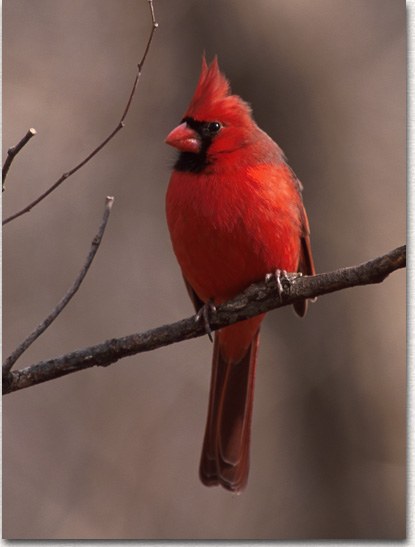
Northern Cardinal
- Habitat
- Woodland edges, fields, thickets, brushy undergrowth, suburbs, gardens, feeders, swamps, desert washes, riparian areas
- Size
- 8–9 in; male bright red with crest and black face, stout red bill; female buff-brown tinged red on crest/wings/tail
- Lifespan
- Average wild lifespan is only about 3 years; oldest banded bird lived nearly 16 years.
- Diet
- Insects, fruit, seeds
About the Northern Cardinal
Few backyard birds are as immediately recognizable as the male Northern Cardinal, whose overall crimson-red plumage, jaunty crest, and black facial mask make it a favorite at feeders across the eastern and central United States. Its thick, cone-shaped bill, orange-red in color, is built for cracking open tough seed hulls with ease, a shape shared with other members of the grosbeak and finch family that specialize in seed-cracking. Females wear a more understated palette of warm buff-brown, but they carry the same crest and stout bill, with red highlights washed across the crest, wings, and tail that keep them from ever looking truly plain. Unusually for North American songbirds, both sexes sing, and pairs are sometimes heard countersinging back and forth, trading matched phrases across a shared territory.
Cardinals favor a mix of dense cover and open feeding areas: woodland edges, fencerows, brushy thickets, garden shrubbery, swamp margins, and desert washes are all suitable, but the species has become just as at home in suburban yards, where dense hedges provide shelter close to well-stocked feeders. It does not migrate, remaining on the same territory in every season, and its range has expanded steadily northward over the past century, a shift widely credited in part to the popularity of backyard bird feeding.
Seeds and fruit make up the bulk of an adult cardinal's diet, with sunflower seeds a particular favorite at feeders, though insects become critically important when parents are provisioning nestlings that need protein to grow quickly. Cardinals typically forage low, hopping through shrubs or picking through leaf litter and grass, and mated pairs sometimes engage in a courtship ritual where the male passes a seed to the female bill-to-bill, a gesture that also continues occasionally after pairing as a bonding behavior.
Cardinal pairs often stay bonded across multiple breeding seasons and can raise two or more broods in a single year, with the male taking over feeding duties for fledglings from an earlier brood while the female starts incubating again. Males defend their territory aggressively, including chasing off rivals and sometimes attacking their own reflection in windows or car mirrors during the breeding season, mistaking it for an intruding male. Come winter, that territoriality relaxes and cardinals often join loose, mixed flocks of dozens of birds foraging together. The species owes its name to the resemblance between the male's red plumage and the ceremonial robes worn by Roman Catholic cardinals. Wild birds typically live only about 3 years on average, though the oldest banded individual on record reached almost 16.
Frequently asked questions
Why is the Northern Cardinal named "cardinal"?
It was named for the red robes traditionally worn by Roman Catholic cardinals.
Do female cardinals sing?
Yes, unlike most North American songbirds, female cardinals sing too, sometimes countersinging with their mate.
Do cardinals migrate?
No, cardinals hold the same territory year-round and do not migrate.
How long do cardinals typically live?
About 3 years on average in the wild, though the oldest banded bird on record lived nearly 16 years.
Where to find it
This species favors city / backyard habitat. See real Oklahoma locations on the Habitats map.