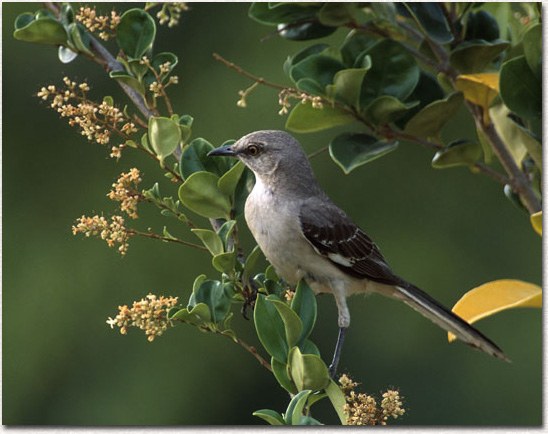
Northern Mockingbird
- Habitat
- Open woodlands, suburban areas, gardens, pastures, thickets, hedges, towns, orchards, deserts
- Size
- 9–11 in
- Lifespan
- Oldest banded bird reached almost 15 years, well beyond its more typical several-year lifespan.
- Diet
- Insects (including crayfish, sowbugs, snails), a few small vertebrates, berries; nestlings are fed mostly insects
About the Northern Mockingbird
The Northern Mockingbird is a slim, long-tailed gray bird, paler on the belly than the back, with bold white patches on the wings and outer tail feathers that flash conspicuously whenever it flies or displays. Its eyes are pale yellow, and males and females look essentially alike, which means the sexes can only reliably be told apart by behavior, such as who is singing or defending the nest, rather than by plumage. Young birds are similarly patterned but often show a duller, more streaked breast and a grayer overall cast, gradually acquiring the crisper adult look over their first several months.
It favors open country studded with shrubs and scattered trees: suburban lawns, gardens, hedgerows, orchards, pastures, and even arid desert scrub all suit it well, and few birds have adapted as thoroughly to life around people. The species has gradually pushed its range northward over the past century, a shift many observers attribute at least partly to the spread of ornamental fruiting shrubs planted in yards, which provide reliable winter food well outside the mockingbird's historical core range. In many neighborhoods it is the single most vocal and visible bird on the block, often singing from a rooftop, wire, or antenna in plain view, seemingly indifferent to passing traffic or foot traffic below. Mockingbirds are also strongly territorial year-round, not just during the breeding season, and a resident bird will often defend the same patch of yard or hedge through the winter months, chasing off other mockingbirds and even much larger birds that intrude on a favored feeding area.
Its diet shifts with the seasons, leaning heavily on insects during the warmer months, including odd prey items like small crayfish, sowbugs, and snails, and turning to berries and fruit such as holly, pokeweed, and mulberry once insect numbers drop in winter. A mockingbird defending a productive fruiting shrub in winter can be remarkably possessive, returning again and again to drive off robins, waxwings, and other fruit-eating birds that try to share the same bush. While foraging on open ground, a mockingbird will sometimes flash its white wing patches open in short, deliberate bursts, a behavior thought to startle hidden insects into moving and giving away their position in the grass.
The species' claim to fame is its extraordinary vocal mimicry: a single male can learn, imitate, and string together the songs and calls of dozens, sometimes over a hundred, other species, along with mechanical sounds like squeaky gates or car alarms, building an ever-expanding repertoire throughout its life that can keep growing well into old age. Researchers have found that older, more experienced males with larger song repertoires often have greater success attracting mates, suggesting the constantly growing repertoire serves as a signal of experience and fitness rather than mimicry for its own sake. Unmated males frequently sing late into the night, especially under a full moon or near bright streetlights, presumably to advertise their availability when few other birds are singing.
Mockingbirds are also famously fearless nest defenders, dive-bombing cats, dogs, hawks, and even people who linger too close to a nest, and some individuals appear to single out and repeatedly target specific people or animals they've identified as recurring threats, sometimes recognizing an individual's face or gait from a distance. The oldest banded Northern Mockingbird on record reached almost 15 years, well beyond the species' more typical several-year lifespan.
Frequently asked questions
Why is the Northern Mockingbird called a "mockingbird"?
It mimics the songs and calls of many other bird species, sometimes stringing together dozens of borrowed phrases in one performance.
Why do mockingbirds sing at night?
Unmated males often sing after dark, especially under bright moonlight or streetlights, to advertise for a mate.
How aggressively do mockingbirds defend their nests?
Very aggressively, they will dive-bomb cats, dogs, hawks, and even people who venture too close.
What do mockingbirds eat?
Mostly insects during the warmer months and fruit or berries in winter, with occasional small vertebrates.
Do mockingbirds defend territory outside the breeding season?
Yes, they are territorial year-round, often guarding a favored winter feeding area such as a fruiting shrub against other birds.
Where to find it
This species favors city / backyard habitat. See real Oklahoma locations on the Habitats map.