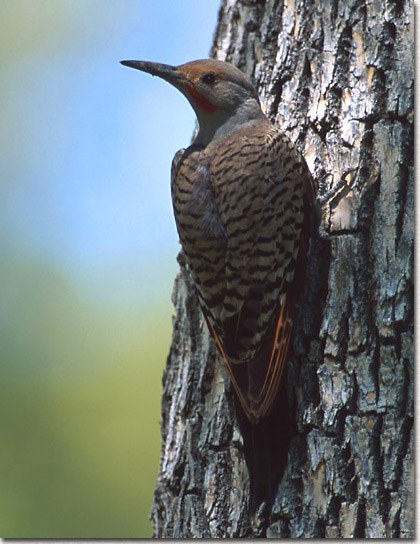
Northern Flicker
- Habitat
- Widespread — open woodlands, suburban areas, saguaro deserts, parks, mature forests
- Size
- 12 in
- Lifespan
- Oldest banded individual reached about 9 years, though typical wild lifespans are shorter.
- Diet
- Especially ants — more than any other North American bird; occasionally seeds, acorns, nuts, grain
About the Northern Flicker
The Northern Flicker breaks nearly every rule people associate with woodpeckers. It is large and brown overall rather than boldly black-and-white, marked with a black crescent bib across the chest, dark spotting below, and a barred pattern above; in flight it flashes a bright white rump patch that is often the quickest way to identify it from a distance. Two regional forms exist across North America, a yellow-shafted form in the east with yellow flight feathers and a red-shafted form in the west with salmon-colored feathers, and males of both show a dark mustache stripe that females lack. Where the two forms' ranges overlap, hybrids showing a mix of features are not uncommon, which can make identification genuinely tricky in the contact zone running roughly through the Great Plains.
Flickers are remarkably adaptable, turning up in open woodlands, suburban parks and yards, and even saguaro desert country, wherever there are enough dead or soft trees to provide nest cavities. This flexibility has made the species one of the most widely distributed woodpeckers on the continent, found from coast to coast and well into Mexico and Central America. In much of Oklahoma, flickers are present year-round, though northern populations to the north of the state shift southward in winter, so local numbers can noticeably swell during the colder months as migrants join resident birds.
What truly sets the Northern Flicker apart is its diet and foraging style. Rather than hammering into wood for insects, it spends much of its time hopping across open ground, probing lawns, and digging into ant mounds with a long, barbed, sticky tongue that can extend well beyond the bill's tip. It eats more ants than any other North American bird, a genuinely unusual specialization for a woodpecker family otherwise built around bark-drilling, and its saliva is notably sticky, helping the tongue's tip pick up ants and their larvae from deep inside a mound with each rapid strike. It also eats other insects such as beetles, and especially in colder months switches to seeds, acorns, and berries when ants are unavailable underground. Because so much of its foraging happens at ground level rather than up in the bark, flickers are also more vulnerable than most woodpeckers to ground predators such as cats and raptors, and they tend to stay alert, flushing to a nearby tree at the first sign of disturbance.
Pairs excavate a new nest cavity most years in a dead limb or utility pole, though they will readily use nest boxes as well, and both parents share incubation and feeding duties, regurgitating a soft mash of insects for the chicks. The excavation process itself can take one to two weeks of steady work, and the finished cavity is often reused in later years by other cavity-nesting species such as bluebirds, wrens, and even small owls once the flickers move on, making the flicker something of an ecological engineer within its woodland community. Rather than drumming purely to excavate wood, flickers often select the loudest, most resonant surface available, including metal gutters, chimney caps, or street signs, purely to broadcast their territorial claim as far as possible, sometimes to the great annoyance of homeowners.
The oldest banded Northern Flicker on record reached about 9 years of age, though typical wild lifespans run considerably shorter given the many hazards facing a woodpecker that spends so much time foraging exposed on open ground.
Frequently asked questions
What makes the Northern Flicker unusual among woodpeckers?
It is the only North American woodpecker that feeds mainly on the ground, digging for ants rather than drilling into wood for food.
What field mark helps identify a flicker in flight?
A bright white rump patch that flashes clearly as the bird flies away.
What is the Northern Flicker's main food?
Ants, of which it eats more than any other North American bird.
Where does the Northern Flicker nest?
In cavities it excavates in dead or soft trees, though it will also use nest boxes.
Do other birds benefit from flicker nest holes?
Yes, abandoned flicker cavities are often reused in later years by species such as bluebirds, wrens, and small owls.
Where to find it
This species favors city / backyard habitat. See real Oklahoma locations on the Habitats map.