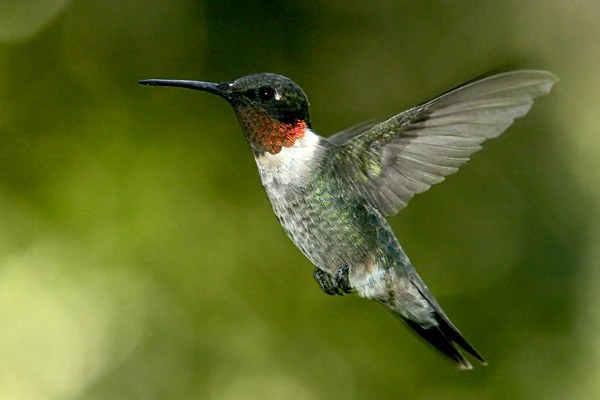
Ruby-throated Hummingbird
- Habitat
- Common in the east in gardens with flowers, woodland edges, orchards, suburban areas with feeders, parks; attracted to red coloring
- Size
- 3.5 in
- Lifespan
- Typically lives about 3-5 years in the wild; the oldest banded individual on record was just over 9 years old.
- Diet
- Spiders, tree sap from woodpecker holes, sugar water from feeders
About the Ruby-throated Hummingbird
The Ruby-throated Hummingbird is a tiny bird packed with outsized personality. Males display an iridescent, fiery-red throat patch, or gorget, that can flash brilliantly in direct sun but appear almost black in duller light, paired with an emerald-green back. Females lack the red throat entirely, showing a plain white throat and buffy-washed sides instead, though they share the same iridescent green back as males, and juveniles resemble females until young males begin acquiring throat color.
It is the only hummingbird species that breeds regularly east of the Mississippi River, making it the default, and often the only, hummingbird encountered across much of the eastern United States. It favors gardens rich in nectar-producing flowers, woodland edges, orchards, and suburban yards with feeders, and it shows a strong, well-documented attraction to the color red on both flowers and feeders, sometimes investigating red objects that have nothing to do with food at all.
Nectar and sugar water provide the quick-burning fuel this species needs to power its rapid metabolism and hovering flight, but nectar alone cannot supply protein, so hummingbirds rely on small insects and spiders for that, often plucking them directly from spiderwebs or visiting sap wells drilled into tree bark by sapsuckers. Insects become especially important once chicks hatch and need protein to grow quickly during their brief time in the nest.
Females build a remarkably small nest, roughly the size of a walnut half, woven from soft plant down and bound together with strands of spider silk, then camouflaged on the outside with flecks of lichen; they raise the young entirely on their own, with no help from the male. Before the fall migration south, individual birds pack on fat reserves that can nearly double their body weight, fuel for a nonstop overwater flight of roughly 500 miles across the Gulf of Mexico that leaves no opportunity to rest or refuel midway. Ruby-throated Hummingbirds typically live 3 to 5 years in the wild, with the oldest banded individual on record surviving just over 9 years. Their wings beat roughly 50 times per second in normal flight, fast enough to produce the humming sound that gives the whole family its name, and this rapid wingbeat allows them to hover in place, fly backward, and change direction almost instantly.
Frequently asked questions
How far can a Ruby-throated Hummingbird fly without stopping?
It can cross the Gulf of Mexico in a nonstop flight of roughly 500 miles during migration.
How does a female Ruby-throated Hummingbird differ from a male?
Females lack the male's iridescent red throat and show a plain white throat instead.
What do Ruby-throated Hummingbirds eat besides nectar?
Small insects and spiders, which supply the protein that nectar and sugar water cannot.
Is the Ruby-throated Hummingbird the only hummingbird in the eastern United States?
Yes, it is the only hummingbird species that regularly nests east of the Mississippi River.
Where to find it
This species favors city / backyard habitat. See real Oklahoma locations on the Habitats map.