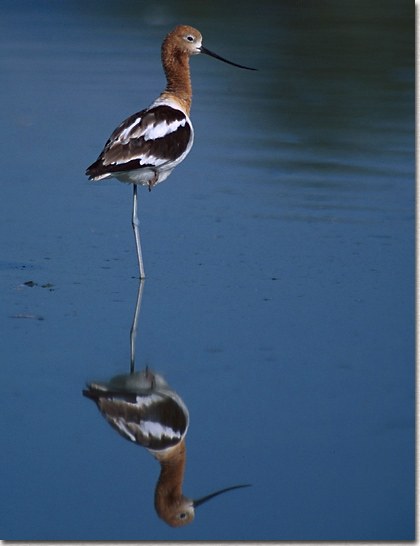
American Avocet
- Habitat
- Shallow saline lakes, sloughs, wet meadows, wetlands, marshes, saltwater/brackish ponds, lakeshores
- Size
- 16–20 in
- Lifespan
- Wild lifespan is poorly studied, but the oldest banded bird on record reached at least 15 years.
- Diet
- Mostly crustaceans and insects, some aquatic vegetation/seeds
About the American Avocet
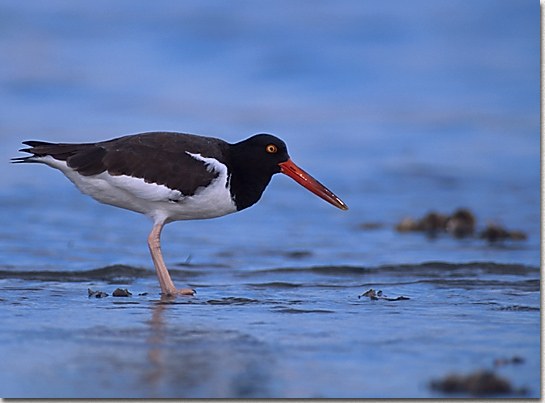
The American Avocet is among the most distinctive shorebirds on the continent, instantly recognizable by its long, thin, upturned bill and long blue-gray legs. In breeding plumage, adults show a warm rust-orange wash across the head and neck that fades to pale gray or white once the breeding season ends, while the body remains boldly patterned in black and white above with clean white underparts. The bill's upward curve is more pronounced in females than males, a subtle difference useful for telling the sexes apart in the field. Standing 16 to 20 inches long, it is one of the larger, more elegant waders found in Oklahoma's wetlands, and its molt into pale gray winter dress happens gradually after nesting, so late-summer flocks often show birds in various stages of transition.
Avocets favor shallow, often alkaline or saline water bodies: sloughs, wet meadows, marshes, brackish or saltwater ponds, and the muddy margins of lakes. This preference for shallow, mineral-rich water reflects the invertebrate communities that thrive in such conditions, which in turn support the avocet's foraging. In Oklahoma the species is best known as a migrant and local breeder, passing through or nesting around larger reservoirs and playa lakes, particularly in the western part of the state, before many head to coastal wintering grounds. Spring migrants typically begin arriving in April, with local nesting activity picking up through May and June, while the heavier southbound push of failed breeders and family groups builds through August and September, so birders have two distinct windows each year to look for the species at productive wetland sites.
Feeding behavior is where the avocet's odd bill shape truly pays off. Rather than hunting by sight alone, the bird wades through shallow water sweeping its bill side to side just beneath the surface, using touch to detect crustaceans, aquatic insect larvae, and other small invertebrates stirred up by the motion. In the alkaline lakes and saline flats it favors, this technique is especially effective at capturing brine shrimp and brine flies, prey items that few other shorebirds exploit as efficiently. It will also pick food directly off the water's surface or mud, and supplements its animal diet with seeds and other aquatic vegetation when available. This scything technique lets avocets forage effectively in murky or silty water where visual hunters would struggle, and it is not uncommon to see several birds wading shoulder to shoulder, sweeping in loose unison as they advance across a flat, a coordinated pattern that likely improves foraging efficiency by stirring up more prey than a lone bird could disturb on its own.
Avocets often share shallow wetlands with the similarly long-legged Black-necked Stilt, but the two are easy to separate: stilts have a straight black bill, deeper pink-red legs, and solid black upperparts without the avocet's bold white shoulder stripes. Avocets are also considerably more vocal in flight and at the first hint of disturbance, giving a sharp, repeated "wheet" or "kleep" call that carries well across open water and often signals a flock's presence before it comes into view. Outside the breeding season, avocets gather into loose, sometimes sizeable flocks, wheeling together over the water in tight formation, wingtip to wingtip, a striking sight against the flat light of a prairie sunset.
Avocets nest on the ground in a simple scrape, often in loose colonies near water, and their defense of the nest is famously coordinated. When a predator approaches, the birds gather and mob it collectively, forming lines and advancing together while calling loudly, a strategy that can drive off far larger animals, including coyotes and raccoons. Chicks are precocial, able to walk and feed themselves within hours of hatching, though the adults continue to guard them closely against the many predators that share their open wetland habitat. Because the species depends on specific water levels in shallow lakes and playas, avocet numbers at any given Oklahoma site can shift considerably from year to year with rainfall and reservoir management, and long-term conservation of the species across its range is tied closely to protecting the alkaline and saline wetlands it needs for both feeding and nesting.
Frequently asked questions
What makes the American Avocet's bill so unusual?
Its bill curves distinctly upward, letting the bird sweep it side to side through shallow water to feel for prey rather than relying on sight alone.
How can you tell a male and female avocet apart?
Females typically have a more strongly upturned bill than males, though both sexes share the same black-and-white plumage pattern.
Do American Avocets breed in Oklahoma?
Yes, they nest locally around larger lakes and reservoirs, especially in the western part of the state, in addition to passing through as migrants.
How do avocets protect their nests from predators?
They mob approaching predators in coordinated groups, often lining up and advancing together while calling loudly to drive the threat away.
How can you tell an American Avocet from a Black-necked Stilt?
Avocets have an upturned bill and blue-gray legs with white shoulder stripes, while stilts have a straight bill, deeper pink-red legs, and solid black upperparts.
Where to find it
This species favors wetland habitat. See real Oklahoma locations on the Habitats map.