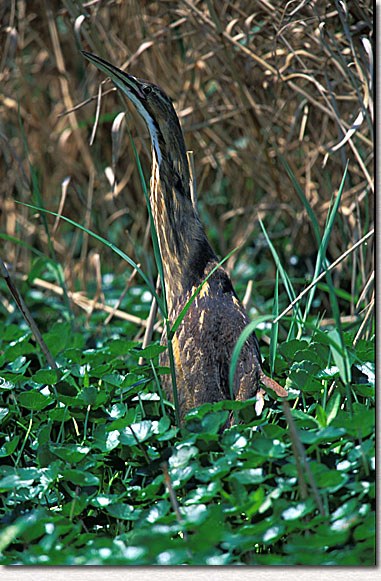
American Bittern
- Habitat
- Freshwater marshes, cattail stands, and dense reedy wetland edges
- Size
- 23-33 in
- Lifespan
- Poorly documented due to its secretive habits; banding recoveries suggest individuals can live at least 8 years in the wild, though most likely survive far less.
- Diet
- Fish, frogs, crayfish, large insects, and small snakes or rodents
About the American Bittern
The American Bittern is a stocky, medium-sized heron relative built for a life of stillness rather than display. Adults measure roughly 23 to 33 inches from bill to tail with a wingspan of over three feet, yet the bird's dense streaking of buff, brown, and black down the neck and body lets it disappear instantly against dry marsh reeds. Two dark, elongated feathers form a mustache-like patch running down each side of the neck to the shoulder, and when agitated the bird can raise these into visible plumes. When alarmed, rather than fleeing, it freezes with its bill pointed skyward and body compressed, swaying gently to mimic wind-blown reeds, a behavior nicknamed "sky-pointing." This posture works remarkably well because the bird's cryptic streaking runs vertically, matching the orientation of the reeds around it, so a motionless, skyward-pointed bittern can be nearly impossible to pick out even at close range.
This is a bird of dense freshwater and brackish marshes—cattail stands, bulrush edges, and wet meadows with standing water and heavy emergent vegetation. It breeds widely across the northern and central United States and Canada and winters in the southern and coastal states, including parts of Oklahoma, where it is most likely encountered as a passage migrant or scarce winter visitor at large wetland complexes. Spring passage through the state generally runs from March into May, with the return movement south beginning in September and continuing into November, and because the species is so secretive, most Oklahoma records come from birders working the edges of large marshes slowly and quietly rather than casual observation. The species forages by wading slowly at the water's edge or standing motionless for long stretches, then striking with a rapid stab of its long bill to seize fish, frogs, crayfish, large insects, and even small snakes and rodents.
American Bitterns are solitary and rarely seen in the open, so most people learn of their presence through sound rather than sight. In spring, males produce an odd, resonant pumping call often rendered as "oonk-a-choonk," audible over long distances across a marsh and used to advertise territory; the sound is produced with the help of specialized esophageal muscles that let the bird gulp air and amplify the call almost like a bellows, a mechanism unique among North American herons. Because the call carries so far through dense vegetation, a single displaying male can make a marsh sound busier with bitterns than it actually is, and the species is consequently easy to under- or overcount depending on how many individuals are actually calling.
Nests are built low over water or on matted marsh vegetation, and females alone incubate and raise the brood, typically laying four or five eggs, with no help from the male beyond mating and territory defense. Young bitterns hatch with the same cryptic streaking as adults and instinctively freeze and sky-point at the first sign of disturbance well before they can fly, a behavior that appears to be largely innate rather than learned. Because they depend on large, undisturbed wetlands, American Bittern populations have declined where marshes have been drained or fragmented, making the species a useful indicator of wetland health; a marsh that still supports a booming bittern in spring is generally a marsh with intact, undisturbed emergent vegetation and healthy water levels.
Beginning birders sometimes confuse a flushed American Bittern with an immature night-heron, since both are brown and streaked and tend to explode from cover at close range, but the bittern shows contrastingly dark flight feathers against paler wing coverts in flight, along with that distinctive slow, deliberate wingbeat and hunched neck posture, different from the more direct flight of young night-herons. Bitterns are also almost always flushed singly rather than in small groups, another useful clue given how solitary and territorial the species remains even outside the breeding season.
Frequently asked questions
What does the American Bittern eat?
Mainly fish, frogs, crayfish, and large insects captured with a quick stab of its bill while standing motionless in shallow water.
Where can I see an American Bittern in Oklahoma?
Look at large marshes and wetland refuges during spring and fall migration or in winter; it's secretive and far more often heard than seen.
How long do American Bitterns live?
Precise data is limited, but banding records show individuals surviving at least 8 years in the wild.
Is the American Bittern common in Oklahoma?
No, it's an uncommon migrant and rare winter visitor in the state, and it does not breed there in numbers.
Why does the American Bittern freeze with its bill pointed skyward?
This 'sky-pointing' posture aligns the bird's vertically streaked plumage with the surrounding marsh reeds, making it nearly invisible to predators and observers alike.
Where to find it
This species favors wetland habitat. See real Oklahoma locations on the Habitats map.