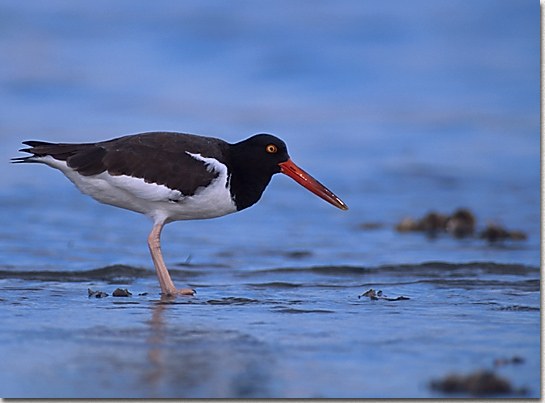
American Oystercatcher
- Habitat
- Coastal beaches, saltmarshes, tidal mudflats, and oyster reefs (a coastal species; not part of Oklahoma's regular avifauna)
- Size
- 17-21 in
- Lifespan
- Can exceed a decade in the wild; a precise oldest-known banding-record age is not confidently established in commonly available sources.
- Diet
- Oysters, clams, mussels, and other marine invertebrates
About the American Oystercatcher
The American Oystercatcher is a large, unmistakable shorebird of ocean coastlines, sporting a black head and breast, dark brown back, crisp white underparts, and pale pink legs. Sexes look similar, though females average slightly larger and longer-billed than males. Its most striking feature is a long, laterally flattened, bright orange-red bill used like a chisel to pry open bivalve shells, paired with a bold yellow eye ringed in red-orange. At 17 to 21 inches long, it is one of the largest shorebirds in North America and unlikely to be mistaken for anything else where it occurs. Its voice matches its bold appearance: a loud, piercing "wheep" or series of piping notes, often given in flight or during territorial disputes, that carries well over open water and surf.
This species is tied closely to salt water, nesting on barrier island beaches and foraging on tidal flats, oyster beds, and salt marshes along the Atlantic and Gulf coasts. It is a specialist feeder, using its bill to stab between the valves of oysters, mussels, and clams and sever the muscle holding the shell closed, or to hammer open thinner-shelled prey outright—a skill young birds take months to master, remaining dependent on parents for food long after fledging. Individual oystercatchers tend to specialize in one technique or the other, stabbing or hammering, apparently learned from the feeding style each bird was taught as a chick, and bill shape can wear differently depending on which method a particular bird favors.
Because it depends so heavily on coastal tidal habitat, the American Oystercatcher is essentially absent from landlocked Oklahoma under normal circumstances; any state record would be a notable, accidental vagrant far outside the species' expected range, likely a young or wandering bird displaced during migration rather than any indication of range expansion. Such inland vagrancy is rare but not unheard of among coastal shorebirds generally, and any purported Oklahoma sighting warrants careful documentation given how far it would fall from the species' normal Atlantic and Gulf coast distribution.
Along its normal coastal range, pairs are territorial and monogamous, often remaining together and reusing the same general nesting area across multiple years, and nesting in a simple scrape on open sand or shell substrate. Both parents defend the nest vigorously against intruders, including other oystercatchers and predators like gulls and raccoons, using loud alarm calls and aggressive chases to drive threats away from eggs or chicks. Chicks are precocial but slow to become independent, reflecting the specialized feeding technique they must learn, and juveniles may continue begging from parents for food well into their first fall.
The species faced serious population declines in the 20th century from coastal development, egg collecting, and human disturbance of nesting beaches, and it remains a conservation priority along much of the U.S. coastline today. Modern conservation work often centers on protecting nesting beaches from vehicles and off-leash pets during the breeding season and on restoring the oyster reefs and shellfish beds the species depends on for food, since healthy oyster habitat supports both the bird and the coastal fisheries humans also rely on. Outside the breeding season, American Oystercatchers often gather into communal roosting flocks on sandbars and remote beach stretches at high tide, sometimes numbering into the dozens, before dispersing again across the flats to feed as the water recedes. Two subtly different forms are recognized across the species' range, with birds along the Gulf Coast averaging slightly paler above than the darker-backed birds of the Atlantic seaboard, though both are considered part of the same species. Pairs also perform a loud, synchronized piping display, running side by side with heads lowered and bills pointed down while calling in unison, a ritual used both to reinforce the pair bond and to signal territorial boundaries to neighboring oystercatchers.
Frequently asked questions
What does the American Oystercatcher eat?
Oysters, clams, mussels, and other shellfish, pried or hammered open with its specialized bladelike bill.
Where can I see an American Oystercatcher in Oklahoma?
Essentially nowhere reliably—it's a coastal specialist, and any Oklahoma sighting would be a rare, accidental vagrant far from its normal Atlantic/Gulf coast range.
How long do American Oystercatchers live?
They can live over a decade in the wild, though a precise maximum banding age isn't well documented in common references.
Is the American Oystercatcher common in Oklahoma?
No, it is not part of Oklahoma's regular bird life at all; it belongs to coastal beaches and estuaries hundreds of miles away.
What sound does the American Oystercatcher make?
A loud, piercing 'wheep' or series of piping notes, often given in flight or during territorial disputes with other oystercatchers.
Where to find it
This species favors wetland habitat. See real Oklahoma locations on the Habitats map.