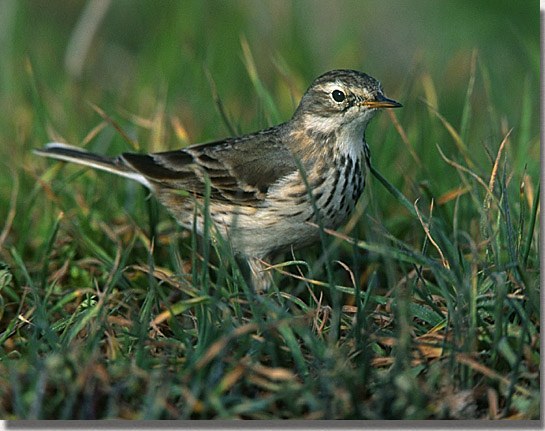
American Pipit
- Habitat
- Open fields, plowed farmland, shortgrass plains, and mudflats/shorelines in migration and winter; alpine and arctic tundra in the breeding season
- Size
- 6-7 in
- Lifespan
- Not well documented for this species; small songbirds of this size typically survive a few years in the wild, with occasional individuals living considerably longer.
- Diet
- Insects and other small invertebrates in summer; seeds and insects in winter
About the American Pipit
The American Pipit is a slender, sparrow-sized songbird easily overlooked among the open ground it favors. It is grayish-brown above and buffy below with fine dark streaking on the breast, a thin bill, and white outer tail feathers that flash conspicuously in flight. Its most distinctive habit is a near-constant up-and-down bobbing of the tail as it walks, a behavior that helps separate it at a glance from similarly plain sparrows and longspurs sharing the same open habitats. Nonbreeding birds, the plumage most Oklahomans encounter, are duller and more uniformly buffy than the crisper, grayer breeding adults seen on the far northern nesting grounds, a seasonal difference visible mainly to observers who have seen the species in both contexts.
Unlike most songbirds, pipits are ground-dwellers through and through: they walk rather than hop, and they forage by striding steadily across bare soil, short grass, mudflats, and plowed fields, picking insects and seeds from the ground. In Oklahoma the species is essentially a winter visitor and migrant, most often found in flocks moving across open farm fields, shoreline mud, and stubble fields from fall through early spring; it is not a breeding bird in the state. Flocks can range from a handful of birds to several dozen, moving together in loose, shifting groups that flush as a unit when disturbed, calling a thin, sharp "pip-it" note in flight that gives the species its name.
American Pipits breed far to the north and at high elevation, nesting on Arctic tundra and above treeline in western mountains, habitats almost entirely unlike the open lowland fields where Oklahomans encounter them in the colder months. On the breeding grounds males perform fluttering display flights over open tundra while singing, rising and then parachuting slowly back to the ground with wings held in a shallow V, and nests are built directly on the ground, often tucked beside a rock or tuft of vegetation for shelter from wind. Several recognized subspecies breed across this vast range, from Arctic tundra populations to isolated alpine populations in the Rockies and Sierra Nevada, differing subtly in average color tone.
After breeding, pipits form loose flocks and undertake a long migration south, with many individuals wintering across the southern United States and Mexico. Birders in Oklahoma should look for pipits mainly from October through April, scanning flocks working across freshly plowed fields or exposed lake-margin mud, where their bobbing tails and white outer tail feathers give them away even at a distance. The similar Sprague's Pipit, a scarcer grassland specialist that also winters in the region, lacks the American Pipit's tail-bobbing habit and shows a more streaked back and paler overall look, and is best separated by its habit of staying in taller native grass rather than bare or plowed ground.
Diet shifts somewhat with the season: insects, especially beetles and flies, dominate during the warmer months, while the wintering diet in Oklahoma leans more heavily on a mix of small invertebrates and seeds gleaned from bare or sparsely vegetated ground, reflecting the reduced insect availability of the colder months. Wintering pipit flocks in Oklahoma often associate loosely with Horned Larks and longspurs feeding in the same open fields, and though the species mix together while foraging, pipits tend to flush a beat earlier and fly higher than the more ground-hugging larks when disturbed. Because pipits depend on bare or sparsely vegetated ground for both cover-free foraging and safety from ambush predators, they will shift locations quickly in response to changing field conditions, moving off a field soon after it greens up with new vegetation growth and searching out freshly disturbed or flooded ground elsewhere nearby.
Frequently asked questions
What does the American Pipit eat?
Mostly insects in summer and a mix of insects and seeds in winter, picked from bare ground while walking.
Where can I see an American Pipit in Oklahoma?
In fall through early spring, look for flocks walking across plowed fields, pastures, or muddy lake edges; it does not breed in the state.
How long do American Pipits live?
Specific longevity data is limited, but small songbirds like this typically live a few years in the wild.
Is the American Pipit common in Oklahoma?
It's a fairly regular winter visitor and migrant in open-country habitats, though easily overlooked among sparrows and longspurs.
How is the American Pipit different from Sprague's Pipit?
American Pipits constantly bob their tails and favor bare ground or mudflats, while Sprague's Pipits lack the tail-bobbing habit, show a more streaked back, and prefer taller native grassland.
Where to find it
This species favors wetland habitat. See real Oklahoma locations on the Habitats map.