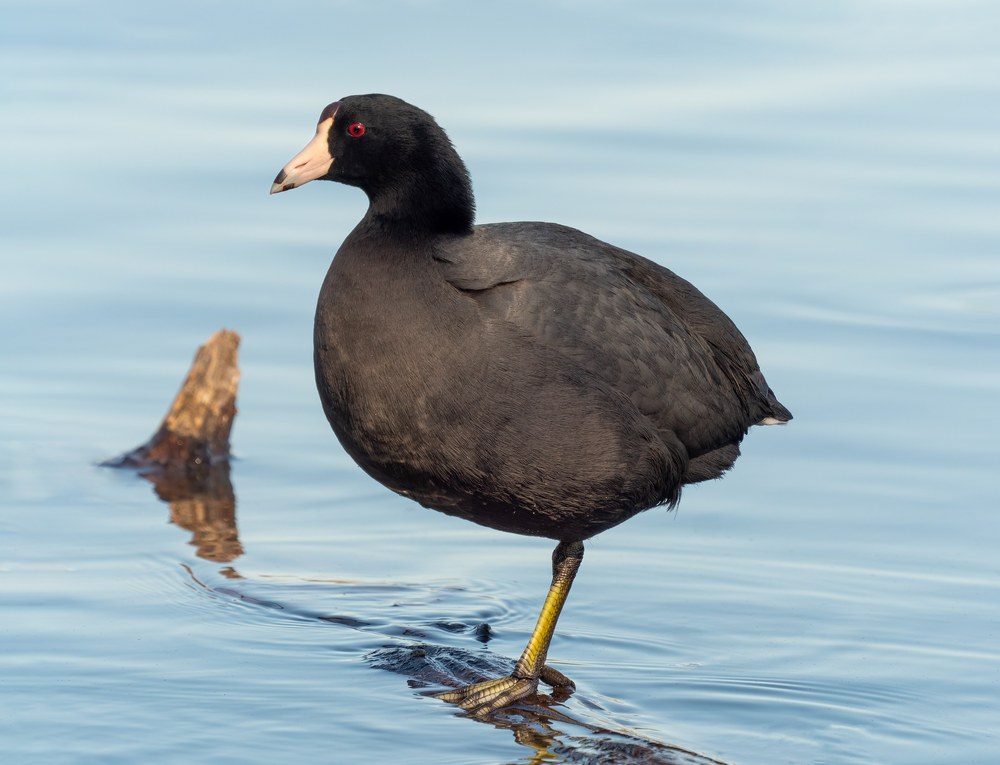
American Coot
- Habitat
- Marshes, wetlands, ponds, lakes, bayous, marshy rivers; occasionally salt water in winter; usually in large flocks near shore
- Size
- 15 in, gray duck-like bird
- Lifespan
- Averages roughly 9 years in the wild; one banded female lived past 22 years.
- Diet
- Mostly aquatic vegetation and algae; also fish, tadpoles, crustaceans, snails, worms, aquatic/terrestrial insects, and eggs of other marsh-nesting birds
About the American Coot
Despite its duck-like silhouette and habit of swimming among true ducks, the American Coot is actually a member of the rail family, betrayed by its chicken-like white bill and slate-gray to blackish body. A small reddish-brown swelling — the frontal shield — caps the base of the bill above the eyes, and rather than webbed feet, the coot's toes carry broad lobes of skin that fold flat on the backstroke and spread open for propulsion, an adaptation more common among diving birds than dabblers.
Common throughout Oklahoma's marshes, ponds, lakes, bayous, and slow marshy rivers, coots gather in large, loosely associated flocks that hug the shoreline, occasionally venturing onto brackish or salt water during winter. Their tolerance for a wide range of freshwater and semi-saline habitats, along with a generalist diet, makes them one of the most numerous waterbirds seen on Oklahoma lakes outside of the breeding season.
Aquatic vegetation and algae make up the bulk of a coot's diet, but it is far from a strict herbivore: fish, tadpoles, crustaceans, snails, worms, and both aquatic and terrestrial insects round out the menu, and it will even take the eggs of other marsh-nesting birds when the opportunity arises. Coots dive readily to reach submerged plants, bobbing their heads forward and back with each swimming stroke, and they are notorious kleptoparasites, chasing down dabbling ducks that have just surfaced with a beakful of vegetation and stealing it outright.
Coot chicks are strikingly different from the adults, hatching with fluffy orange-tipped down and bald red skin on the head, a coloration thought to trigger extra feeding attention from parents. Pairs can be fiercely territorial during the breeding season, chasing off rivals with aggressive splashing displays, before relaxing into the large, sociable rafts that characterize the species for the rest of the year. When taking flight, a coot must first patter awkwardly across the water's surface for some distance before becoming fully airborne, a labored takeoff quite different from the effortless liftoff of the ducks it often shares a pond with. In hard winters, large numbers sometimes die of starvation or exposure when a sudden freeze seals off their feeding water faster than the flock can relocate, a vulnerability tied to the species' heavy reliance on open water for both food and safety from land predators.
Frequently asked questions
Is the American Coot a duck?
No — despite its duck-like look and swimming habits, the coot is a member of the rail family, identifiable by its white bill and lobed (not webbed) toes.
What is the red patch on a coot's forehead?
It's called a frontal shield, a fleshy swelling at the base of the bill that sits above the reddish-tinged bill itself.
Why do coots bob their heads while swimming?
The forward-and-back head bob is timed with each paddling stroke of their lobed feet, a motion typical of many diving waterbirds.
Do coots really steal food from ducks?
Yes, coots are known kleptoparasites that chase down ducks which have just surfaced with aquatic plants and snatch the food away.
Where to find it
This species favors wetland habitat. See real Oklahoma locations on the Habitats map.