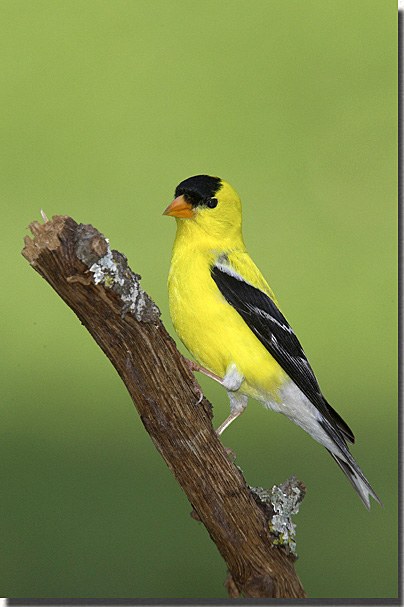
American Goldfinch
- Habitat
- Woodland edges, fields, thickets, orchards, roadsides, riparian willows, feeders
- Size
- 4.5–5 in, smaller than a sparrow
- Lifespan
- Most live only a few years, but the oldest banded individual reached nearly 11 years.
- Diet
- Insects and seeds of deciduous trees, forbs (especially composites), grass, floral buds, and berries
About the American Goldfinch
One of the most colorful visitors to Oklahoma feeders, the breeding male American Goldfinch wears brilliant lemon-yellow plumage set off by a black cap, black wings with white bars, and a white rump patch visible in flight. Females and males in nonbreeding (winter) plumage trade this vivid look for a much more subdued olive-gray body, retaining the black wings and crisp white wing-bars as the best field marks. At just 4.5 to 5 inches long, smaller than a sparrow, it is among the tiniest songbirds regularly seen in the state, and its deeply undulating flight — a few wingbeats followed by a closed-wing dip — is often the first clue to its identity before the color is even visible, especially when accompanied by its cheerful flight call, often rendered as "potato-chip," given in rhythm with the dips of its bounding flight path.
Goldfinches favor open, weedy habitats: woodland edges, old fields, thickets, orchards, roadsides, and streamside willows, and they are enthusiastic feeder visitors, especially where nyjer or sunflower seed is offered. This preference for weedy, seed-rich edge habitat rather than deep forest lines up neatly with a diet built around composite-family forbs like thistle and sunflower, along with grass seed, tree seed, floral buds, and occasional insects.
Because so much of the goldfinch's diet depends on seed heads that don't mature until mid-to-late summer, the species delays nesting far later than almost any other North American songbird, often not beginning until July. This late start means goldfinches typically manage only a single brood per year, in contrast to many songbirds that raise two or three, but it ensures a ready supply of thistledown for lining the nest and seed for feeding growing chicks. The nest itself, woven so tightly with plant down that it can hold water, is built by the female alone in the fork of a shrub or sapling, and unlike most seed-eating songbirds, goldfinch parents feed their nestlings an almost entirely regurgitated seed diet rather than the insect-heavy diet typical of other finches, one reason cowbird chicks fare so poorly in goldfinch nests.
The nickname "Wild Canary" reflects both the male's canary-yellow color and its cheerful, twittering flight call, often rendered as "per-chick-o-ree." Outside the breeding season goldfinches become highly social, forming loose flocks that roam fields and feeders together, sometimes mixing with Pine Siskins or Purple Finches at winter feeding stations, and the transition between drab winter plumage and brilliant breeding yellow happens through a complete body molt each spring, one of the more dramatic seasonal transformations among common backyard birds. Unusually among North American songbirds, the American Goldfinch molts twice a year, replacing its body feathers completely both in early spring and again in fall, while flight feathers are renewed only in the fall molt, an energetically costly strategy that keeps the male's breeding colors especially fresh and bright each summer.
Goldfinches are also frequent targets of Brown-headed Cowbird parasitism, but cowbird chicks placed in a goldfinch nest rarely survive, since the seed-heavy diet the parents provide lacks the protein a growing cowbird nestling needs. The species is popular enough to have been named the official state bird of three states, and in Oklahoma it is one of the most reliable and eagerly welcomed feeder visitors of the cooler months, arriving in modest olive-gray winter dress each fall and departing—or transforming in place—into brilliant yellow by the time spring migration and nesting season roll around.
Frequently asked questions
Why do American Goldfinches look so different in winter?
They molt out of their bright yellow breeding plumage into a duller olive-gray coat, keeping only the black wings and white wing-bars year-round.
Why does the American Goldfinch nest so late in the year?
Its diet and nest-building rely heavily on thistle and other composite-plant seed heads, which don't mature until mid-summer, so nesting is delayed to match.
How many broods does a goldfinch raise each year?
Typically just one, since its late nesting start leaves little time in the season for a second attempt.
Why is the American Goldfinch called the "Wild Canary"?
The nickname comes from the breeding male's bright canary-yellow plumage and its cheerful twittering calls.
Does the American Goldfinch migrate?
Many populations shift south in winter, but goldfinches are also frequent year-round residents in Oklahoma, with local birds often supplemented by additional migrants from farther north during the colder months.
Where to find it
This species favors forest habitat. See real Oklahoma locations on the Habitats map.