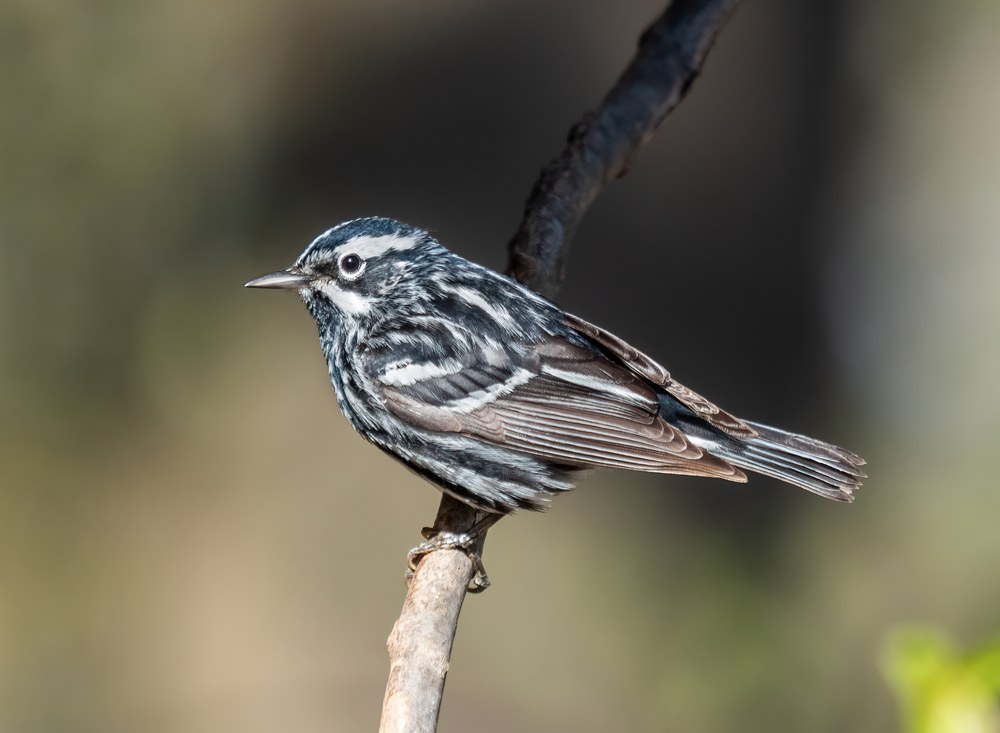
Black-and-white Warbler
- Habitat
- Deciduous and mixed forests; forages on tree trunks and larger branches
- Size
- 4.5-5.5 in
- Lifespan
- Not well documented; small warblers of similar size generally live a few years in the wild.
- Diet
- Insects and spiders gleaned from bark
About the Black-and-white Warbler
The Black-and-white Warbler is easy to identify by its bold pattern of black-and-white stripes covering essentially its entire body, including the crown, back, and flanks. Males show a solid black throat and cheek patch in breeding plumage, while females and immatures have a paler, whitish throat and cheek, but both sexes share the same overall striped appearance that sets the species apart from every other North American warbler. Its feet and claws are proportionally larger and more strongly curved than those of most other warblers, an adaptation well suited to gripping bark securely while climbing, much like a nuthatch or creeper.
Its behavior is as distinctive as its plumage. Unlike most warblers, which glean insects from leaves and outer branches, the Black-and-white Warbler forages by creeping along tree trunks and large limbs, moving up, down, and around the bark much like a nuthatch, probing into bark crevices with its slightly downcurved bill to extract insects and spiders. This unusual foraging niche lets it exploit food sources other warblers largely ignore, and it can often be picked out among mixed foraging flocks by this trunk-climbing habit alone.
The species breeds in deciduous and mixed forests across much of the eastern and northern United States and Canada, and despite its bark-foraging habits, it nests on the ground, tucking a well-hidden cup nest at the base of a tree, stump, or log, often against a rock, root, or fallen branch that offers some concealment and shelter from rain.
It winters from Florida and Mexico south through Central America and into northern South America, and Oklahoma sees the species chiefly as a spring and fall migrant passing through wooded habitats, with some breeding activity in forested parts of the state. Spring migrants typically pass through from early April into May, among the earlier-arriving wood warblers each year, with the fall movement south beginning as early as late July and continuing through October.
Its thin, high, rhythmic song, often compared to the squeak of a rusty wheel repeated over and over, is frequently the first clue to its presence high in the forest canopy, where its small size and constant motion can otherwise make it difficult to pick out visually. The Black-and-white Warbler is also notable among wood warblers for beginning its northbound migration earlier in spring than most of its relatives, and on the wintering grounds it readily joins mixed-species foraging flocks of resident tropical birds, using its familiar trunk-climbing technique alongside antwrens, woodcreepers, and other bark-foraging specialists it encounters there. Females defending a nest will sometimes perform a distraction display, fluttering away from the nest site while feigning injury to lure a predator off before flying free once the threat has been drawn a safe distance away, a behavior shared with a number of other ground-nesting warblers. Because the species breeds across such a broad swath of eastern and northern forest, regional population trends vary, but forest fragmentation and the loss of mature woodland with abundant standing timber, which provides the bark surfaces the species depends on for foraging, remain among the more commonly cited long-term concerns for breeding populations in parts of its range. Adults undergo a complete molt after the breeding season before migration, and by fall the black throat that distinguishes breeding males has often become partly obscured by pale feather edges, narrowing the visible plumage difference between the sexes until a fresh molt the following spring restores the male's bolder look. Fall migrants moving south through Oklahoma are frequently seen foraging alongside chickadees and titmice in mixed flocks, using the same trunk-creeping technique that sets them apart from every other warbler species passing through at the same time.
Frequently asked questions
What does the Black-and-white Warbler eat?
Insects and spiders, gleaned from tree bark by creeping along trunks and branches rather than foliage.
Where can I see a Black-and-white Warbler in Oklahoma?
In wooded areas during spring and fall migration, watching tree trunks and large branches where it forages like a nuthatch.
How long do Black-and-white Warblers live?
Specific data is limited, but similar small warblers typically live a few years in the wild.
Is the Black-and-white Warbler common in Oklahoma?
It's a fairly regular migrant through the state's wooded areas, with more limited breeding in forested regions.
Why does the Black-and-white Warbler have such strong feet?
Its feet and claws are proportionally larger and more curved than those of most warblers, an adaptation that helps it grip bark securely while creeping along trunks and limbs like a nuthatch.
Where to find it
This species favors forest habitat. See real Oklahoma locations on the Habitats map.