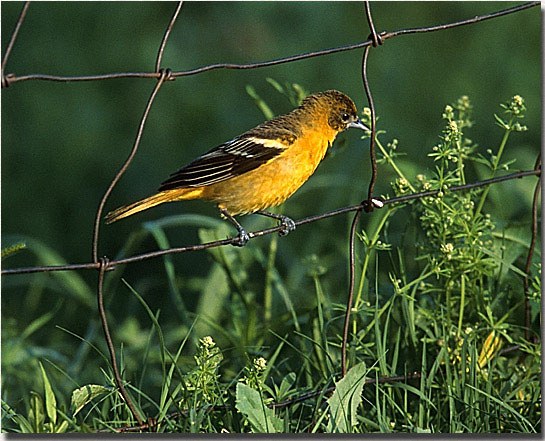
Baltimore Oriole
- Habitat
- Open deciduous woodland, riverside trees, parks, and shade trees near yards
- Size
- 7-8 in
- Lifespan
- Typically a few years in the wild; the oldest known banded individual on record lived over 11 years.
- Diet
- Insects, nectar, and fruit
About the Baltimore Oriole
The Baltimore Oriole is a strikingly colored songbird, with adult males showing flame-orange underparts and rump set off against a solid black head, back, and wings marked by a white wingbar. Females and immature males are more subdued, typically olive-brown above and yellow-orange below, sometimes with patches of black developing on the head as young males mature, and full adult male plumage is not typically reached until the bird's second year. Its clear, whistled song and its habit of weaving an unmistakable hanging, sock-shaped nest from plant fibers and grasses make it one of the more distinctive summer songbirds of eastern Oklahoma.
This species favors open woodland edges, especially tall deciduous trees along rivers and streams, as well as shade trees in parks and residential neighborhoods, where it often nests high in cottonwoods, elms, or maples. Its diet shifts seasonally: insects and caterpillars make up a large share of its food during the breeding season, especially for feeding nestlings, while ripe fruit and nectar become more important later in summer and during migration, which is why orange halves and grape jelly at backyard feeders reliably attract them each spring.
Baltimore Orioles are long-distance migrants, wintering from Mexico south through Central America and into northern South America before returning to the central and eastern United States, including Oklahoma, each spring, typically arriving in late April to early May and departing again by late summer once nesting is complete. The female alone weaves the nest, an intricately woven pouch that hangs from a slender outer branch, taking up to a week or more of gathering fibers, grass, and sometimes string or hair to complete. This hanging design helps protect eggs and young from many climbing predators, swaying safely out of reach at the end of a thin branch too flexible to support a snake or raccoon's weight.
Male orioles arrive on breeding grounds first and sing persistently to establish territory before pairing, and their bright plumage combined with a fluty, rich whistled song makes them one of the most eagerly anticipated arrivals of the Oklahoma spring migration season for birdwatchers. The song consists of a series of clear, liquid whistled phrases, distinct from the harsher chattering call both sexes give when agitated near the nest.
Across the Great Plains, including parts of western Oklahoma, the Baltimore Oriole's range meets that of the closely related Bullock's Oriole, and the two species interbreed in a narrow hybrid zone, producing offspring with intermediate plumage features from both parent species. The two were briefly considered a single species, the "Northern Oriole," before being split again based on genetic and behavioral evidence, and any oriole showing an unusual mix of the two patterns in the western part of the state is worth documenting carefully as a possible hybrid. Like many long-distance Neotropical migrants, Baltimore Oriole populations are influenced by conditions on both ends of their annual journey, and conservation groups have pointed to the loss of shaded, tree-covered coffee and cacao plantations in its wintering range as one likely contributor to gradual declines noted in some long-term surveys; shade-grown farms retain more of the canopy structure orioles and many other migratory songbirds rely on compared with sun-grown monocultures. Young males take more than a year to acquire their full black-and-orange adult plumage, and second-year males in transitional plumage can look notably patchy, sometimes prompting misidentification. After nesting is complete, adults undergo a complete molt before migration, and by the time they depart Oklahoma in later summer, both sexes look considerably duller and less conspicuous than during the peak of the breeding season, which combined with reduced singing can make them easy to overlook just before they leave.
Frequently asked questions
What does the Baltimore Oriole eat?
Insects and caterpillars during the breeding season, shifting toward ripe fruit and nectar in summer and migration.
Where can I see a Baltimore Oriole in Oklahoma?
In tall deciduous trees along rivers, in parks, and in neighborhoods with mature shade trees, especially during spring migration and summer.
How long do Baltimore Orioles live?
Most live only a few years, though the oldest banded individual on record reached over 11 years.
Is the Baltimore Oriole common in Oklahoma?
Yes, it's a regular and often conspicuous summer breeder and migrant across the eastern half of the state.
Does the Baltimore Oriole hybridize with other orioles?
Yes, where its range meets that of the Bullock's Oriole across the Great Plains, including parts of western Oklahoma, the two species interbreed and produce offspring with intermediate plumage.
Where to find it
This species favors forest habitat. See real Oklahoma locations on the Habitats map.