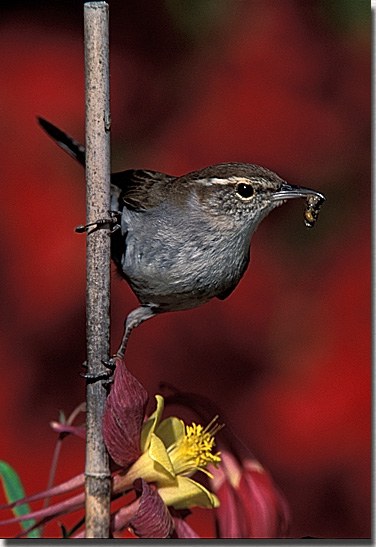
Bewick's Wren
- Habitat
- Brushy areas, thick undergrowth, clearings, gardens, orchards, fencerows, suburbs, stream edges, open scrubby woods, cactus/mesquite, chaparral
- Size
- 5.5 in
- Lifespan
- Usually lives around 5-6 years; the best-documented banding record reached 8 years.
- Diet
- Mostly insects, including spiders; forages along the ground and in trees
About the Bewick's Wren
Bewick's Wren is a slim, active little bird, gray-brown above and pale grayish-white below, with a bold white eyebrow stripe that stands out clearly against the darker crown. Its most distinctive feature is a long, fan-shaped tail edged in white spots, which the bird habitually flicks and waves from side to side as it forages, a movement that often catches the eye before the bird itself is spotted. At 5.5 inches, it is a touch larger and longer-tailed than the similar Carolina Wren, with a slimmer overall build and a noticeably thinner bill.
This wren favors brushy, scrubby habitat of many kinds: thick undergrowth, forest clearings, gardens, orchards, fencerows, suburban yards, streamside thickets, open scrubby woodlands, and in parts of its range cactus and mesquite country or chaparral. This flexibility across brushy habitat types, from humid stream edges to arid scrubland, has allowed Bewick's Wren to persist across a wide swath of the country even as it has declined or disappeared in parts of its historic eastern range. In Oklahoma the species is a widespread year-round resident, found in suitable brushy habitat across nearly the entire state in every season.
Almost entirely insectivorous, Bewick's Wren gleans spiders and insects from foliage, bark crevices, and leaf litter, foraging both low in shrubs and on the ground, poking its slightly downcurved bill into cracks and under debris in search of hidden prey. Its constant motion and habit of investigating every nook of brush piles and fencerows make it a particularly effective hunter of small invertebrates that larger, less agile birds would miss.
Named by John James Audubon in honor of the English naturalist and engraver Thomas Bewick, the species is also known for the male's habit of building several incomplete "dummy" nests in different cavities before the female chooses one to finish and lay in, a behavior shared with a few other wren species. The male's song is loud, clear, and remarkably variable, often described as more musical than that of many other wrens, and individual males may know dozens of distinct song variations, which they use to defend their territory year-round.
This eastern range contraction has been linked in part to competition with House Wrens, which are known to puncture or remove the eggs of cavity-nesting neighbors, including Bewick's Wren, from nearby nest sites, along with broader habitat changes across the eastern part of the historic range. Young males appear to learn their song repertoire in part by listening to neighboring adult males shortly after settling on a first territory, a process that produces regional song "dialects" documented in populations studied elsewhere in the species' range, so that birds from different areas can sound subtly different even while using recognizably similar song structure. Like many wrens, Bewick's Wren habitually holds its tail cocked upward over its back while foraging or perched, a jaunty posture shared with its Carolina Wren relative that adds to the bird's characteristically energetic appearance. Bewick's Wrens are cavity nesters of very flexible taste, readily using natural tree hollows, old woodpecker holes, nest boxes, and a wide range of artificial nooks around farms and homes, including crevices in stacked firewood, sheds, and abandoned equipment. Across its broad range the species shows notable geographic variation in plumage tone, with populations in humid coastal regions of the Pacific Northwest generally darker and richer brown than the paler, grayer birds found across the drier interior, including Oklahoma. Pairs tend to remain together on a shared territory across the year in milder parts of the range, and the male's loud, wide-ranging song serves both to guard that territory from rivals and to reinforce the pair bond through the seasons.
Frequently asked questions
How did Bewick's Wren get its name?
John James Audubon named it after Thomas Bewick, an English naturalist and engraver he admired.
What is a "dummy nest" in Bewick's Wrens?
Males build several incomplete, unused nests in different spots before the female selects and finishes just one for laying eggs.
How can you recognize a Bewick's Wren in the field?
Look for its bold white eyebrow and long, white-tipped tail, which it habitually flicks side to side while foraging.
What does a Bewick's Wren eat?
Almost entirely insects and spiders, gleaned from shrubs, bark, and leaf litter both near the ground and in low vegetation.
Does Bewick's Wren have regional song dialects?
Evidence from studied populations suggests young males learn song variations partly from neighboring adult males, producing subtle regional differences in song even though the overall song structure remains recognizable across the species' range.
Where to find it
This species favors forest habitat. See real Oklahoma locations on the Habitats map.