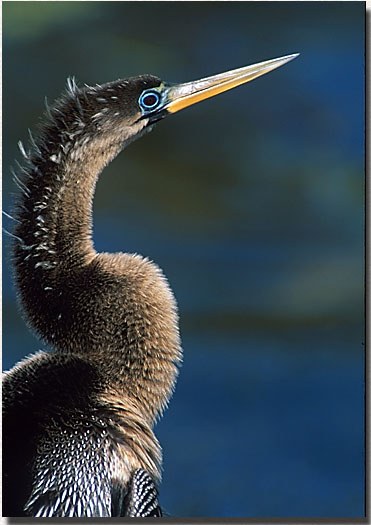
Anhinga
- Habitat
- Freshwater swamps, marshes, and slow-moving wooded rivers; a southeastern U.S. species, rare/local at the edge of its range in southeastern Oklahoma
- Size
- 32-36 in
- Lifespan
- Wild lifespan not precisely documented in accessible records; related waterbirds of similar size commonly live a decade or more.
- Diet
- Fish, speared underwater with its bill, plus some aquatic invertebrates
About the Anhinga
The Anhinga is a large, distinctive waterbird with a long, snake-like neck, a slim dagger-shaped bill, and a long fanned tail. Males are glossy black overall with silvery-white streaking on the upper wings and back, while females share the same pattern but have a pale buff or tan head and neck contrasting with a darker body. The bird's habit of swimming with its body submerged and only its thin head and neck above the waterline has earned it the nicknames "snakebird" and "water turkey." During courtship, the skin around the eye briefly turns a striking turquoise-blue, one of several breeding adornments that fade again once pairs have formed and nesting is underway.
Anhingas are tied to warm, quiet freshwater habitats—swamps, marshes, and slow rivers with overhanging trees—found throughout the southeastern United States and points south into the tropics. Rather than catching fish by grabbing with a hooked bill like a cormorant, an Anhinga swims underwater and impales its prey by rapidly thrusting its sharp bill forward, then surfaces, tosses the fish into the air, and swallows it head-first. Because their feathers are not fully waterproof, Anhingas must regularly perch with wings spread wide to dry after swimming, a familiar and photogenic pose.
Anhingas are also accomplished soarers, and on warm days they frequently ride thermals high overhead in loose groups, wings held flat and tail spread, a silhouette sometimes mistaken from a distance for a small raptor rather than a waterbird. This soaring habit sets them apart from most other water birds and lets them cover long distances between wetlands with little effort, particularly useful during seasonal movements when water levels change and birds shift to more productive fishing sites.
In Oklahoma, the Anhinga is found chiefly in wooded wetlands of the southeastern part of the state, at the northwestern fringe of a range centered on the Gulf Coast and Southeast, making it an uncommon and local species rather than a widespread one. Anhingas nest in colonies, often alongside herons and egrets, building stick platforms in trees over or near water, and both parents share incubation and chick-rearing duties, typically raising two to four young that are fed by regurgitation directly into the nest.
Anhingas are often confused at a distance with the Double-crested Cormorant, another dark waterbird that shares similar habitat and the same wing-drying posture, but the Anhinga's slimmer profile, straight dagger-like bill, and longer, more fan-shaped tail distinguish it from the cormorant's thicker, hook-tipped bill and shorter tail. The same reduced feather waterproofing that helps them swim with their body submerged forces them to spend real time each day drying out, a trade-off that shapes much of their daily behavior and makes them easy to spot perched with wings outstretched near the water's edge. Juvenile Anhingas resemble adult females, with a pale buffy head, neck, and underparts that gradually darken as the bird matures over its first couple of years. Like some other water birds adapted to warm climates, Anhingas can cool themselves through gular fluttering, rapidly vibrating the throat area to dissipate heat on hot days, a technique that supplements simple panting. The species sometimes forages in loose association with wading birds and even alligators, which can stir up fish while moving through shallow water, giving nearby Anhingas an easier opportunity to spear disturbed prey. Anhinga populations are not considered to be of major conservation concern at a continental scale, though the species remains sensitive to the loss and degradation of the quiet, wooded wetlands it depends on for both feeding and colonial nesting.
Frequently asked questions
What does the Anhinga eat?
Primarily fish, which it spears underwater with its sharp bill before surfacing to swallow them.
Where can I see an Anhinga in Oklahoma?
Mainly in wooded swamps and slow rivers of southeastern Oklahoma, at the edge of the species' Gulf Coast/Southeast range.
How long do Anhingas live?
Precise figures are limited, but similar-sized waterbirds commonly live a decade or longer in the wild.
Is the Anhinga common in Oklahoma?
No, it's uncommon and local, found only in a limited area of southeastern wetlands.
How is the Anhinga different from a cormorant?
Anhingas have a slimmer body, a straight dagger-shaped bill, and a longer fan-shaped tail, while cormorants have a thicker hook-tipped bill and a shorter tail, though both species share the habit of drying their wings spread open after swimming.
Where to find it
This species favors wetland habitat. See real Oklahoma locations on the Habitats map.