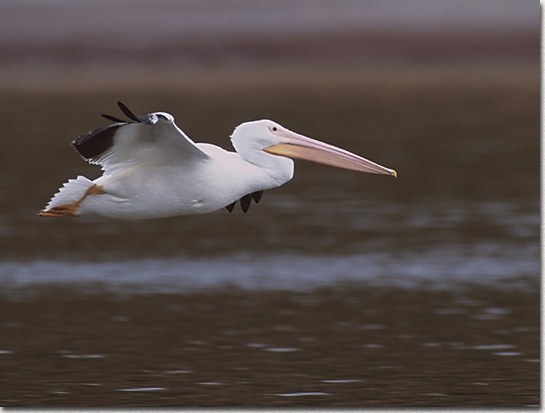
American White Pelican
- Habitat
- Lakes, ponds, and coastal waters in winter; breeds on isolated islands in inland lakes; usually in flocks
- Size
- 50–70 in
- Lifespan
- Often lives well past 16 years in the wild; the oldest documented bird reached about 26 years.
- Diet
- Mostly fish, occasionally salamanders or crayfish — roughly 3 lbs a day; swims and submerges its head to catch fish, sometimes cooperatively with other pelicans
About the American White Pelican
Among the largest birds found in Oklahoma, the American White Pelican measures an impressive 50 to 70 inches in length, with a wingspan to match, and is unmistakable in flight thanks to its all-white body offset by sharply contrasting black flight feathers along the trailing edge and tips of the wings. Its long, flat, orange-yellow bill and expandable throat pouch are used for scooping up fish rather than the spearing stab of a heron. During the breeding season, adults develop a peculiar flattened, horny plate on the upper bill and a short shaggy crest on the back of the head, both of which are shed once breeding is complete.
These pelicans breed colonially on isolated, predator-free islands in inland lakes, often far from the wintering grounds they'll use later in the year along lakes, ponds, and coastal waters. In Oklahoma they are most often seen as migrants or winter visitors on the state's larger reservoirs, typically in tight flocks that swim, feed, and fly together in coordinated lines or V-formations.
Fish make up the overwhelming majority of the diet, with salamanders and crayfish taken only occasionally, and an adult pelican may consume roughly three pounds of food in a day. Unlike the Brown Pelican, which plunge-dives from the air, the American White Pelican feeds while swimming, dipping its head and bill underwater to scoop up prey; groups of pelicans will sometimes cooperate, forming a line or semicircle to herd fish into shallow water where they become easier to catch, a rare example of coordinated group hunting among birds.
Generally a quiet bird, the American White Pelican rarely vocalizes outside the breeding colony. Breeding pairs typically lay two eggs, but sibling rivalry in the nest is often severe: the second-hatched chick is frequently outcompeted and harassed by its older, larger sibling for food, and in many nests it does not survive, a harsh but well-documented feature of the species' reproductive strategy. Despite this early mortality risk, individuals that reach adulthood tend to be long-lived, commonly surviving past 16 years, with the oldest banded bird on record reaching about 26. Colonies can number in the hundreds or even thousands of pairs on a single island, and disturbance from people or predators can cause panicked adults to trample eggs and chicks in a mass flush, which is why active pelican breeding islands are typically kept off-limits to visitors.
Frequently asked questions
Does the American White Pelican dive for fish like the Brown Pelican?
No, it feeds while swimming on the surface, dipping its bill and head underwater rather than plunge-diving from the air.
What is the odd bump on a pelican's bill in spring?
Breeding adults grow a flattened, horny plate on the upper bill along with a short crest, both shed after the breeding season.
Do American White Pelicans hunt together?
Yes, groups sometimes form a line to herd fish into shallow water, a cooperative technique that makes catching prey easier.
Do both pelican chicks in a nest usually survive?
Often not — the second chick is frequently outcompeted for food by its older sibling and does not survive.
Where to find it
This species favors wetland habitat. See real Oklahoma locations on the Habitats map.