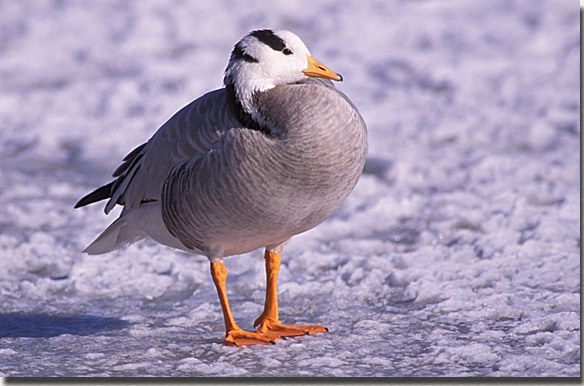
Bar-headed Goose
- Habitat
- Native to high-altitude lakes and wetlands of Central Asia; in North America occurs only as an escapee from captive waterfowl collections, not as a wild population
- Size
- 27-30 in
- Lifespan
- In captivity, individuals commonly live 15-20 years or more; wild lifespan is less thoroughly documented in accessible sources.
- Diet
- Grasses, grains, and aquatic plants
About the Bar-headed Goose
The Bar-headed Goose is a distinctive, pale gray goose named for the two dark horizontal bars crossing the back of its white head, paired with an orange bill and orange-yellow legs. It is a native of Central Asia, breeding on high mountain lakes of the Tibetan Plateau and surrounding regions and wintering on lowland wetlands of the Indian subcontinent. At around 28 inches long, it is a mid-sized goose, somewhat smaller and paler overall than the Canada Geese it is sometimes seen mixing with in captivity or in escaped flocks. This species has no natural range in North America, and any bird seen in Oklahoma or elsewhere in the United States is essentially certain to be an escapee or descendant of escapees from a zoo, park, or private waterfowl collection rather than a genuinely wild vagrant.
In its native range, the Bar-headed Goose feeds on grasses, sedges, grains, and other plant material, grazing much like other geese on open ground near water. It is world-famous among ornithologists for one extraordinary trait unrelated to its Oklahoma occurrence: during migration it crosses the Himalayas at extreme altitudes, with documented flights well above 20,000 feet, among the highest sustained flight altitudes recorded for any bird, aided by unusual physiological adaptations for extracting oxygen from thin air. Researchers studying the species have found that its hemoglobin binds oxygen more efficiently than that of most other birds, along with proportionally larger lungs and other adaptations that together let its flight muscles keep working in air so thin that most other birds, and most mammals, would quickly become incapacitated.
This astonishing capability evolved to solve a very specific problem: the most direct migratory path between its Central Asian breeding lakes and its Indian wintering grounds crosses directly over the Himalayan range, and rather than detouring around the mountains, Bar-headed Geese fly straight over them, often completing the crossing within a single extended flight. Flocks are known to time their crossings to take advantage of favorable winds and often fly at night or in the early morning when air turbulence over the peaks is lower.
Because the species is not part of North America's native avifauna, Bar-headed Geese here are typically found in captive collections at zoos, aviaries, and private waterfowl breeders, and free-flying individuals sometimes join flocks of Canada Geese on park ponds or lakes, including occasional reports from Oklahoma. Such birds should be understood as escaped or released captives rather than natural range extensions, and their presence does not indicate any change in the species' true wild distribution.
In captivity, Bar-headed Geese are hardy and long-lived, often breeding readily in aviary settings, and they are commonly kept as an ornamental waterfowl species because of their striking head pattern and generally calm temperament around other birds. In their native range, the species is generally considered to be of lower conservation concern than many other Asian waterfowl, though it faces ongoing pressure from wetland loss and hunting along parts of its migratory route, and its dramatic high-altitude flights continue to attract scientific interest into the physiological limits of vertebrate flight. Taxonomically, the Bar-headed Goose belongs to the genus Anser, the group that includes most of the world's true gray geese, and its closest relatives are found across temperate Eurasia rather than in the Americas. Because it is not part of the natural avifauna of Oklahoma or any other U.S. state, birding record-keeping organizations and databases typically flag Bar-headed Goose sightings as provenance-uncertain or exclude them from official state or countable lists unless clear evidence of natural vagrancy can somehow be established, which in practice essentially never happens given the enormous distance and mountain barriers separating its native range from North America.
Frequently asked questions
What does the Bar-headed Goose eat?
Grasses, grains, and other plant material, grazed from open ground near water.
Where can I see a Bar-headed Goose in Oklahoma?
Only as an occasional escapee mixed in with Canada Goose flocks on park ponds or lakes; it has no natural wild population in the state or anywhere in North America.
How long do Bar-headed Geese live?
In captivity they commonly live 15-20 years or more; wild lifespan data from their native Asian range is less well documented in accessible sources.
Is the Bar-headed Goose common in Oklahoma?
No, any sighting represents an escaped or released captive bird, not a wild population.
How does the Bar-headed Goose survive flying so high?
It has hemoglobin that binds oxygen unusually efficiently along with proportionally larger lungs, adaptations that let its flight muscles keep working in the thin air found at extreme Himalayan altitudes.
Where to find it
This species favors wetland habitat. See real Oklahoma locations on the Habitats map.