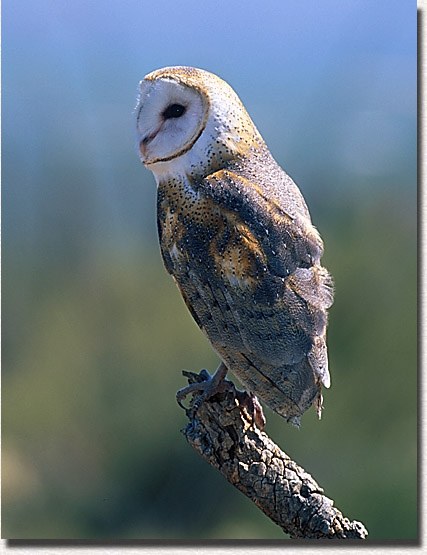
Barn Owl
- Habitat
- Open farmland, grasslands, and pastures; nests in barns, silos, tree cavities, and nest boxes
- Size
- 13-16 in
- Lifespan
- Wild mortality is high, with many individuals surviving only 1-4 years; banding records document a few individuals reaching over a decade.
- Diet
- Almost exclusively small rodents such as voles, mice, and rats
About the Barn Owl
The Barn Owl is one of the most recognizable owls in the world, identified by its pale, heart-shaped facial disc rimmed in a thin dark border, golden-buff and gray upperparts finely speckled with black and white, and clean white to buffy underparts. It has dark, forward-facing eyes set within that distinctive facial disc, which functions like a satellite dish to funnel sound toward its ears, and its silent, buoyant flight is made possible by specialized soft-fringed flight feathers that muffle the sound of air moving over the wings. Unusually, its two ear openings are positioned asymmetrically on the skull, one slightly higher than the other, which helps the owl pinpoint the vertical origin of a sound as well as its horizontal direction, sharpening its already remarkable ability to hunt in total darkness.
This species favors open country—hayfields, pastures, and grasslands—where it hunts almost entirely by sound, flying low over fields at dusk and through the night listening for the rustle of small mammals in grass. Its hearing is so precise that it can locate and capture prey in complete darkness using sound alone. Nearly its entire diet consists of small rodents, especially voles and mice, making it an important natural check on agricultural pest populations; a single family can consume many hundreds of rodents over a breeding season.
Barn Owls do not build stick nests but instead lay their eggs directly on debris or pellets in dark cavities: hollow trees, cliff crevices, abandoned buildings, silos, and, especially in farm country, barns and specially built nest boxes, which the species readily accepts and which have become an important conservation tool. Clutch size and breeding success are closely tied to rodent abundance, and pairs may raise unusually large broods, sometimes six or more chicks, in years when prey is plentiful, sometimes attempting a second brood; in leaner years clutches shrink accordingly, making the species one of the more responsive breeders to fluctuating food supply among North American owls.
The Barn Owl is also one of the most widely distributed land birds on Earth, with close relatives or the same species complex found on every continent except Antarctica, a testament to how effectively its hunting strategy and nesting flexibility travel across very different landscapes. Its voice is equally distinctive: rather than the hooting typical of many owls, it gives an eerie, drawn-out, raspy screech, often startling to people unfamiliar with it, along with hisses and bill-snapping used defensively at the nest.
Because the species is sensitive to cold, wet winters and to the loss of both open hunting ground and nest cavities, Barn Owl numbers can fluctuate regionally, but the species remains widespread across Oklahoma's farmland and rural landscapes, most often detected by its eerie, raspy screech rather than a hoot. Conservation programs across the farm belt, including in Oklahoma, have promoted nest box installation as a low-cost way to support Barn Owl populations while providing farmers with natural rodent control, a mutually beneficial relationship that has helped sustain the species even as old barns and hollow trees have become scarcer across the modern agricultural landscape. Like other owls, Barn Owls regurgitate the indigestible fur and bones of their prey as compact pellets, and biologists and students alike commonly dissect these pellets to reconstruct a remarkably detailed picture of the local rodent community an owl has been hunting. Vehicle collisions are a significant source of mortality for the species, since low, open roadside verges attract hunting owls at dusk and through the night, right along roads carrying fast-moving traffic. Despite these hazards, the Barn Owl's global success as a species reflects a highly effective combination of acute low-light vision, silent flight, and hearing precise enough to strike prey it cannot see at all, a combination unmatched by most other predatory birds.
Frequently asked questions
What does the Barn Owl eat?
Almost exclusively small rodents like voles and mice, hunted by sound over open fields at night.
Where can I see a Barn Owl in Oklahoma?
In rural farmland and grasslands statewide, often nesting in barns, silos, or nest boxes; it's more often heard than seen.
How long do Barn Owls live?
Many die within their first few years in the wild, though banded individuals have been recorded living over a decade.
Is the Barn Owl common in Oklahoma?
It's a fairly widespread year-round resident of farm country, though its nocturnal and secretive habits make it easy to overlook.
Why doesn't the Barn Owl hoot like other owls?
Instead of hooting, it gives an eerie, drawn-out, raspy screech, a very different and often startling sound compared to the hoots typical of many other owl species.
Where to find it
This species favors grassland habitat. See real Oklahoma locations on the Habitats map.