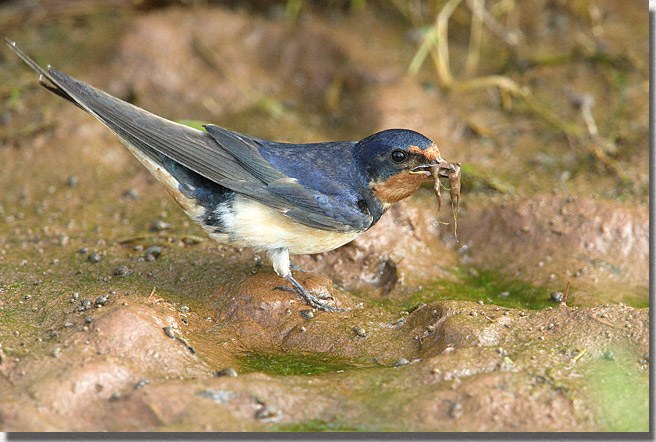
Barn Swallow
- Habitat
- Open country near barns, bridges, culverts, and other structures used for nesting; forages over fields, water, and open ground
- Size
- 6-7 in
- Lifespan
- Typically a few years in the wild; banding records include individuals living close to a decade.
- Diet
- Flying insects caught in the air
About the Barn Swallow
The Barn Swallow is a sleek, agile songbird known for its long, deeply forked tail—the most pronounced tail fork of any North American swallow—paired with a steel-blue back, wings, and crown, and warm rust to buff underparts and forehead. In flight it appears as a swift, streamlined shape skimming low over fields, water, and roadsides, chasing insects with quick, banking turns. The length of the outer tail streamers is thought to function as a signal of quality to potential mates, and research on the species elsewhere in its range has linked longer, more symmetrical streamers in males to earlier pairing and greater reproductive success.
This is one of the most widespread swallow species in the world, breeding across most of the Northern Hemisphere and wintering into South America, Africa, and parts of Asia and Australia depending on the population. In North America it is closely tied to human structures for nesting: barns, sheds, bridges, culverts, and highway overpasses provide sheltered ledges where the birds build open cup nests of mud pellets mixed with grass, often lined with feathers. Before European settlement the species nested mainly in caves and on cliff faces, and it has since adapted almost entirely to artificial structures across most of its range, including farms and rural buildings throughout Oklahoma.
Barn Swallows feed exclusively on flying insects captured on the wing, foraging low over fields, ponds, and grassy areas, and their presence often signals healthy local insect populations. They are long-distance migrants, breeding across most of North America in summer and wintering as far south as central Argentina, one of the longest migratory journeys undertaken by any songbird in the hemisphere.
Pairs are often socially monogamous and may nest alone or in loose colonies where suitable structures allow multiple nests nearby; both parents feed the nestlings, and pairs frequently raise two broods in a season, sometimes reusing and simply refurbishing the same mud nest from a previous year rather than building entirely from scratch. Building or repairing a nest requires hundreds of individual trips carrying small mud pellets, usually gathered from puddle edges or muddy shoreline, mixed with grass fibers and applied in layers that dry and harden into a sturdy cup capable of supporting a growing brood.
Because they nest so readily on buildings, Barn Swallows are among the most familiar and closely observed birds of the rural Oklahoma summer, their twittering song and swooping flight a common sight around farms, barns, and lake marinas from spring through late summer. Their close association with human structures has made them, along with House Sparrows and a handful of other species, one of the few songbirds to genuinely thrive because of, rather than despite, agricultural development, though the availability of open barns and outbuildings suited to nesting has declined somewhat as older farm structures are replaced with sealed metal buildings less hospitable to nesting swallows. Before undertaking their long southbound migration, Barn Swallows often gather into large pre-migration roosts in reedbeds or similar dense vegetation, sometimes alongside other swallow species, feeding heavily beforehand to build the fat reserves needed for the journey ahead. Juveniles differ from adults in showing shorter, less deeply forked tails and a paler, less glossy back, features that fill out fully only after their first complete molt. Broad-scale population trends for the Barn Swallow have shown some decline in recent decades across parts of its range, a pattern attributed by researchers to a combination of reduced flying-insect abundance and the loss of traditional open farm structures suitable for nesting, even as the species remains common and widespread across Oklahoma today.
Frequently asked questions
What does the Barn Swallow eat?
Exclusively flying insects, caught in mid-air during low, swooping flight over fields and water.
Where can I see a Barn Swallow in Oklahoma?
Around barns, bridges, and farm buildings statewide from spring through late summer, where it builds mud nests on ledges.
How long do Barn Swallows live?
Typically a few years, with some banded individuals documented living close to a decade.
Is the Barn Swallow common in Oklahoma?
Yes, it's a common and widespread summer breeding bird wherever suitable nesting structures are available.
Why do Barn Swallows have such long, forked tails?
The tail streamers, especially in males, appear to function as a signal of quality to potential mates, with longer and more symmetrical streamers linked to earlier pairing success in studied populations.
Where to find it
This species favors grassland habitat. See real Oklahoma locations on the Habitats map.