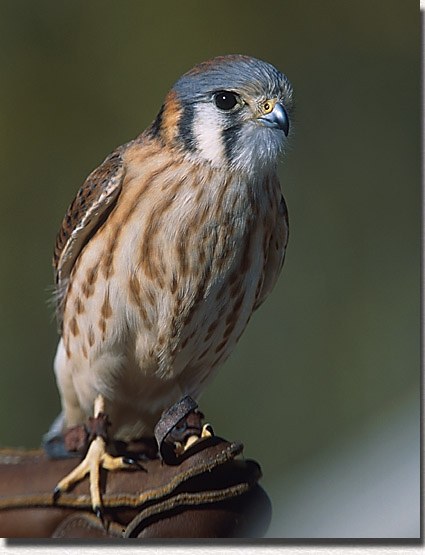
American Kestrel
- Habitat
- Woodland borders, farmlands, open fields, pastures with scattered trees, marshes, suburban areas, grasslands, arid plains
- Size
- 9–12 in, jay-sized falcon
- Lifespan
- Typically survives under 5 years in the wild, though the oldest known bird reached almost 15 years.
- Diet
- Mostly small vertebrates, some insects, occasionally birds
About the American Kestrel
The American Kestrel is North America's smallest falcon, roughly jay-sized at 9 to 12 inches, but it packs striking color into that small frame. Males show slate-blue wings contrasting with a rufous back and tail, while females carry rufous-brown wings and back instead; both sexes display a rufous crown patch and two bold black vertical stripes on each side of the face, a pattern sometimes likened to a pair of painted "sideburns." Its old nickname, "Sparrow Hawk," reflects both its small size and its historical, if somewhat inaccurate, reputation as a hunter of small birds. A pair of dark false eyespots on the back of the head may help deter attacks from other predators by giving the impression the bird is watching in both directions at once.
Kestrels are birds of open country, favoring woodland borders, farmland, pastures dotted with scattered trees, grasslands, arid plains, marshes, and even suburban areas with enough open ground for hunting. They are a familiar sight across Oklahoma perched on roadside utility wires and fence posts, scanning the grass below, and readily use nest boxes as substitutes for the natural tree cavities they prefer, which has helped the species adapt well to human-altered landscapes. Kestrel populations have nonetheless declined in parts of the eastern United States in recent decades, a trend researchers attribute partly to a loss of open foraging habitat and competition for nest cavities with introduced starlings.
Small vertebrates make up the bulk of the diet — mice, voles, small snakes, and lizards — supplemented by large insects like grasshoppers and, less often, small birds. One of the kestrel's signature hunting techniques is hovering in place on rapidly beating wings above open ground, head held remarkably steady, before dropping onto prey detected below; it also hunts from a perch, watching for movement and diving down in a short, controlled stoop. Kestrels can see in the ultraviolet range, and since fresh vole urine trails reflect UV light, this sensory ability may help the birds locate rodent-rich hunting grounds simply by scanning for the trails from above.
A telltale habit that helps identify a perched kestrel at a distance is its tail-pumping: immediately after landing, it bobs its tail up and down several times, a behavior shared by few other raptors of similar size. Kestrels nest in cavities rather than building nests of their own, relying on old woodpecker holes, natural tree hollows, and nest boxes, and despite modest average lifespans in the wild — often under five years — banding records show individuals can survive close to fifteen. Kestrels also cache surplus prey, tucking a freshly caught mouse or grasshopper into a clump of grass or a tree cavity to retrieve later, a habit that helps them ride out short stretches of poor hunting weather.
Adult kestrels themselves fall prey to larger raptors such as Cooper's Hawks, Sharp-shinned Hawks, and Great Horned Owls, and the species' preference for open perches, while useful for hunting, can also expose it to ambush from these bigger predators. Kestrels give a sharp, repeated "klee-klee-klee" call, most often heard during territorial disputes or when a pair reunites at the nest site, a vocalization distinct enough that many birders learn to recognize a kestrel by ear before ever spotting the bird itself. Concern over regional population declines has spurred large-scale nest box programs across parts of the kestrel's range, including citizen-science monitoring efforts that track occupancy and breeding success, since the species readily accepts an appropriately sized box as a substitute for a natural cavity, and such programs have become one of the more successful grassroots approaches to supporting a declining raptor.
Frequently asked questions
Why is the American Kestrel called the 'Sparrow Hawk'?
It's an old nickname reflecting both its small size and its reputation, not entirely accurate, as a hunter of small birds.
How does the American Kestrel hunt?
It often hovers in place over open ground on fast-beating wings before dropping onto prey, and also hunts by watching from a perch.
What does it mean when a kestrel pumps its tail?
Bobbing the tail up and down right after landing is a characteristic kestrel behavior useful for identifying the species at a distance.
Where do American Kestrels nest?
They don't build their own nests, instead using natural tree cavities, old woodpecker holes, or nest boxes provided by people.
Can kestrels see things humans can't while hunting?
Yes, they can see ultraviolet light, which may help them spot UV-reflective vole urine trails and locate rodent-rich hunting areas from the air.
Where to find it
This species favors grassland habitat. See real Oklahoma locations on the Habitats map.