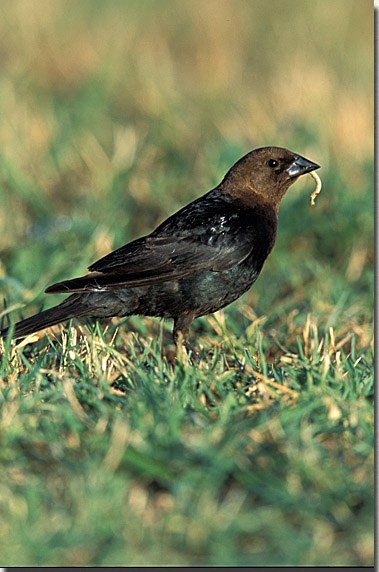
Brown-headed Cowbird
- Habitat
- Open grassland, farmland, and forest edges, often near grazing livestock
- Size
- 7.5-8.7 in
- Lifespan
- Banding records show individuals living to at least 16 years, though most survive far fewer years in the wild.
- Diet
- Seeds, grain, and insects, often foraged on the ground near grazing animals
About the Brown-headed Cowbird
Male Brown-headed Cowbirds have a glossy black body with subtle greenish iridescence, contrasting with a solid brown head, while females are a plain grayish-brown overall, sometimes mistaken for a female blackbird or large sparrow. Both sexes have a short, conical, finch-like bill well suited to a seed-heavy diet, and the species is noticeably smaller and more compact than the true blackbirds it often flocks with. Males perform a distinctive courtship display, fluffing out their body feathers, spreading the wings and tail, and bowing forward while giving a bubbling, liquid song, a performance given to multiple females across a breeding season rather than to a single mate.
The species is common and widespread across Oklahoma in open country, farmland, prairie, and edge habitat, and is often seen walking on lawns and pastures. Historically it followed roaming bison herds across the Great Plains, feeding on insects and seeds stirred up by the animals as they grazed; as forests were cleared and cattle replaced bison across the continent, the cowbird expanded its range dramatically eastward and is now found nearly coast to coast, well beyond its original prairie range.
It forages on the ground for seeds and grain, and for insects flushed by the movement of grazing cattle, a foraging habit directly descended from its bison-following ancestry. It will also pick ticks and other insects directly from the backs and legs of livestock, and readily joins mixed flocks of blackbirds and starlings outside the breeding season, sometimes numbering in the thousands at winter roosts.
The Brown-headed Cowbird is unique among most North American birds for its total reliance on brood parasitism: it never builds a nest of its own, and does not incubate or raise its own young directly. Instead, a female may lay dozens of eggs across a season, often one per day, in the nests of other birds, leaving all incubation and chick-rearing to unwitting host parents. Rather than mimicking any single host's egg pattern the way cuckoos in other parts of the world sometimes do, cowbird eggs are generalist in appearance, whitish and finely speckled, an approach that works across a very broad range of host species rather than specializing narrowly on one. More than 200 species of North American birds have been documented raising cowbird young, from tiny warblers to birds many times the cowbird's own size, and because cowbird chicks often hatch first and grow quickly, they frequently outcompete host chicks for food, sometimes significantly reducing the host species' own reproductive success in heavily parasitized populations.
Some host species have evolved defenses in response, such as recognizing and ejecting foreign eggs or abandoning a parasitized nest to start over, while others show little or no ability to detect the intrusion at all. Female cowbirds are thought to actively watch and remember the locations of other birds' nests during the building stage, timing their own egg-laying visit to coincide with a brief window when the host is away, and a single female may parasitize a dozen or more different nests across a season. Because certain rare or declining songbirds, such as the Black-capped Vireo and Kirtland's Warbler, have proven especially vulnerable to heavy cowbird parasitism, targeted cowbird trapping and removal programs have been used in some parts of the cowbird's range as part of broader efforts to help those host species recover.
Frequently asked questions
Why does the Brown-headed Cowbird lay eggs in other birds' nests?
It's an obligate brood parasite, a strategy likely tied to its ancestral habit of following roaming bison herds, which made staying at a fixed nest site impractical.
Does cowbird parasitism harm other bird species?
It can, especially for small songbirds, since a cowbird chick often outcompetes host young for food, though the impact varies widely by host species and population.
How many host species does it parasitize?
More than 200 species of North American birds have been documented raising cowbird young.
Do Brown-headed Cowbirds migrate?
Northern populations migrate south for winter, while many Oklahoma birds are present year-round or make only short-distance movements.
How does a female cowbird find nests to parasitize?
She is thought to quietly watch other birds building nests and remembers their locations, then returns to lay an egg during a brief window when the host parents are away.
Where to find it
This species favors grassland habitat. See real Oklahoma locations on the Habitats map.