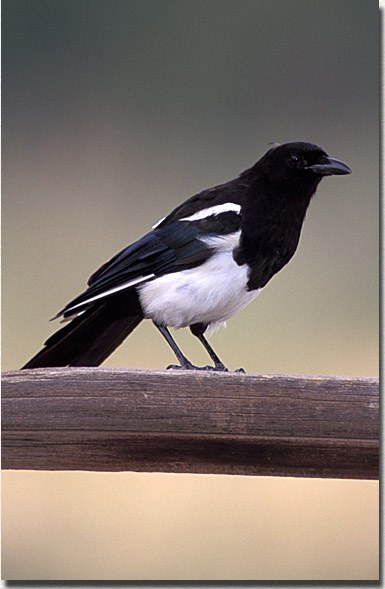
Black-billed Magpie
- Habitat
- Open country with scattered trees, shrubby draws, and ranchland; a western Great Plains species reaching Oklahoma mainly in the panhandle and far northwest
- Size
- 18-24 in (including a long, graduated tail)
- Lifespan
- Not extensively documented; comparable corvids often live several years in the wild, with some banding records extending into double digits.
- Diet
- Omnivorous: insects, carrion, small animals, grain, and fruit
About the Black-billed Magpie
The Black-billed Magpie is a strikingly patterned corvid with bold black-and-white plumage set off by an iridescent green-blue sheen visible on the wings and tail in good light. Its most obvious feature is an extremely long, graduated tail that makes up nearly half of its total length of 18 to 24 inches, giving the bird a distinctive silhouette in flight and at rest that is unlike any other bird sharing its range. Like other magpies, it is considered among the most intelligent birds studied; in research on the closely related Eurasian Magpie, individuals have shown the ability to recognize themselves in a mirror, a capacity for self-recognition otherwise documented in very few animal groups.
This is a bird of open, semi-arid country with scattered trees—ranchland, river-bottom groves, and shrubby draws across the western Great Plains, Rocky Mountain foothills, and Great Basin. It is a highly opportunistic omnivore, eating insects, small mammals, carrion (including roadkill), grain, and fruit, and it will readily gather at livestock operations to feed on insects stirred up by grazing animals or to pick at carcasses, sometimes landing directly on the backs of cattle or deer to pick off ticks and other parasites.
In Oklahoma, the Black-billed Magpie reaches only the westernmost edge of its range, occurring uncommonly in the panhandle and adjacent northwestern parts of the state, and it is absent or very rare across the rest of Oklahoma.
Where established, magpies are highly social and intelligent, often gathering in flocks outside the breeding season, and pairs build large, conspicuous domed stick nests with a roofed dome and side entrance, sometimes reused or repaired across multiple years and taking weeks of steady work to construct; the enclosed design offers protection from both weather and predators for the eggs and nestlings inside. Their vocal repertoire includes harsh chattering calls used for group communication, along with a variety of other calls used to signal alarm or coordinate with other magpies nearby.
Like American Crows, magpies are members of the corvid family and share a similar vulnerability to West Nile virus, which has caused documented declines in some regional magpie populations since the virus became established in North America. Their close association with livestock and carrion has made them a familiar sight around ranches throughout the western Great Plains, even as their range barely touches Oklahoma's far northwest corner, and their large, obvious nests are often one of the easiest ways to confirm the species' presence in an area even when the birds themselves are not immediately visible. Like many corvids, Black-billed Magpies cache surplus food for later use, tucking away items in shallow holes in the ground or under debris and, in some documented cases, appearing to remember and even relocate caches when they suspect another bird has been watching them hide food, a level of apparent social awareness that has drawn considerable interest from researchers studying corvid cognition. The magpie's extraordinarily long tail likely serves both as a balance aid during its varied foraging movements and as a visual signal used in social and courtship displays, since related magpie species elsewhere are known to use tail posture as part of status and communication among flock members. Historically, Black-billed Magpies were sometimes persecuted by ranchers concerned about their opportunistic feeding on livestock carcasses and occasional predation of the eggs and nestlings of other birds, though the species is now generally recognized as a normal and largely beneficial part of the rangeland ecosystems it inhabits, providing a natural cleanup service around carcasses and livestock operations.
Frequently asked questions
What does the Black-billed Magpie eat?
A wide variety of foods including insects, small animals, carrion, grain, and fruit.
Where can I see a Black-billed Magpie in Oklahoma?
Only in the far western panhandle and adjacent northwest, at the very eastern edge of its Great Plains range; it's absent from most of the state.
How long do Black-billed Magpies live?
Specific figures are limited, but this social corvid often lives several years in the wild, with some records extending into double digits.
Is the Black-billed Magpie common in Oklahoma?
No, it's uncommon and restricted to the state's far western edge.
How intelligent is the Black-billed Magpie?
Magpies are considered among the most intelligent birds studied; research on the closely related Eurasian Magpie has shown individuals can recognize themselves in a mirror, a rare ability among animals generally.
Where to find it
This species favors grassland habitat. See real Oklahoma locations on the Habitats map.