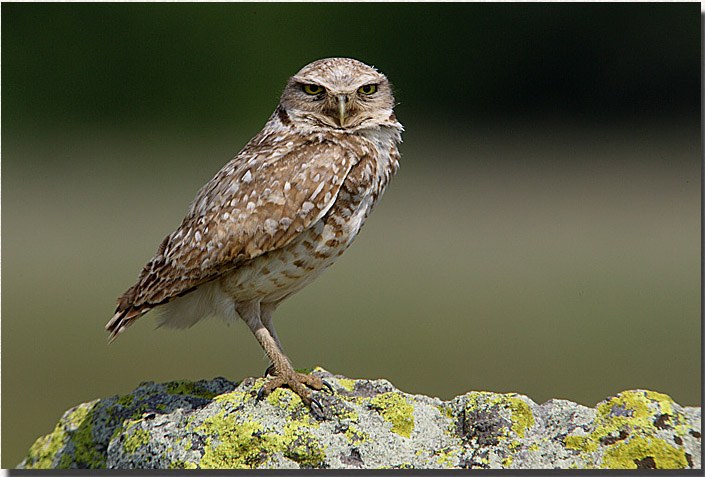
Burrowing Owl
- Habitat
- Open grassland, prairie, and agricultural fields with existing ground burrows for nesting
- Size
- 9-11 in
- Lifespan
- Typically 6-8 years in the wild; the oldest documented individual was almost 10 years old (9 years, 11 months) when reported in California.
- Diet
- Large insects, small rodents, and occasionally small birds or reptiles
About the Burrowing Owl
The Burrowing Owl is a small, long-legged owl with a rounded head lacking ear tufts, bright yellow eyes, and sandy-brown plumage marked with white spotting and barring across the body. It often stands upright on the ground, on a fence post, or on a low mound near its burrow entrance, bobbing its head visibly when alarmed and sometimes extending its legs to appear taller as a threat display.
In Oklahoma it occurs mainly in the western half of the state in shortgrass prairie, pasture, and agricultural land with abundant mammal burrows, historically those of prairie dogs, along with ground squirrels and badgers. Rather than digging its own burrow from scratch, it typically adopts and sometimes enlarges an existing one, occasionally forming loose colonies where burrow density is high. Populations have declined across the Great Plains alongside efforts to control prairie dog colonies, which remove the burrows the owl depends on, making habitat availability the central conservation issue for the species in the region.
Unusually for an owl, the Burrowing Owl is often active by day, hunting from low perches or on foot as well as at dusk and after dark, a trait shared by few other North American owls. It takes large insects such as grasshoppers and beetles, especially in warmer months, along with small mammals and occasionally small birds or amphibians, sometimes running down prey on foot across open ground rather than relying solely on flight, and caching surplus prey inside the burrow for later use.
It nests underground, laying as many as a dozen eggs deep within the burrow, one of the largest clutch sizes among North American owls. One especially interesting habit is lining the burrow entrance and chamber with dried livestock manure, likely both to mask the scent of the owls and eggs from predators and to attract dung beetles as an additional, convenient food source close to the nest. Young owls in the burrow can also produce a rattlesnake-like rattling or hissing sound when threatened, a defense that likely deters animals from digging into the nest to investigate. Both parents help raise the brood, with the male generally handling most hunting duties while the female stays close to the burrow, and juveniles disperse from the natal burrow after several weeks once they've learned to fly and hunt on their own.
Frequently asked questions
Does the Burrowing Owl dig its own burrow?
Usually not; it typically takes over a burrow already dug by a prairie dog, ground squirrel, or badger.
Why is it active during the day?
Unlike most owls, Burrowing Owls frequently hunt in daylight, especially around dawn and dusk, though they hunt at night as well.
Why does it line its burrow entrance with manure?
Researchers believe dried dung helps mask scent from predators and attracts dung beetles, providing an additional food source.
Is the Burrowing Owl declining?
Yes, populations have dropped in many areas as prairie dog colonies, which provide the burrows it depends on, have been reduced through control programs and habitat conversion.
Where to find it
This species favors grassland habitat. See real Oklahoma locations on the Habitats map.