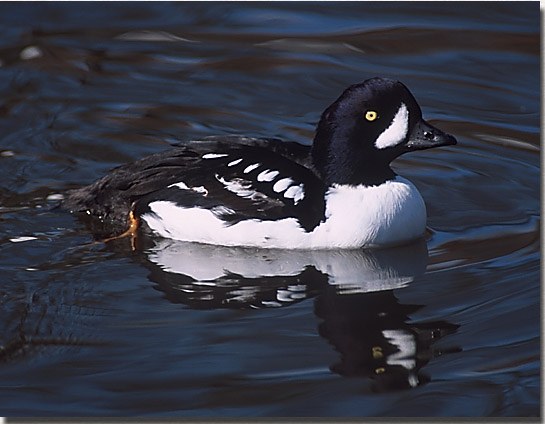
Barrow's Goldeneye
- Habitat
- Mountain lakes and ponds in the west (breeding); coastal bays and inland lakes/rivers in winter — a rare, irregular winter visitor in Oklahoma
- Size
- 16-18 in
- Lifespan
- Not well documented in accessible records; related diving ducks of similar size often live into the low teens.
- Diet
- Aquatic invertebrates such as mollusks and crustaceans, with some plant material
About the Barrow's Goldeneye
The Barrow's Goldeneye is a compact diving duck closely resembling the more widespread Common Goldeneye but separable with care. Breeding males show a glossy purplish-black head with a crescent-shaped white patch in front of the golden-yellow eye (versus the round white spot of the Common Goldeneye), a mostly black back with bold white spotting along the shoulder, and a steep forehead giving the head a more angular profile. Females are grayish overall with a chocolate-brown head, differing subtly from female Common Goldeneyes mainly in bill shape and head shape, with the Barrow's typically showing a more uniformly dark, stubbier bill often lacking the extensive yellow tip common on female Common Goldeneyes.
This species breeds primarily in mountainous areas of western North America, nesting in tree cavities near clear lakes and ponds, and it winters mainly along the Pacific coast and in scattered locations across the interior and eastern United States, with a separate population also breeding in Iceland, one of very few duck species with an Atlantic outpost so far from its main North American range. It is a diving duck, foraging underwater for aquatic invertebrates—especially mollusks and crustaceans—along with some aquatic plant material, typically in cold, clear lakes, rivers, and coastal bays.
In Oklahoma, the Barrow's Goldeneye is a genuine rarity, occurring irregularly and in very small numbers among the far more common Common Goldeneye on the state's larger lakes and rivers during winter. Any report should be treated as notable and typically requires careful documentation of head shape, the shape and extent of the white facial patch, and back pattern to rule out the expected species, since hybrids between the two goldeneye species do occur occasionally and can show confusing intermediate features.
Where it does breed in western mountain habitats, Barrow's Goldeneye depends on natural tree cavities or nest boxes near water, and ducklings leave the nest within a day or two of hatching to follow the female to water, where they feed themselves from the start—a pattern typical of cavity-nesting ducks. Females often show strong fidelity to a particular nesting lake across years, returning to the same general area even though males take no part in raising the brood and typically leave the breeding lake to molt elsewhere once incubation begins.
Courtship in Barrow's Goldeneye involves an elaborate head-throw display, in which the male snaps his head sharply back until it nearly touches his back while giving a soft grunting call, a display shared in modified form with the closely related Common Goldeneye. In flight, both goldeneye species produce a distinctive whistling or humming tone from their wingbeats, audible well before the birds come into view and often the first clue that goldeneyes, rather than another diving duck, are approaching. Because suitable montane nesting habitat is limited and specific, the species' overall range remains far more restricted than its widespread lookalike, making any Oklahoma sighting a highlight for local birders. Like other diving ducks, Barrow's Goldeneye typically forages in relatively shallow water close to shore, diving for periods of under a minute before resurfacing, often near the same general area repeatedly while working through a productive patch of substrate. Males, like many ducks, molt into a subdued eclipse plumage after breeding and become flightless for a few weeks during the wing molt, generally seeking out secluded water away from predators during this vulnerable period before regaining their striking black-and-white breeding dress by fall. Juveniles resemble adult females through their first year, and young males only gradually acquire the glossy head color and bold white shoulder spotting of adult males as they mature.
Frequently asked questions
What does the Barrow's Goldeneye eat?
Mostly aquatic invertebrates like mollusks and crustaceans, obtained by diving underwater.
Where can I see a Barrow's Goldeneye in Oklahoma?
Only rarely, mixed in with flocks of the much more common Common Goldeneye on large lakes and rivers in winter.
How long do Barrow's Goldeneyes live?
Specific data is limited, but similar diving ducks often live into their low teens.
Is the Barrow's Goldeneye common in Oklahoma?
No, it is a rare and irregular winter visitor, and any sighting is considered notable.
Do Barrow's and Common Goldeneyes ever hybridize?
Yes, occasionally, and hybrids can show confusing intermediate head and facial-patch features, which is one reason any Barrow's Goldeneye report in Oklahoma requires careful documentation.
Where to find it
This species favors wetland habitat. See real Oklahoma locations on the Habitats map.