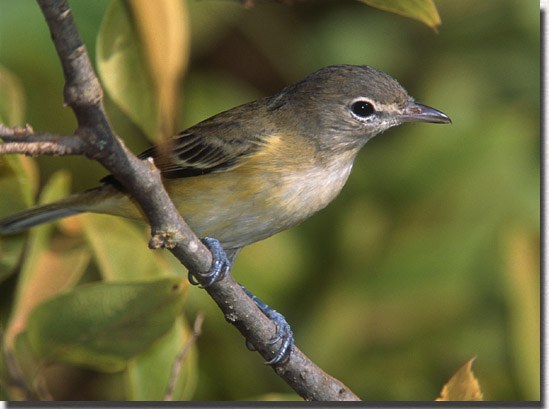
Bell's Vireo
- Habitat
- Dense shrubby thickets, brushy riparian growth, and scrubland
- Size
- 4.5-5 in
- Lifespan
- Not extensively documented; small vireos of similar size typically live a few years in the wild.
- Diet
- Insects and caterpillars gleaned from dense foliage
About the Bell's Vireo
Bell's Vireo is a small, plain-looking songbird that is far easier to hear than to see. It is grayish-olive above and pale yellowish-white below, with faint white "spectacles" formed by a thin eye-ring and pale lores, and one or two indistinct whitish wingbars. Its understated plumage blends easily into the dense brush it prefers, and most observers first notice the bird by its scratchy, chattering song rather than its appearance. At around 4.5 inches, it is one of the smallest vireos, restless and constantly on the move within cover, rarely pausing long enough for a clear, prolonged look even when singing nearby.
This species is a specialist of dense, shrubby habitat: thick riparian tangles along streams, brushy fencerows, and regenerating scrubland, where it forages low and stays largely hidden within cover rather than perching in the open. It gleans small insects and caterpillars from leaves and twigs, moving actively but inconspicuously through dense vegetation, and its persistent, scolding, run-on song—often described as sounding like a question followed by an answer—is delivered frequently through the day and is one of the best ways to detect its presence.
Bell's Vireo breeds across the southern and central United States, including much of Oklahoma, building a small cup nest suspended from a low fork in dense shrubbery, and it winters primarily in Mexico and Central America. Several subspecies are recognized across this range, including the federally endangered Least Bell's Vireo of coastal California, a population that has declined sharply due to loss of riparian habitat; the interior populations breeding across Oklahoma and the central United States remain considerably more numerous and secure by comparison.
The species is a frequent host of the Brown-headed Cowbird, a brood parasite that lays its eggs in vireo nests for the vireo parents to raise at the expense of their own young, often at the cost of most or all of the vireo's own eggs or chicks in a parasitized nest. Despite this pressure, Bell's Vireo remains a common and widespread breeding bird across much of its central and southern range, its persistent, scolding song a familiar sound of brushy edges and overgrown fields through the summer months.
Bell's Vireo arrives on Oklahoma breeding territories in spring, typically by mid-April, and departs again by early fall for its Central American wintering grounds, spending relatively little time in full song compared to some other migratory songbirds since it begins nesting soon after arrival. It can be confused with the similarly plain White-eyed Vireo, which shares overlapping range and habitat in parts of the state, but the White-eyed Vireo shows a more contrasting yellow-washed flank, brighter yellow spectacles, and a pale iris rather than the darker eye of Bell's Vireo, along with a more varied, less repetitive song. Bell's Vireo populations across parts of its range have faced pressure from the loss and degradation of riparian shrub habitat to agriculture, development, and invasive plant species, concerns that extend well beyond the well-documented decline of the California subspecies, even though the interior populations breeding in Oklahoma remain comparatively secure. Individual males often have a slightly distinctive cadence to their otherwise formulaic song, subtle enough that experienced birders working a single territory over multiple visits can sometimes learn to recognize one bird's voice from a neighbor's. The species forages almost entirely within a few feet of the ground, rarely venturing into the forest canopy the way many other vireos do, a habit consistent with its overall preference for dense, low, shrubby cover over taller woodland.
Frequently asked questions
What does Bell's Vireo eat?
Small insects and caterpillars, gleaned from dense shrubs and thickets.
Where can I see a Bell's Vireo in Oklahoma?
In dense brushy thickets and riparian scrub during the breeding season, where it's usually detected by its scolding, chattering song rather than by sight.
How long do Bell's Vireos live?
Specific longevity data is limited, but similar small vireos typically live a few years in the wild.
Is Bell's Vireo common in Oklahoma?
Yes, it's a locally common summer breeding bird in suitable brushy habitat across much of the state, though it's often overlooked because it stays hidden in cover.
Is Bell's Vireo endangered?
The interior populations found in Oklahoma and across the central United States are common and stable, though a distinct subspecies, the Least Bell's Vireo of coastal California, is federally endangered due to riparian habitat loss.
Where to find it
This species favors wetland habitat. See real Oklahoma locations on the Habitats map.