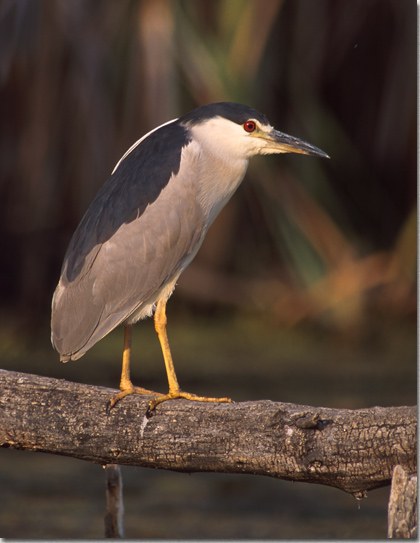
Black-crowned Night Heron
- Habitat
- Marshes, wooded swamps, forests along shallow rivers/streams, mangroves; fresh, brackish, and salt water
- Size
- 23–28 in; medium, stocky, short-necked, black crown, gray wings, white underparts
- Lifespan
- Generally lives 10-15 years in the wild; the oldest banded bird reached over 21 years.
- Diet
- Mainly fish within its territory; also insects, eggs and young birds (especially terns, herons, ibis), small mammals, and amphibians (especially in spring)
About the Black-crowned Night Heron
The Black-crowned Night Heron is a stocky, short-necked heron quite different in build from the lanky Great Blue Heron, standing 23 to 28 inches tall with a black crown and back set against pale gray wings and white underparts. Its red eyes, visible at close range, are thought to be an adaptation for low-light vision, fitting a species that does much of its hunting after dark. In flight it holds its head tucked back in line with its body, flying on slow, deep wingbeats with the wings noticeably arched, quite unlike the flatter wing profile of most other herons.
This heron occupies a wide range of wetland types, including marshes, wooded swamps, forested banks along shallow rivers and streams, and mangroves, and it tolerates fresh, brackish, and full salt water equally well. It is generally considered common but local, meaning it can be abundant at a handful of colony sites while being entirely absent from otherwise suitable-looking habitat nearby, a pattern tied to the availability of secure daytime roost trees and productive nearby feeding water.
Fish caught within its own defended feeding territory form the bulk of the diet, but the Black-crowned Night Heron is a notably opportunistic predator, also taking insects, small mammals, and amphibians — the last especially in spring — along with the eggs and young of other colonial waterbirds such as terns, herons, and ibises nesting nearby. Its signature hunting method is patience rather than pursuit: the bird stands motionless at the water's edge or in shallow water, waiting for prey to come within range before thrusting its bill forward in a quick strike.
True to its name, this heron is active mainly at night and during twilight hours, spending daylight roosting quietly in trees, often alongside other individuals in loose colonies. Because it is more heard than seen — its harsh, barking "quok" call carrying over marshes after dark — many people are more familiar with its call than its appearance despite the species' wide distribution. Individuals that survive to adulthood are relatively long-lived for a mid-sized heron, typically reaching 10 to 15 years, with the oldest banded bird on record surviving past 21.
Frequently asked questions
Why does the Black-crowned Night Heron have red eyes?
Its red eyes are thought to be an adaptation that improves vision in low light, suited to a bird that hunts mainly after dark.
How does the Black-crowned Night Heron catch fish?
It stands motionless in or near the water, waiting for prey to approach before quickly thrusting its bill forward to strike.
Is the Black-crowned Night Heron active during the day?
Mostly not — it is chiefly nocturnal, spending daylight hours roosting in trees and becoming active around dusk.
What besides fish does this heron eat?
It also takes insects, small mammals, amphibians, and sometimes the eggs and young of other nesting waterbirds like terns and herons.
Where to find it
This species favors wetland habitat. See real Oklahoma locations on the Habitats map.