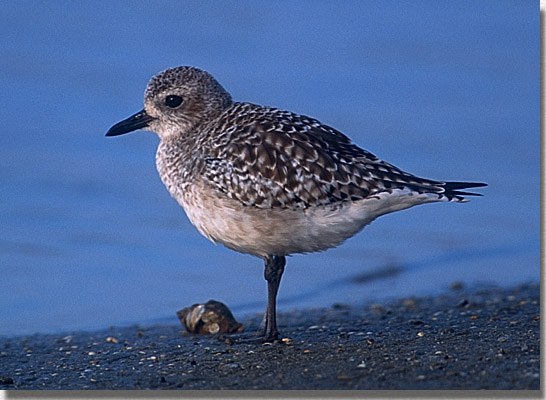
Black-bellied Plover
- Habitat
- Arctic tundra (breeding); coastal mudflats and beaches (winter); in Oklahoma, seen at reservoir shorelines, mudflats, and plowed fields during migration
- Size
- 11-12 in
- Lifespan
- Not precisely documented in commonly available records; shorebirds of similar size are known in some cases to live well over a decade.
- Diet
- Insects, marine worms, and small crustaceans or mollusks
About the Black-bellied Plover
The Black-bellied Plover is the largest plover regularly seen in North America, a chunky, short-billed shorebird that changes dramatically between seasons. In breeding plumage, adults show a striking black face, throat, and belly bordered by a broad white stripe along the neck and shoulder, with a spangled black-and-white back. In the nonbreeding plumage typically seen in Oklahoma during migration, the bird is a plainer mottled gray-brown above and pale below, but in flight it always reveals black patches at the base of the underwing—called axillaries or "wingpits"—that distinguish it instantly from the similar American Golden-Plover, which lacks this mark and shows a more uniformly dark underwing.
This species breeds on high Arctic tundra, one of the northernmost-nesting shorebirds in the world, and winters along coastlines across much of the globe, from the southern United States to South America, Africa, and beyond, making it one of the more widely distributed shorebirds on Earth. Its diet consists mainly of invertebrates—insects on the tundra breeding grounds, and worms, small crustaceans, and mollusks picked from mudflats and beaches during the nonbreeding season—foraged using a characteristic run-stop-peck technique typical of plovers, relying on keen eyesight to spot prey rather than probing blindly like many other shorebirds.
Oklahoma lies well inland of both the Black-bellied Plover's Arctic breeding range and its coastal wintering grounds, so the species is encountered in the state strictly as a migrant, chiefly in spring and fall, when birds pass through en route between the two. It favors the exposed mudflats, shorelines, and sometimes plowed agricultural fields around the state's larger reservoirs and lakes, often in the company of other shorebirds.
In flight the species gives a clear, mournful, three-note whistle, often rendered as "pee-oo-ee," a call distinct enough that experienced birders can identify passing flocks by sound alone well before the birds are visible. This same call is heard on the breeding grounds, where it likely helps pairs and family groups keep track of one another across open tundra with few landmarks. Compared to the American Golden-Plover, the Black-bellied Plover is also noticeably bulkier and shorter-necked, with a heavier bill, differences useful for separating the two species even in similarly drab nonbreeding plumage.
Because nonbreeding and juvenile plumages are far less showy than the striking breeding plumage, most Oklahoma sightings involve birds in duller gray-brown dress, making the diagnostic black wingpit patches visible in flight one of the most reliable field marks for confirming identification away from the breeding grounds. Adults typically begin their molt out of breeding plumage before departing the Arctic, so many fall migrants passing through Oklahoma are already showing a mix of retained black belly feathers and incoming gray winter plumage, a transitional look that can add to the identification challenge for birders unfamiliar with the species' seasonal changes. Unlike many shorebirds in which only one parent tends the nest, Black-bellied Plover pairs typically share incubation duties on the Arctic breeding grounds, an arrangement that may help offset the short tundra summer and the intense predation pressure from Arctic foxes and jaegers on eggs and chicks. After hatching, however, parental care shortens considerably, and chicks are capable of feeding themselves within a short time, with adults primarily providing vigilance and alarm calls rather than direct feeding. Juvenile plumage differs subtly from the nonbreeding adult look, typically showing a more scaly, spangled pattern above that gradually gives way to plainer gray-brown feathers over the bird's first year. As one of the more far-ranging shorebirds, individual Black-bellied Plovers may cover many thousands of miles between their Arctic nesting grounds and wintering areas each year, making the birds passing briefly through Oklahoma's lake margins part of a genuinely hemispheric migratory journey.
Frequently asked questions
What does the Black-bellied Plover eat?
Insects on its Arctic breeding grounds, and worms, small crustaceans, and mollusks on mudflats and shorelines elsewhere.
Where can I see a Black-bellied Plover in Oklahoma?
At exposed mudflats and shorelines around the state's larger lakes and reservoirs during spring and fall migration.
How long do Black-bellied Plovers live?
Precise data is limited, but some shorebirds of similar size are known to live well over a decade.
Is the Black-bellied Plover common in Oklahoma?
It's a regular but not abundant migrant, most likely seen during spring and fall passage rather than in summer or winter.
What does the Black-bellied Plover sound like in flight?
It gives a clear, mournful, three-note whistle often rendered as 'pee-oo-ee,' distinctive enough that experienced birders can identify passing flocks by sound alone.
Where to find it
This species favors wetland habitat. See real Oklahoma locations on the Habitats map.