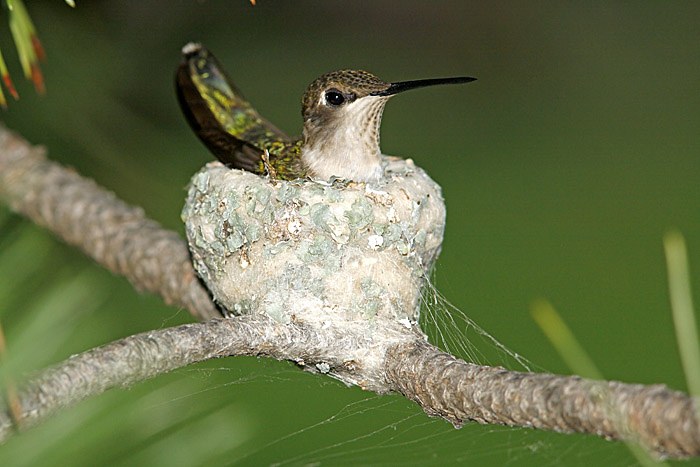
Black-chinned Hummingbird
- Habitat
- Dry canyons, streamside woodlands, and gardens; a western species reaching Oklahoma mainly in the western part of the state
- Size
- 3.5 in
- Lifespan
- Not extensively documented; small hummingbirds of similar size are known in some banding records to live into their early teens, though most survive far fewer years.
- Diet
- Nectar, tree sap, and small insects and spiders
About the Black-chinned Hummingbird
The Black-chinned Hummingbird is a small, subtly colored hummingbird whose most dramatic feature—an iridescent purple throat band—is often invisible except at precise angles of light, appearing simply black most of the time, which gives the species its common name. Males show a black chin and upper throat bordered below by that thin purple band, a metallic green back, and whitish underparts; females and immatures lack the colorful throat and are pale grayish-white below with a green back, distinguished from other similar hummingbirds mainly by subtle structural features and range. One helpful field behavior is a habit of pumping the tail up and down while hovering to feed, a movement less pronounced in the similar Ruby-throated Hummingbird found farther east in Oklahoma.
This species favors drier habitats than many of its hummingbird relatives, including desert washes, canyon bottoms, streamside woodlands, and increasingly, residential gardens with flowering plants and feeders, across the southwestern United States and northern Mexico. Like other hummingbirds, it feeds on flower nectar using its long tongue and hovering flight, and it supplements this energy-rich diet with small insects and spiders gleaned from foliage or caught in flight, an important source of protein, especially for growing young.
To survive cool nights when nectar is unavailable and body heat is hard to maintain given its tiny size, the Black-chinned Hummingbird, like other hummingbirds, can enter torpor, a controlled, dramatic drop in body temperature and metabolic rate that conserves energy until foraging resumes at dawn. This adaptation is essential for a bird that burns through its fat reserves so quickly relative to its body size, and without the ability to power down overnight, an inactive hummingbird could starve before morning even with a full day's feeding behind it.
The Black-chinned Hummingbird's range extends into western Oklahoma at the eastern edge of its normal distribution, making it a locally uncommon summer visitor there compared with its greater abundance farther west and south. Males perform a distinctive courtship display, diving repeatedly in a wide U-shaped arc and producing a sharp, buzzy sound at the bottom of each dive, timed to court females perched nearby, a sound produced mechanically by air rushing through modified outer tail feathers rather than vocally.
The species is migratory, wintering in Mexico, and it returns north in spring, with nesting females building a small cup nest of plant down and spider silk on a low horizontal branch, often stretched to accommodate growing chicks—a flexible design characteristic of hummingbird nests generally. Males take no part in nest building or chick-rearing and are notably territorial around good nectar sources, aggressively chasing off other hummingbirds, and sometimes even much larger birds, that intrude on a productive patch of flowers or a feeder. Hovering flight requires an extraordinary rate of wingbeats, and like other hummingbirds, the Black-chinned Hummingbird's wings move so quickly that the motion blurs beyond what the human eye can resolve, a capability made possible by a uniquely flexible shoulder joint that lets the wing rotate through a full figure-eight pattern on both the forward and backward stroke. This flight style is energetically expensive, and the species must feed frequently throughout the day, visiting large numbers of flowers or making repeated feeder visits to meet its metabolic needs. The species has adapted well to suburban landscaping and supplemental feeders across much of its range, and in some areas this has likely helped it persist in habitat that would otherwise offer fewer natural nectar sources during the hottest, driest parts of summer. Their small size makes eggs and nestlings vulnerable to a range of predators, including jays, snakes, and even large insects, and nesting females rely heavily on the nest's camouflaged, lichen-covered exterior and a well-chosen, inconspicuous location to avoid detection.
Frequently asked questions
What does the Black-chinned Hummingbird eat?
Flower nectar, along with small insects and spiders for protein.
Where can I see a Black-chinned Hummingbird in Oklahoma?
Mainly in the western part of the state during summer, at the eastern edge of its normal range; it's less common further east.
How long do Black-chinned Hummingbirds live?
Most live only a few years, though banding records for similar hummingbirds show occasional individuals reaching their early teens.
Is the Black-chinned Hummingbird common in Oklahoma?
It's locally uncommon, more regularly found in western Oklahoma than in the rest of the state.
How does the Black-chinned Hummingbird survive cold nights?
It can enter torpor, dramatically lowering its body temperature and metabolic rate overnight to conserve the energy reserves it would otherwise burn through too quickly to survive until morning.
Where to find it
This species favors wetland habitat. See real Oklahoma locations on the Habitats map.