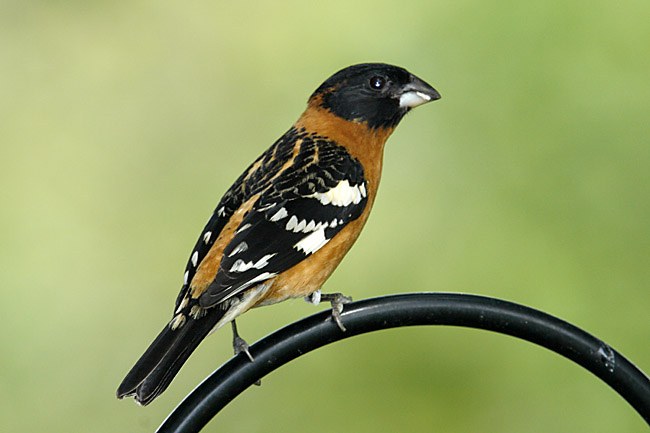
Black-headed Grosbeak
- Habitat
- Open deciduous/mixed woodland and streamside groves; a western species reaching western Oklahoma, where it overlaps with the related Rose-breasted Grosbeak
- Size
- 7-8.5 in
- Lifespan
- Not extensively documented; comparable grosbeaks often live several years in the wild.
- Diet
- Insects, seeds, and fruit; notably one of the few birds that regularly eats toxic monarch butterflies on its Mexican wintering grounds
About the Black-headed Grosbeak
The Black-headed Grosbeak is a robust songbird with a heavy, conical bill built for cracking seeds. Breeding males show a black head, rich cinnamon-orange underparts and collar, and black wings marked with white patches, while females and immatures are streaky brown overall, resembling an oversized sparrow but distinguished by their thick bill and buffy breast wash. The species closely resembles the Rose-breasted Grosbeak of the eastern United States, and the two forms interbreed where their ranges meet across the Great Plains, producing occasional hybrids with intermediate underpart color and head pattern.
This species favors open deciduous and mixed woodland, especially streamside groves and canyon edges, across the western United States, with its range extending into western Oklahoma near the zone of overlap with the Rose-breasted Grosbeak. Its diet includes insects, seeds, and fruit gathered by gleaning foliage and branches, and its heavy bill lets it crack open seeds too tough for many smaller songbirds to handle.
One of the more remarkable facts about this species concerns its wintering grounds in Mexico, where Black-headed Grosbeaks are among the very few birds that regularly prey on overwintering monarch butterflies, tolerating the cardiac toxins that make monarchs unpalatable or dangerous to most other predators. This dietary tolerance allows the species to exploit a food source largely unavailable to competitors, and along with a small number of other predator species at the monarch overwintering colonies, grosbeaks can have a locally significant impact on monarch numbers each winter.
During the breeding season, males are notable for sharing incubation duties with females, even singing softly from the nest itself, an unusual behavior among grosbeaks. Unusually among North American songbirds, female Black-headed Grosbeaks also sing, a trait shared with only a modest number of other species; her song is generally quieter and somewhat simpler than the male's rich, rolling warble, which itself is often likened to a more polished, faster version of an American Robin's song.
Pairs build a loosely woven, somewhat flimsy cup nest of twigs and plant material in a shrub or tree fork, typically well concealed within foliage, and both parents feed the nestlings a diet weighted heavily toward insects during the early growth period. The species is a medium-distance migrant, arriving on Oklahoma breeding grounds in spring and departing again by late summer for wintering areas in Mexico. In Oklahoma, the species is most likely encountered in the western part of the state during the breeding season, with occasional hybrids showing intermediate plumage where its range meets that of the Rose-breasted Grosbeak farther east. The Black-headed Grosbeak is a medium- to long-distance migrant, generally arriving on Oklahoma breeding territories in late April or May and departing by August or September for wintering grounds concentrated in central and southern Mexico. Males sing persistently from exposed perches to establish and defend territory upon arrival, and both members of a pair will scold and mob potential nest predators, including jays and snakes, with a sharp, distinctive call note used specifically to signal alarm near the nest. Population trends for the species are generally considered stable across its range, and its adaptability to a variety of woodland edge habitats, along with its tolerance of humans in residential and park settings within its western range, has likely helped it remain a common and conspicuous breeding bird outside of the narrow hybrid zone it shares with the Rose-breasted Grosbeak. On the wintering grounds in Mexico, Black-headed Grosbeaks sometimes overlap locally with wintering Rose-breasted Grosbeaks from farther east, and careful attention to underpart color and wing pattern is needed to separate the two species outside the breeding season when song is less reliably heard.
Frequently asked questions
What does the Black-headed Grosbeak eat?
Insects, seeds, and fruit; on its Mexican wintering grounds it is notably one of few birds that regularly eats toxic monarch butterflies.
Where can I see a Black-headed Grosbeak in Oklahoma?
In woodland and streamside habitat in the western part of the state during the breeding season.
How long do Black-headed Grosbeaks live?
Specific data is limited, but comparable grosbeaks typically live several years in the wild.
Is the Black-headed Grosbeak common in Oklahoma?
It's a regular breeder in western Oklahoma, becoming less common eastward, where it overlaps and hybridizes with the Rose-breasted Grosbeak.
Do female Black-headed Grosbeaks sing?
Yes, unusually for North American songbirds, females sing as well as males, though her song is typically quieter and simpler than the male's rich, rolling warble.
Where to find it
This species favors forest habitat. See real Oklahoma locations on the Habitats map.