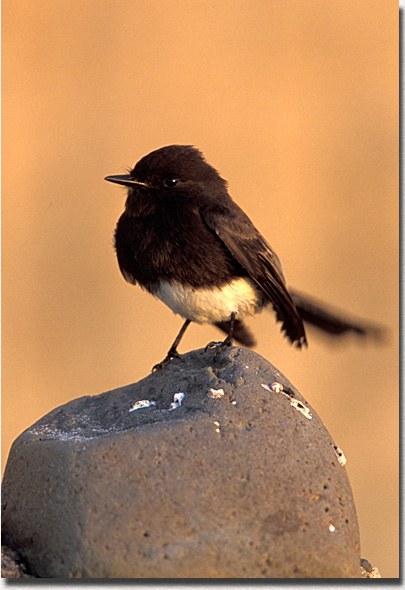
Black Phoebe
- Habitat
- Near streams, ponds, and canyons, often close to bridges or buildings used for nesting; a western species, rare/casual in Oklahoma at the eastern edge of its range
- Size
- 6-7 in
- Lifespan
- Not well documented; similar small flycatchers commonly live several years in the wild.
- Diet
- Flying insects, occasionally small fish or aquatic invertebrates
About the Black Phoebe
The Black Phoebe is a small flycatcher with a simple but striking pattern: sooty black covering the head, chest, back, and wings, cut sharply by a clean white belly and undertail. Its upright posture, habitual tail-pumping while perched, and habit of returning repeatedly to the same low perch near water make it a distinctive and easily learned bird wherever it occurs. The tail-wagging habit, shared with several other phoebe species, may help flush hidden insects into view or could simply signal alertness to potential predators, though its exact function remains debated among researchers.
This species is strongly tied to water, typically found perched low over streams, ponds, canyon pools, or irrigation ditches, from which it sallies out to catch flying insects and returns to the same perch—a classic flycatcher foraging technique. It frequently nests on human structures, plastering a cup nest of mud and plant fibers to the underside of bridges, culverts, eaves, or other sheltered ledges near its foraging water.
The Black Phoebe's core range covers the western and southwestern United States and Mexico, extending north along the Pacific coast, and much of its population is resident or only a short-distance mover rather than a long migrant. Oklahoma sits at the eastern edge of the species' expected range, so records here are rare and local, most likely in the far western part of the state, and any sighting elsewhere is noteworthy.
Where it is established, the species often raises multiple broods in a season, reusing or refurbishing the same mud nest in consecutive years, and pairs typically remain on or near their territory year-round in milder climates, giving them a more sedentary lifestyle than many other small flycatchers. Its voice includes a thin, rising "fee-bee" whistle somewhat reminiscent of the unrelated Eastern Phoebe's call, along with a sharper alarm chip given when a predator or intruder approaches the nest area.
Although both share the name "phoebe" and give superficially similar whistled calls, the Black Phoebe and the more familiar Eastern Phoebe of the eastern two-thirds of Oklahoma are not especially close relatives and look entirely different, with the Eastern Phoebe showing plain grayish-brown upperparts and a dingy white breast rather than the Black Phoebe's bold sooty-and-white pattern. Where their ranges might plausibly overlap in the western part of the state, the striking black-and-white plumage makes the Black Phoebe straightforward to distinguish at a glance. Pairs tend to be strongly faithful to a single well-chosen territory along a reliable water source, since a consistent supply of low perches, flying insects, and safe nest sites is not easily replaced from one year to the next. Because it depends on a reliable perch close to the water's surface, the Black Phoebe typically forages noticeably lower than the Eastern Phoebe, often just a foot or two above a stream or pond rather than from higher fence lines or low tree branches, and it will frequently dip down to snatch prey directly from the water's surface in addition to catching insects in the air. Juveniles resemble adults but often show pale cinnamon-buff edging on the wing feathers, a subtle warmth to the plumage that fades as the bird completes its first molt into adult dress. Nests are sometimes reused for several years running, with pairs simply patching cracks and repairing worn areas of the mud cup each spring rather than starting over, provided the structure they were built on remains intact and undisturbed. The species' overall population across its core western and Mexican range appears stable, and its close association with human-built structures for nesting has likely made suitable nest sites more, rather than less, available across much of its range in recent decades.
Frequently asked questions
What does the Black Phoebe eat?
Mostly flying insects caught near water, occasionally supplemented with small aquatic prey.
Where can I see a Black Phoebe in Oklahoma?
Rarely, and mainly in the far western part of the state; it's a western species at the very edge of its range here.
How long do Black Phoebes live?
Specific figures are limited, but similar small flycatchers commonly live several years in the wild.
Is the Black Phoebe common in Oklahoma?
No, it's rare and local in the state, with sightings considered notable outside its normal western range.
Is the Black Phoebe related to the Eastern Phoebe?
They share the name 'phoebe' and similar whistled calls, but they are not especially close relatives and look quite different, with the Black Phoebe's bold black-and-white pattern easily distinguishing it from the plain grayish Eastern Phoebe.
Where to find it
This species favors wetland habitat. See real Oklahoma locations on the Habitats map.