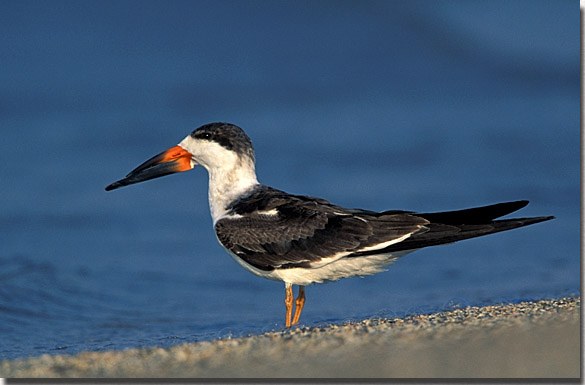
Black Skimmer
Rynchops niger
- Habitat
- Coastal beaches, sandbars, estuaries, and lagoons; very rare far inland, so Oklahoma occurrences are exceptional vagrant records
- Size
- 16-20 in
- Lifespan
- Not thoroughly documented in accessible records; comparable coastal terns and skimmers often live a decade or more.
- Diet
- Small fish, caught by skimming the lower bill through the water's surface in flight
About the Black Skimmer
The Black Skimmer is unmistakable among North American birds thanks to its odd, laterally flattened bill, bright orange-red at the base and black toward the tip, with a lower mandible distinctly longer than the upper -- a specialized tool rather than a deformity. Its upperparts are black, underparts white, and its long, pointed wings and low, buoyant flight style over water make it as distinctive in motion as in shape. Interestingly, chicks hatch with upper and lower mandibles roughly equal in length; the lower bill only begins outgrowing the upper after fledging, once the young bird actually needs the elongated shape to skim, a developmental sequence unlike almost any other bird's bill growth.
True to its name, the Black Skimmer feeds by flying low and fast just above calm water with its long lower mandible slicing the surface; when it touches a small fish, the bill snaps shut reflexively, allowing the bird to catch prey without needing to see it strike, which is why skimmers often feed most actively at dusk, dawn, and even at night. Unlike most birds, skimmers have a narrow, vertical pupil similar to a cat's, an adaptation thought to help the eye gather more light and reduce glare off the water during these low-light feeding bouts. This technique restricts the species almost entirely to calm coastal waters -- lagoons, estuaries, and sheltered bays along the Atlantic and Gulf coasts -- where it can fly the necessary long, low passes without obstruction.
Black Skimmers nest colonially on open sandy or shelly beaches and islands, scraping a shallow depression in sand where eggs and chicks rely on camouflage for protection. Colonies are often loosely associated with terns, which share similar nesting requirements and may offer some collective benefit in mobbing predators such as gulls, crows, and foxes. Chicks are precocial enough to walk from the nest scrape within days but remain dependent on parents for food for weeks, during which time both adults share incubation and feeding duties, often continuing to feed young skimmers well after they can fly. Colonies are especially vulnerable to disturbance from beachgoers, off-leash dogs, and vehicles, as well as to tidal flooding and predators, and conservation programs along the Gulf and Atlantic coasts now rope off or monitor many nesting beaches during the summer season.
Because the species' feeding technique and coastal nesting habits tie it so closely to salt water, it is essentially absent from landlocked regions under normal conditions, and any Oklahoma record would be a rare and notable vagrant, historically most likely to occur after tropical storms or hurricanes displace coastal birds far inland. Such displacement events have produced scattered inland records of Black Skimmers across the central United States in the past, underscoring how unusual -- but not impossible -- an Oklahoma sighting would be. Skimmers are also strongly gregarious away from the nest, often loafing in tight, uniformly aligned groups on sandbars and beaches, all facing into the wind, a habit shared with many shorebirds that helps reduce wind resistance and keep watch for danger collectively. The species' harsh, barking calls, often rendered as a series of short "kak" or "yip" notes, carry well over open water and are frequently the first clue to a colony's presence long before the birds themselves come into view.
Three skimmer species exist worldwide, one in the Americas and two closely related forms in Africa and southern Asia, all sharing the same unmistakable bill shape and low, water-slicing feeding style, which suggests the technique evolved once in a shared ancestor rather than independently in each region. North American Black Skimmer numbers dropped sharply in the early twentieth century due to plume hunting and egg collecting, then recovered under stronger protections, only to face renewed pressure in recent decades from beachfront development and recreational disturbance at the relatively few sandy sites still suitable for colony formation. Because so much of its life cycle -- feeding, nesting, and roosting -- depends on undisturbed, gently sloping coastal shoreline, the species is often used by biologists as an indicator of overall beach and estuary health along the coasts it calls home.
Frequently asked questions
What does the Black Skimmer eat?
Small fish, caught by flying low over calm water with its lower bill slicing the surface until it contacts prey.
Where can I see a Black Skimmer in Oklahoma?
Essentially nowhere under normal conditions; it's a coastal species, and any Oklahoma sighting would be a rare vagrant, sometimes following tropical storms.
How long do Black Skimmers live?
Precise records are limited, but comparable coastal birds often live a decade or more.
Is the Black Skimmer common in Oklahoma?
No, it is not part of the state's regular bird life at all; it belongs to Atlantic and Gulf coast beaches far away.
Why is the Black Skimmer's lower bill so much longer than its upper bill?
The extra length lets the lower mandible slice the water's surface during flight while the upper bill stays clear, snapping shut only when it contacts a fish; chicks are actually born with the two mandibles nearly equal in length.
Where to find it
This species favors wetland habitat. See real Oklahoma locations on the Habitats map.