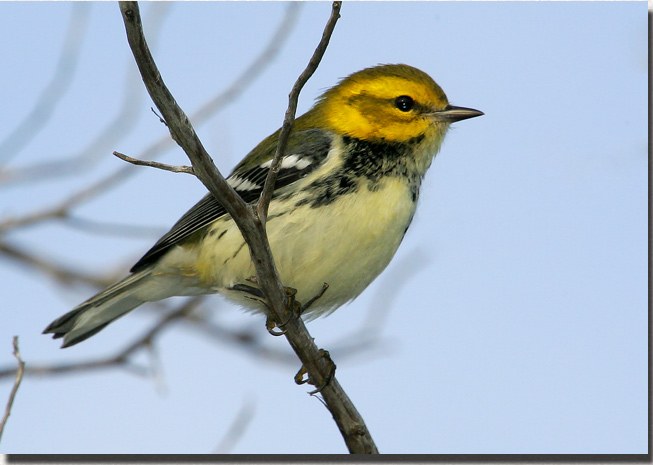
Black-throated Green Warbler
- Habitat
- Coniferous and mixed forests on the breeding grounds; passes through Oklahoma's wooded habitats chiefly during migration
- Size
- 4.5-5 in
- Lifespan
- Not extensively documented; similar small warblers typically live a few years in the wild.
- Diet
- Insects and caterpillars, gleaned from foliage
About the Black-throated Green Warbler
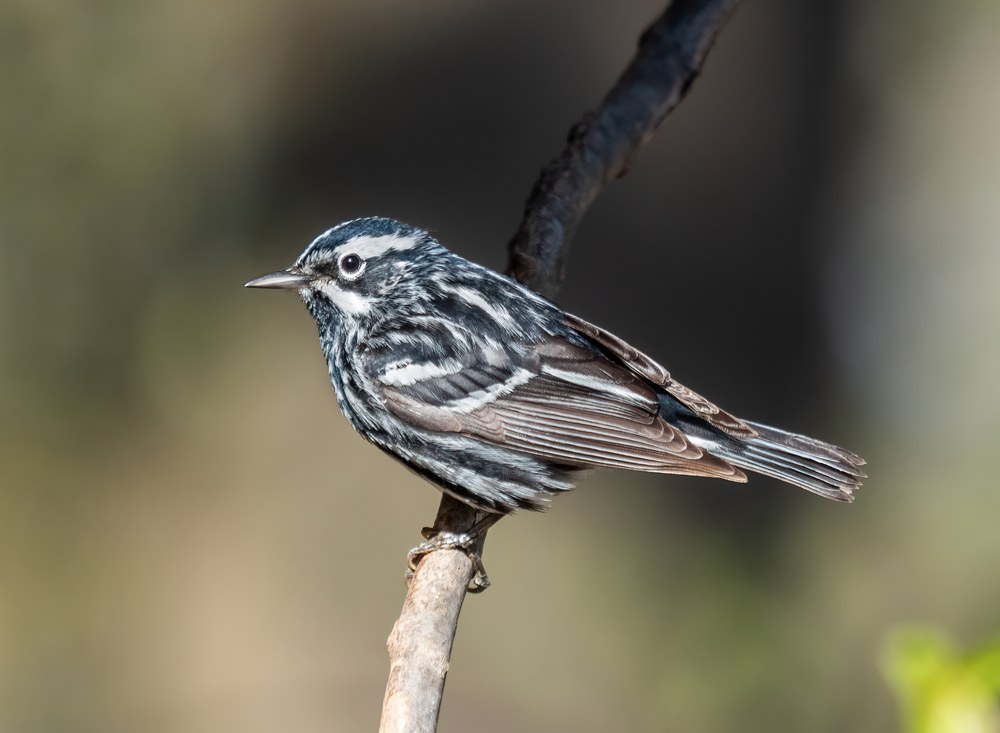
The Black-throated Green Warbler is a small, brightly marked songbird with an olive-green crown and back, a bright yellow face crossed by a dark eyeline, and, in males, a solid black throat and upper breast that fades into white-and-black streaked flanks. Females and immatures show a similar pattern but with the black throat reduced to partial mottling or largely absent, retaining the same yellow face and olive back that make the species identifiable at a glance. It belongs to a small cluster of closely related warblers, including the Golden-cheeked Warbler of central Texas and the Townsend's and Hermit Warblers of the West, that likely diverged from a shared ancestor and still show clear similarities in pattern and voice.
This species breeds in coniferous and mixed forests across a broad swath of the northern United States, Canada, and the Appalachian Mountains, favoring stands of spruce, fir, hemlock, and pine mixed with deciduous trees. It forages actively in the forest canopy, gleaning caterpillars and other insects from needles and leaves, often moving steadily through foliage at a height that can make it more easily heard than seen. Males typically use two distinct song types on the breeding grounds: an "unaccented" version thought to function mainly in communication with a mate or nearby male, and a slightly different "accented" version, ending in an emphasized note, used more often in direct territorial confrontation.
Oklahoma lies well south of this species' breeding range and mostly north of its Mexican, Central American, and Caribbean wintering grounds, so it occurs in the state chiefly as a spring and fall migrant passing through wooded habitats of varying types, rather than as a breeding bird. Its buzzy, rising song, often rendered as "zee-zee-zee-zoo-zee," is a distinctive and frequently the first clue to its presence high in the canopy during migration, though migrating birds are often largely silent or give only simple call notes, making careful visual scanning of foliage important as well. Like many wood-warblers, the species can appear in loose mixed-species foraging flocks with other migrants during spring and fall passage, and careful observers scanning such flocks in Oklahoma's forested parks and riparian corridors during these windows have the best chance of encountering it.
On the breeding grounds farther north, the female builds a compact cup nest of bark strips, twigs, and plant down, usually well concealed in a conifer, and typically raises a single brood per season, with both parents helping to feed the resulting nestlings once they hatch. Habitat loss on the wintering grounds, particularly the clearing of shade-coffee plantations and other forest types in Central America, has been identified as a concern for the species' long-term population trend, even though its northern breeding forests remain comparatively extensive and stable. Because the species migrates relatively late in spring compared with some other warblers, Oklahoma birders often have their best luck finding it a bit later in the season than many of its more hurried warbler relatives, lingering briefly in wooded migrant traps before continuing north.
Identification can occasionally be complicated in fall, when duller immature birds show a more muted version of the yellow face and reduced black throat, but the combination of olive back, yellow face, and the characteristic buzzy call note usually separates it from superficially similar fall warblers. Within its breeding range the species shows some regional variation in habitat preference, using drier upland conifer stands in parts of New England and the Appalachians but shifting toward wetter cedar or hemlock bogs in portions of the Great Lakes region, a flexibility that has likely helped it remain a fairly common warbler even as some other forest-interior species have declined. Banding studies suggest individual birds show reasonably strong fidelity to both breeding and wintering sites in successive years, returning to the same patch of forest or the same section of wintering habitat when conditions there remain suitable.
Frequently asked questions
What does the Black-throated Green Warbler eat?
Insects and caterpillars, gleaned from foliage high in the forest canopy.
Where can I see a Black-throated Green Warbler in Oklahoma?
In wooded areas during spring and fall migration; it does not breed in the state.
How long do Black-throated Green Warblers live?
Specific data is limited, but similar small warblers typically live a few years in the wild.
Is the Black-throated Green Warbler common in Oklahoma?
It's a regular but not abundant migrant, passing through the state en route between northern breeding grounds and southern wintering areas.
Is the Black-throated Green Warbler related to the Golden-cheeked Warbler of Texas?
Yes, the two are close relatives within a small group of similar-looking warblers that share comparable patterns and songs, likely descended from a common ancestor.
Where to find it
This species favors forest habitat. See real Oklahoma locations on the Habitats map.