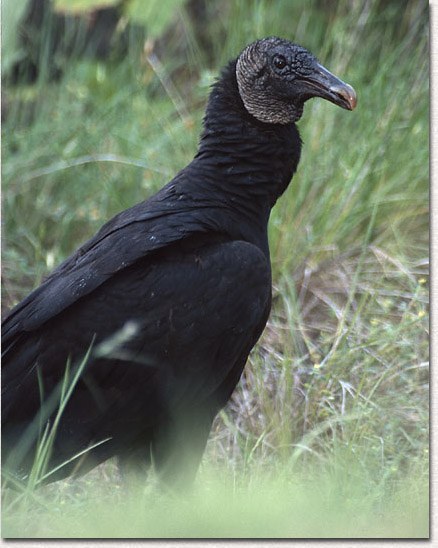
Black Vulture
- Habitat
- Open country, garbage dumps, fishing wharves; less common than the Turkey Vulture except along the coast
- Size
- 22–24 in (length; wingspan not stated)
- Lifespan
- Averages around 10 years but can reach 25 or more; the oldest banded record exceeded 25 years.
- Diet
- Occasionally takes young birds, small mammals, other vertebrates; young are fed regurgitant; also carrion
About the Black Vulture
The Black Vulture is an all-black scavenger measuring 22 to 24 inches in length, distinguished in flight by a pale whitish patch near each wingtip that flashes clearly against the otherwise dark plumage. Its wings are shorter and rounder than those of the Turkey Vulture, giving it a distinctly different flight silhouette and forcing it to flap far more often and rapidly to stay aloft, in contrast to the Turkey Vulture's long, effortless soaring on flattened wings held in a shallow V.
Black Vultures favor open country and are strongly drawn to human-associated food sources such as garbage dumps and fishing wharves, where carrion and discarded scraps are reliably available. The species is generally less common than the Turkey Vulture across most of the interior, though it becomes more numerous and conspicuous along the coast, and its range has been expanding northward and inland in recent decades.
Carrion makes up the bulk of the diet, but the Black Vulture is more of an opportunistic predator than its Turkey Vulture cousin, occasionally taking young birds, small mammals, and other vertebrates when the chance arises rather than relying purely on scavenging. Unlike Turkey Vultures, which locate carcasses partly by an unusually keen sense of smell, Black Vultures depend much more heavily on eyesight to find food, often following Turkey Vultures to a carcass the latter has located by scent and then muscling in.
Despite being the smaller of the two common American vultures, the Black Vulture is markedly more aggressive at a carcass, frequently displacing Turkey Vultures through sheer numbers and boldness even though it lacks the size advantage. Nestlings are fed by regurgitation, a common feeding strategy among vultures that lets adults transport food over long distances from where it was found back to the nest site. Black Vultures are also long-lived, averaging around a decade in the wild but capable of reaching 25 years or more, a lifespan matched by the oldest banded individual on record. Black Vultures are also notably social, roosting communally in large numbers overnight and apparently tracking the location of reliable food sources partly by watching and following other vultures that depart the roost with purpose.
Frequently asked questions
How can you tell a Black Vulture from a Turkey Vulture in flight?
Black Vultures show pale patches near the wingtips, have shorter rounder wings, and flap more frequently, while Turkey Vultures soar on longer wings held in a shallow V.
Does the Black Vulture use smell to find food?
Not much — it relies mainly on eyesight, often locating carcasses by watching and following Turkey Vultures, which have a stronger sense of smell.
Is the Black Vulture more aggressive than the Turkey Vulture?
Yes, despite being smaller, Black Vultures are bolder at carcasses and frequently displace Turkey Vultures through aggressive behavior.
What do Black Vultures feed their young?
Adults feed chicks regurgitated food, a common strategy among vultures for carrying meals back from distant carcasses.
Where to find it
This species favors wetland habitat. See real Oklahoma locations on the Habitats map.