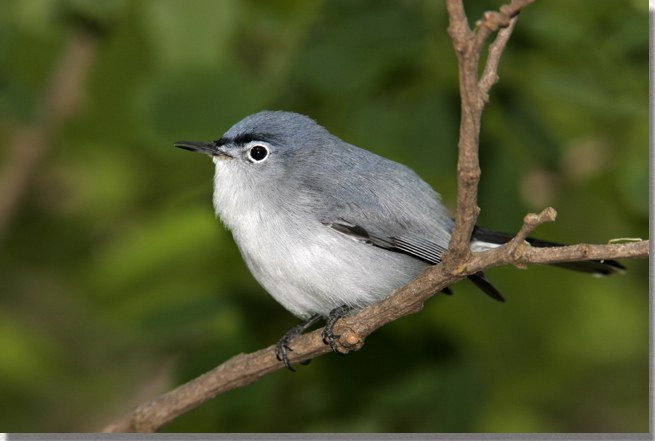
Blue-gray Gnatcatcher
- Habitat
- Open deciduous woodland, scrub, and woodland edges; a common summer resident across Oklahoma
- Size
- 4-4.5 in
- Lifespan
- Not extensively documented; comparably tiny songbirds typically live only a few years in the wild.
- Diet
- Small insects and spiders
About the Blue-gray Gnatcatcher
The Blue-gray Gnatcatcher is a tiny, slender songbird, blue-gray above and white below, with a thin dark bill, a bold white eye-ring, and a long, mostly black tail edged in white that it flicks and cocks almost constantly as it moves through foliage. Its small size and constant motion make it feel almost hyperactive compared with many other songbirds sharing its habitat. The species belongs to a small family, the gnatcatchers and gnatwrens, most of whose members live in the tropics of Central and South America, making the Blue-gray Gnatcatcher one of the few representatives of the group to breed so far north.
This species favors open deciduous woodland, scrubby edges, and streamside growth, where it forages restlessly through outer branches and foliage, gleaning small insects and spiders and frequently hovering briefly at leaf tips to snatch prey it cannot reach while perched -- a technique that lets it access insects other similarly sized birds might miss. Its thin, wheezy, buzzy calls often reveal its presence in the canopy before it is spotted visually, and the species is also a surprisingly capable vocal mimic, occasionally weaving fragments of other birds' calls into its own thin chatter.
Blue-gray Gnatcatchers are common summer breeders across Oklahoma, arriving in spring and departing for wintering grounds in the southern United States, Mexico, and Central America by fall. One of the species' most notable traits is its nest construction: a compact, neat cup built of plant fibers and spider silk, covered externally with flakes of lichen, giving it camouflage and a texture and appearance strikingly similar to a hummingbird's nest, though built by a bird several times larger. The nest is often built on a horizontal branch well out from the trunk, and pairs will sometimes dismantle a nest partway through construction and rebuild elsewhere if a site proves unsatisfactory, recycling the same lichen and fiber material at the new location.
Both parents typically participate in nest building and care of the young, taking turns incubating the small clutch and later shuttling insects back to the nest at a steady pace through the day. The species is also a fairly frequent host of Brown-headed Cowbird parasitism, and pairs nesting in more open or edge habitat, where cowbirds are common, may lose a portion of nesting attempts to a foreign egg laid alongside or in place of their own. Despite this pressure, Blue-gray Gnatcatchers can be found in a wide range of wooded habitats across the state during the warmer months, and some evidence suggests the species' breeding range has crept gradually northward over past decades, possibly tracking a warming climate. This makes it one of the more widespread and easily heard, if less easily seen, small songbirds of the Oklahoma summer, its scolding, insistent calls a familiar soundtrack to a walk through any patch of streamside woods.
Blue-gray Gnatcatchers are also notably bold for their size, frequently joining mixed flocks of chickadees, titmice, and vireos while foraging and readily scolding and mobbing much larger birds, including hawks and jays, that venture too close to an active nest. Clutch size is typically small, usually four eggs, incubated by both sexes in short alternating shifts, and the pale, finely speckled eggs are themselves well camouflaged within the lichen-covered cup. Once fledged, young birds remain with their parents for a further week or two, begging noisily and following adults through the canopy before becoming fully independent, after which family groups gradually disperse and the adults may occasionally attempt a second brood if the season allows. The species' genus name, Polioptila, translates roughly to "gray feather," a fitting nod to the muted, understated plumage that contrasts so sharply with its restless, outsized personality in the field.
Frequently asked questions
What does the Blue-gray Gnatcatcher eat?
Small insects and spiders, gleaned from foliage or snatched in brief hovering flights.
Where can I see a Blue-gray Gnatcatcher in Oklahoma?
In open woodland and scrub statewide during the breeding season, usually detected first by its thin, wheezy calls.
How long do Blue-gray Gnatcatchers live?
Specific figures are limited, but tiny songbirds of this size typically live only a few years in the wild.
Is the Blue-gray Gnatcatcher common in Oklahoma?
Yes, it's a common summer resident found in wooded habitats across the state.
Why does the Blue-gray Gnatcatcher's nest look like a hummingbird's?
Both build a compact cup covered in lichen flakes and bound with spider silk, giving the nests a similar camouflaged texture even though the gnatcatcher is much larger than a hummingbird.
Where to find it
This species favors forest habitat. See real Oklahoma locations on the Habitats map.