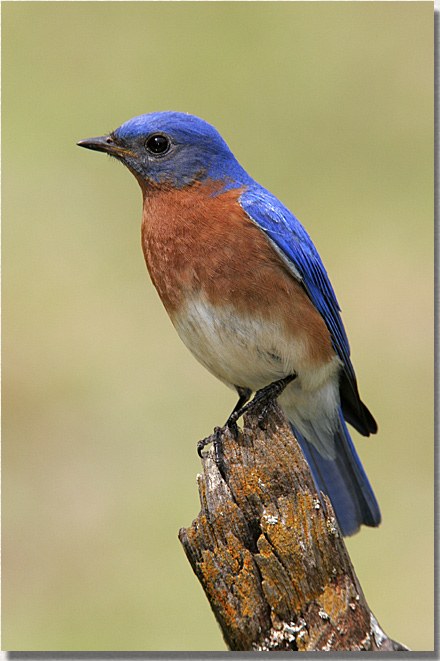
Eastern Bluebird
- Habitat
- Open woodlands, clearings, farmlands, parks, orchards, gardens, fields, roadsides on wires/fences
- Size
- 7 in, iridescent blue above/wings/tail with a rusty throat and breast
- Lifespan
- Can live 6-10 years, though most mortality occurs in year one; the oldest banded bird reached about 10.5 years.
- Diet
- Insects, earthworms, snails, other invertebrates, and berries — very dependent on berries in winter; young are fed primarily insects
About the Eastern Bluebird
The male Eastern Bluebird is a strikingly colored bird, its back, wings, and tail a rich iridescent blue that seems to shift with the light, contrasted against a warm rusty-orange throat and breast and a white belly. Females show a more muted version of the same pattern, with grayer upperparts and a paler rust wash below. At about 7 inches, it's a compact thrush relative, often seen perched conspicuously on roadside wires and fences scanning the ground for movement.
Bluebirds favor open habitat interspersed with scattered trees or perches: open woodlands, clearings, farmland, parks, orchards, gardens, fields, and roadsides. This open-country preference, combined with a cavity-nesting habit, made the species highly dependent on nest boxes through much of the twentieth century after competition from introduced European Starlings and House Sparrows sharply reduced access to natural tree cavities, a decline substantially reversed by widespread nest-box programs.
True to its "hawking" foraging style, the Eastern Bluebird typically watches from a low perch before dropping onto insects, earthworms, snails, and other invertebrates spotted on the ground below, then returning to the same or a nearby perch to look again. Berries become critical during the colder months when invertebrate prey is scarce, allowing bluebirds to remain through winter in areas with reliable fruit sources, while nestlings are raised almost entirely on insects for the protein needed for rapid growth.
Outside the breeding season, Eastern Bluebirds can form large winter flocks of 100 birds or more, though at night they typically roost singly or in small groups, sometimes packing into nest boxes for shared warmth on cold nights. When defending a nest cavity, bluebirds will actively fight off competing native species such as Tree Swallows and House Sparrows, but curiously tend not to contest starlings for the same cavity, likely owing to the size and aggressiveness disadvantage a bluebird faces against that larger, more dominant competitor. Older offspring from an earlier brood sometimes remain nearby to help their parents feed a later clutch of nestlings, a form of cooperative breeding that is uncommon among North American songbirds. A pair may raise two or even three broods across a single breeding season, reusing the same nest box or cavity as long as it remains suitable and undisturbed.
Frequently asked questions
Why did Eastern Bluebirds decline so much in the past?
Introduced European Starlings and House Sparrows outcompeted them for natural tree cavities, a problem later eased by widespread nest-box programs.
How does the Eastern Bluebird typically hunt?
It watches from a low perch, then drops down onto insects, earthworms, or other invertebrates spotted on the ground.
Do Eastern Bluebirds migrate in winter?
Not always — where berries are plentiful, they can remain through winter, switching their diet to rely heavily on fruit.
Will Eastern Bluebirds defend a nest box against all competitors?
They actively fight off Tree Swallows and House Sparrows but tend not to contest cavities with the larger, more dominant European Starling.
Where to find it
This species favors forest habitat. See real Oklahoma locations on the Habitats map.