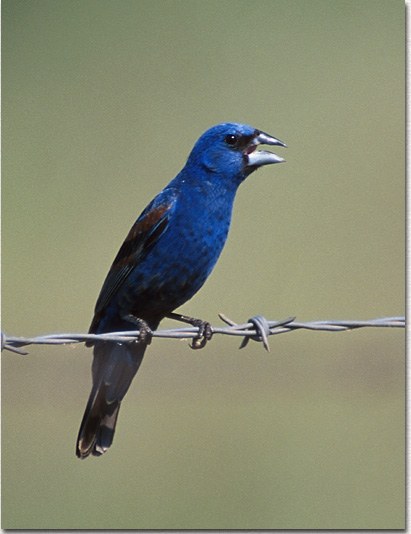
Blue Grosbeak
- Habitat
- Woodland edges, overgrown fields, thickets, brambles, hedgerows, farmland, mesquite, orchards, streamside willows, brushy roadsides; often perches on wires/fences
- Size
- 6–7½ in
- Lifespan
- Longevity data is sparse, but a recaptured banded male was confirmed almost 11 years old.
- Diet
- Insects, seeds, snails, grain, occasionally fruit
About the Blue Grosbeak
The male Blue Grosbeak is a deep, rich blue overall, set off by two contrasting chestnut wing bars and a notably large, stout, conical bill built for cracking seeds. Females present a completely different look, a warm buffy brown overall with paler buff wing bars echoing the male's pattern, and can be mistaken for a large sparrow or an oversized female Indigo Bunting until the heavier bill comes into view. At 6 to 7.5 inches, the species is appreciably larger and thicker-billed than the similar-looking, closely related buntings it's sometimes confused with, and the two groups do occasionally forage or migrate in loose association where their ranges and habitats overlap.
Blue Grosbeaks favor brushy, semi-open habitat: woodland edges, overgrown fields, thickets, brambles, hedgerows, farmland, mesquite country, orchards, streamside willow stands, and brushy roadsides, frequently perching in the open on wires or fence lines to sing or watch for food. This affinity for early successional and edge habitat has allowed the species to do well in agricultural landscapes across Oklahoma, where brushy field margins provide exactly the structure it favors, and its range has actually expanded northward across parts of the central and eastern United States over the past century as such edge habitat became more widespread.
The diet is a broad mix of insects, seeds, snails, waste grain, and occasional fruit, gathered mostly by foraging low in dense vegetation or picking food from the ground near cover. The heavy, conical bill is well suited to handling larger or harder seeds and snail shells that smaller-billed songbirds would struggle with, giving the species access to food sources not fully exploited by its neighbors. Males typically arrive on the breeding grounds a little ahead of females each spring to establish and defend a territory, singing a rich, warbling song from an exposed perch to advertise both the territory's boundaries and his own availability.
Blue Grosbeaks are a frequent host of Brown-headed Cowbird parasitism, often raising cowbird chicks alongside or instead of their own, and pairs nesting in the open, brushy edge habitat the species prefers are especially exposed to cowbirds, which favor the same kind of semi-open country for finding host nests. One curious nesting habit is the male's tendency to weave shed snakeskin into the nest structure, a behavior shared by a handful of other songbird species and thought to help deter nest predators, possibly by mimicking the presence of a snake; where snakeskin isn't available, pairs have also been known to substitute shed skin-like plastic debris such as cellophane. Pairs will often attempt a second brood in a season if the first succeeds early enough, rebuilding a fresh nest nearby rather than reusing the original. Outside the breeding season the species becomes markedly more social, gathering into large flocks during fall migration before heading to wintering grounds farther south in Mexico and Central America. Males typically take a couple of years to acquire their full, uniformly deep-blue adult plumage, so first-year breeding males often show a patchy mix of blue and brown feathers that can make correct identification tricky in the field.
The species' rich, warbling song is often compared to that of the Indigo Bunting or Painted Bunting but delivered in a lower, more sustained, and less choppy series of notes, a useful clue for separating an unseen singing bird from its smaller relatives. Blue Grosbeaks typically raise their young on a diet weighted heavily toward insects such as grasshoppers, cicadas, and caterpillars, even though adults themselves eat a much larger proportion of seeds outside the nesting season, reflecting the higher protein demands of growing chicks. Nest height is generally low, often just a few feet off the ground in a dense shrub or sapling, which can leave eggs and young exposed to snakes and other climbing predators despite the cover the surrounding brush provides.
Frequently asked questions
How do male and female Blue Grosbeaks differ in appearance?
Males are deep blue with chestnut wing bars, while females are buffy brown with paler wing bars, giving them a very different look overall.
Why does the Blue Grosbeak sometimes put snakeskin in its nest?
It's thought to help deter predators, possibly by making the nest seem guarded by a snake, though the exact mechanism isn't fully proven.
Is the Blue Grosbeak commonly parasitized by cowbirds?
Yes, it's a frequent host of Brown-headed Cowbirds, which lay their eggs in grosbeak nests for the grosbeaks to raise.
What kind of habitat does the Blue Grosbeak prefer?
Brushy edge habitat such as overgrown fields, thickets, hedgerows, and streamside willows, often perching openly on wires or fences.
Do young male Blue Grosbeaks look like adult males?
Not right away; it takes a couple of years for males to gain full adult blue plumage, so first-year breeding males often show a patchy mix of blue and brown feathers.
Where to find it
This species favors forest habitat. See real Oklahoma locations on the Habitats map.