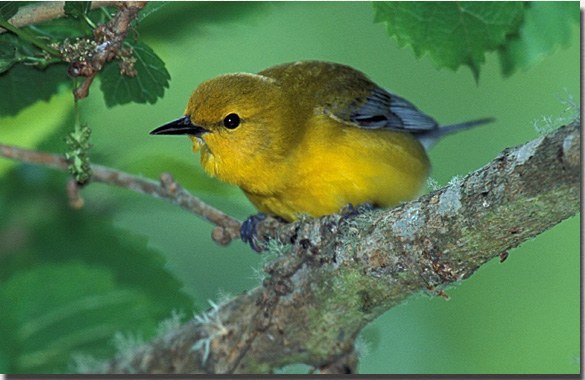
Blue-winged Warbler
- Habitat
- Shrubby old fields, forest edges, and regenerating clearcuts with dense low growth
- Size
- 4.3-4.7 in
- Lifespan
- Most live only a few breeding seasons; the oldest banded individual on record was recaptured in Ontario at nearly 10 years old (9 years, 11 months).
- Diet
- Caterpillars, spiders, and other small insects gleaned from leaves and twigs
About the Blue-winged Warbler
The Blue-winged Warbler is a small, sharply marked wood-warbler with a lemon-yellow head and underparts, blue-gray wings crossed by two white wingbars, and a thin black line running through the eye that gives it a slightly stern expression. Males and females look similar, though females are slightly duller overall, and both have a thin, pointed bill well suited to picking tiny insects from foliage rather than cracking seeds. Its song, a lazy, buzzy two-note 'bee-buzz,' is often the first clue to its presence, since the bird itself tends to stay low and can be easy to overlook in dense brush.
It breeds across the eastern and midwestern United States in shrubby, early-successional habitat such as abandoned farmland, regenerating clearcuts, overgrown pastures, and power-line corridors, favoring sites with a mix of scattered saplings and thick low cover. In Oklahoma it is mostly a scarce migrant passing through in spring and fall, with confirmed breeding limited to the far eastern edge of the state where suitable habitat and the edge of its breeding range barely overlap. It winters in Central America and southern Mexico, generally in similar scrubby second-growth habitat.
Blue-winged Warblers forage low in dense shrubs and small trees, gleaning caterpillars and other soft-bodied insects from the undersides of leaves, sometimes hanging upside down or hovering briefly to reach awkward spots, a technique shared with several of its close warbler relatives. They will also join mixed foraging flocks with chickadees, titmice, and other small songbirds during migration, taking advantage of insects flushed by the larger group's movement through the foliage.
Nesting takes place on or near the ground, in a well-hidden open cup tucked into grass or at the base of a shrub, typically holding four to six eggs. Perhaps the species' most genuinely interesting trait is its extensive hybridization with the closely related Golden-winged Warbler wherever the two overlap, producing distinctive hybrid forms known as Brewster's and Lawrence's warblers, whose plumage patterns are controlled by a surprisingly small number of genes. Because Blue-winged genes tend to dominate in these hybrids, and because the species has been expanding its range northward as habitat conditions shift, it is gradually replacing Golden-winged Warbler in parts of that species' range, a dynamic that has become a genuine conservation concern for Golden-wings across the upper Midwest and Appalachians.
Frequently asked questions
Where can I see a Blue-winged Warbler in Oklahoma?
Look for it during spring and fall migration in brushy edge habitat in the eastern part of the state; breeding is rare and confined to the extreme eastern edge.
How do you tell it apart from a Golden-winged Warbler?
Blue-winged has a yellow body and head with a black eyeline, while Golden-winged has a gray body, yellow cap, and black throat patch; hybrids mix features of both.
What does its song sound like?
A buzzy, insect-like two-note 'bee-buzz' that descends slightly in pitch.
Is it a threatened species?
It isn't considered threatened itself, but its range expansion is linked to the decline of the closely related Golden-winged Warbler through hybridization and habitat competition.
Where to find it
This species favors forest habitat. See real Oklahoma locations on the Habitats map.